What is the Time Until Calculator?
The Time Until Calculator tells you exactly how much time remains between the current time of day and a target time of day. It works entirely within a single 24-hour clock, so if the target time has already passed today it automatically rolls over to the next day. This makes it ideal for counting down to the end of a shift, a meeting, an alarm, or any fixed time on the clock.
How to use it
Enter the current time as hours, minutes and seconds, then enter the target time the same way. The calculator returns the remaining duration formatted as HH:MM:SS, along with the equivalent in total seconds, total minutes and total hours.
The formula explained
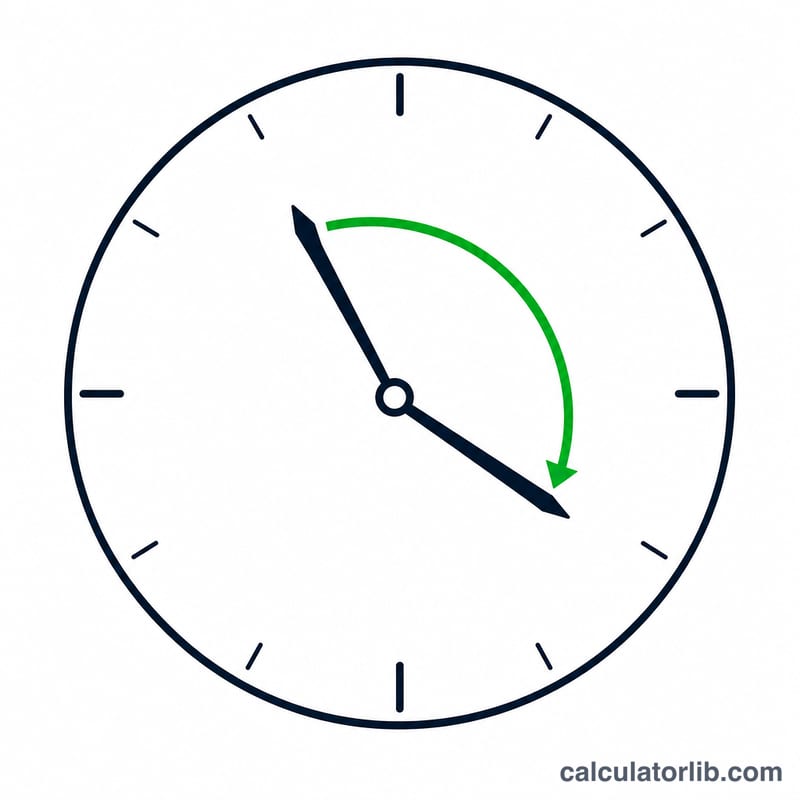
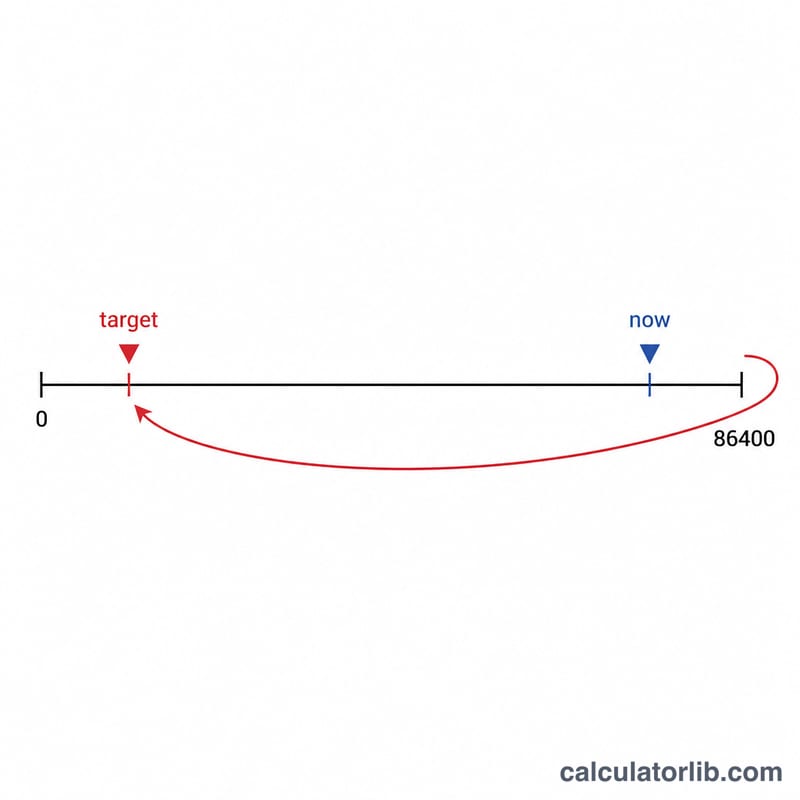
Both times are converted to a number of seconds since midnight. The remaining time is the target minus the current time. Because the target may be earlier in the day than now, we add a full day (86,400 seconds) and take the result modulo 86,400. This guarantees a non-negative answer between 0 and one full day.
$$\text{Remaining} = \Big(\,(T - N)\bmod 86400\,\Big)\bmod 86400 \;\text{seconds}$$
$$\begin{gathered} \text{Remaining} = \Big(\,(T - N)\bmod 86400\,\Big)\bmod 86400 \\[1.5em] \text{where}\quad \left\{ \begin{aligned} N &= 3600\,\text{Hour} + 60\,\text{Min} + \text{Sec} \\ T &= 3600\,\text{Hour} + 60\,\text{Min} + \text{Sec} \end{aligned} \right. \end{gathered}$$
Worked example
From 09:30:00 to 17:00:00: now = 34,200 s, target = 61,200 s. Difference = 27,000 s = 7 hours 30 minutes, so the countdown reads 07:30:00.
$$\text{Remaining} = \Big(\,(61200 - 34200)\bmod 86400\,\Big)\bmod 86400 = 27000\;\text{s} = 07\!:\!30\!:\!00$$
Time Unit Conversion Table
The countdown is produced internally in seconds, then expressed in three ways. The conversions are exact and international (SI-based), so they hold regardless of country or calendar system.
| Unit | In hours | In minutes | In seconds |
|---|---|---|---|
| 1 second | 1/3,600 ≈ 0.000278 | 1/60 ≈ 0.01667 | 1 |
| 1 minute | 1/60 ≈ 0.01667 | 1 | 60 |
| 1 hour | 1 | 60 | 3,600 |
| 1 day | 24 | 1,440 | 86,400 |
Converting the remaining seconds \(D\) into the two summary figures:
$$\text{total minutes} = \frac{D}{60}, \qquad \text{total hours} = \frac{D}{3600}$$
Going the other way — from a decimal number of hours to a clock-style duration — multiply by 3,600 and split the seconds back out:
| Decimal hours | Seconds | Total minutes | HH:MM:SS |
|---|---|---|---|
| 0.0083 | 30 | 0.5 | 00:00:30 |
| 0.25 | 900 | 15 | 00:15:00 |
| 0.5 | 1,800 | 30 | 00:30:00 |
| 0.7375 | 2,655 | 44.25 | 00:44:15 |
| 1 | 3,600 | 60 | 01:00:00 |
| 1.75 | 6,300 | 105 | 01:45:00 |
| 7.5 | 27,000 | 450 | 07:30:00 |
| 8.5 | 30,600 | 510 | 08:30:00 |
| 24 | 86,400 | 1,440 | 24:00:00 (one full day) |
Note the difference between a decimal hour and a clock reading: 0.75 hours is 45 minutes (00:45:00), not "75 minutes" and not 00:75:00. Decimal hours are convenient for multiplying by an hourly rate; HH:MM:SS is what a clock or timer displays.
FAQ
What if the target is earlier than now? The result wraps to the next day. For example 22:00 to 06:30 gives 08:30:00.
What does the same time produce? Entering identical times gives a full-day wrap of 00:00:00 (0 seconds remaining).
Does it handle seconds? Yes — all inputs and the breakdown are second-accurate.