What this calculator does
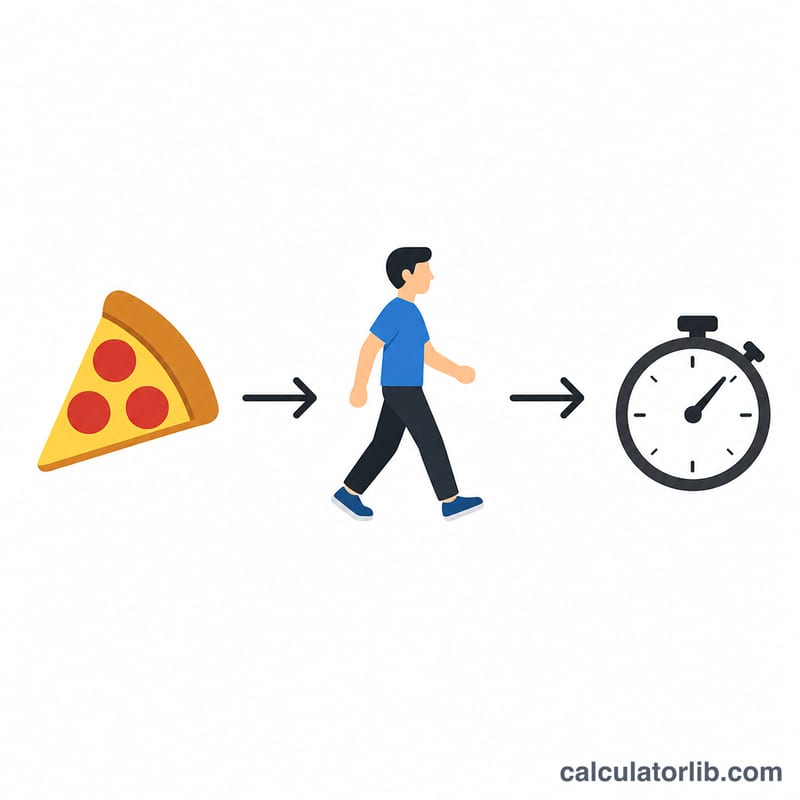
This tool estimates how long you'd need to walk to burn off the calories in a particular food or drink. Enter the calorie content of the food, your body weight, and how fast you plan to walk, and it returns the walking time in minutes — plus an estimate of the steps involved. It's a fun, motivating way to put treats into perspective and plan your daily movement.
How to use it
1. Enter the food's calories (kcal) — check the nutrition label or a food database. 2. Enter your body weight in kilograms; heavier people burn more calories per minute. 3. Choose a walking pace. Faster walking has a higher MET (Metabolic Equivalent of Task), so it burns the calories off sooner.
The formula explained
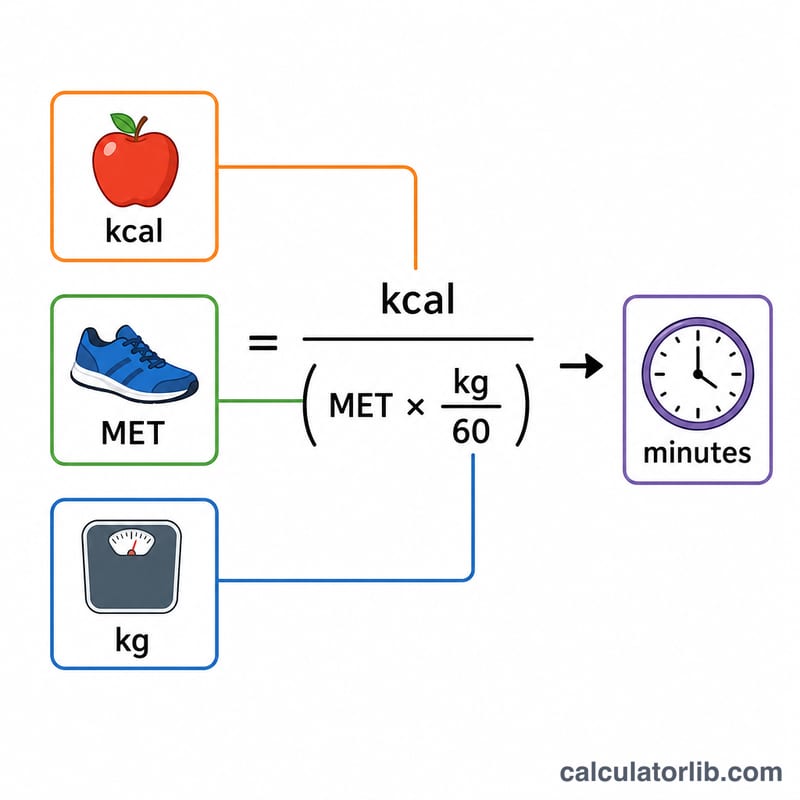
Calorie burn is based on MET values. One MET roughly equals 1 kcal per kilogram of body weight per hour. So calories burned per minute equals \(\dfrac{\text{MET} \times \text{weight (kg)}}{60}\). To find how long to burn a given amount of food energy, divide:
$$\text{minutes} = \frac{\text{food kcal}}{\dfrac{\text{MET} \times \text{weight}}{60}}$$
Walking METs used here range from 2.8 (slow stroll) to 7.0 (very brisk). Steps are estimated at about 100 steps per minute.
Worked example
A 70 kg person eats a 300 kcal snack and walks at a moderate pace (MET 3.5). Calories per minute = \(3.5 \times 70 / 60 = 4.083\) kcal/min. Walking time = \(300 \div 4.083 \approx 73.5\) minutes, or roughly 7,350 steps.
Walking MET Values by Pace
A MET (metabolic equivalent of task) expresses the energy cost of an activity as a multiple of resting metabolism. The walking values below are drawn from the Compendium of Physical Activities (Ainsworth et al.), the reference list of MET codes used in most exercise-science and public-health work. The calculator uses the relationship \(\text{kcal per hour} = \text{MET} \times \text{weight in kg}\), so the per-minute column scales directly with body mass.
| Description | Speed | MET | kcal/min at 70 kg |
|---|---|---|---|
| Slow stroll, firm surface | 3.2 km/h (2.0 mph) | 2.8 | ≈ 3.3 |
| Moderate walking | 4.8 km/h (3.0 mph) | 3.5 | ≈ 4.1 |
| Brisk walking | 5.6 km/h (3.5 mph) | 4.3 | ≈ 5.0 |
| Very brisk walking | 6.4 km/h (4.0 mph) | 5.0 | ≈ 5.8 |
| Fast walking / near race-walk transition | 7.2 km/h (4.5 mph) | 7.0 | ≈ 8.2 |
| Brisk walking, slight incline (1–5% grade) | 5.6 km/h (3.5 mph) | ≈ 5.3 | ≈ 6.2 |
| Moderate walking, steeper hill | 4.8–5.6 km/h, >5% grade | ≈ 6–8 | ≈ 7–9 |
Two cautions about reading this table. First, Compendium MET codes describe steady-state energy cost — the oxygen uptake once pace has settled, not the first minute of acceleration, and not stop-start walking through traffic lights. Second, the MET figure is a gross multiple of resting metabolism, so a 3.5 MET walk is 3.5 times rest, not 3.5 times rest on top of rest; the extra energy attributable to the walking itself is closer to 2.5 METs. The uphill rows in particular vary strongly with grade, surface and load, and the Compendium lists them as broad bands rather than precise constants.
This calculator's pace selector offers 2.8, 3.5, 5.0 and 7.0 METs, matching the slow, moderate, very brisk and fast rows above. If you walk at an intermediate or uphill pace, choose the nearest listed value and read the result as an approximation.
Walking Time for Common Foods: Scenario Comparison
Every figure below comes from the same equation the calculator uses:
$$\text{Minutes} = \frac{\text{Food kcal} \times 60}{\text{MET} \times \text{Weight (kg)}}$$"Moderate" is 3.5 MET (about 4.8 km/h or 3.0 mph) and "brisk" is 5.0 MET (about 6.4 km/h or 4.0 mph). Step counts assume a cadence of 100 steps per minute, a common rule-of-thumb threshold for moderate-intensity walking in adults. Calorie values for the foods are rounded typical figures, not brand-specific label data.
| Food | Body weight | Minutes at 3.5 MET | Steps | Minutes at 5.0 MET | Steps |
|---|---|---|---|---|---|
| Medium apple, ~90 kcal | 60 kg | 25.7 | ≈ 2,570 | 18.0 | ≈ 1,800 |
| Medium apple, ~90 kcal | 70 kg | 22.0 | ≈ 2,200 | 15.4 | ≈ 1,540 |
| Medium apple, ~90 kcal | 90 kg | 17.1 | ≈ 1,710 | 12.0 | ≈ 1,200 |
| 250 ml can of cola, ~140 kcal | 60 kg | 40.0 | ≈ 4,000 | 28.0 | ≈ 2,800 |
| 250 ml can of cola, ~140 kcal | 70 kg | 34.3 | ≈ 3,430 | 24.0 | ≈ 2,400 |
| 250 ml can of cola, ~140 kcal | 90 kg | 26.7 | ≈ 2,670 | 18.7 | ≈ 1,870 |
| Snack / cereal bar, ~300 kcal | 60 kg | 85.7 | ≈ 8,570 | 60.0 | ≈ 6,000 |
| Snack / cereal bar, ~300 kcal | 70 kg | 73.5 | ≈ 7,350 | 51.4 | ≈ 5,140 |
| Snack / cereal bar, ~300 kcal | 90 kg | 57.1 | ≈ 5,710 | 40.0 | ≈ 4,000 |
| Fast-food burger, ~520 kcal | 60 kg | 148.6 | ≈ 14,860 | 104.0 | ≈ 10,400 |
| Fast-food burger, ~520 kcal | 70 kg | 127.3 | ≈ 12,730 | 89.1 | ≈ 8,910 |
| Fast-food burger, ~520 kcal | 90 kg | 99.0 | ≈ 9,900 | 69.3 | ≈ 6,930 |
| Large milkshake, ~1,100 kcal | 60 kg | 314.3 | ≈ 31,430 | 220.0 | ≈ 22,000 |
| Large milkshake, ~1,100 kcal | 70 kg | 269.4 | ≈ 26,940 | 188.6 | ≈ 18,860 |
| Large milkshake, ~1,100 kcal | 90 kg | 209.5 | ≈ 20,950 | 146.7 | ≈ 14,670 |
Worked check on the highlighted 300 kcal row:
$$\text{Minutes} = \frac{300 \times 60}{3.5 \times 70} = \frac{18{,}000}{245} = 73.5$$At 100 steps per minute that is about 7,350 steps. Raising the pace to 5.0 MET cuts the same row to \(\frac{300 \times 60}{5.0 \times 70} = \frac{18{,}000}{350} = 51.4\) minutes, and the two patterns visible across the table follow directly from the formula: time is inversely proportional to both body weight and MET value, so a 90 kg walker needs two-thirds the time of a 60 kg walker, and a 5.0 MET pace needs 70% of the time of a 3.5 MET pace.
Interpreting Your Result
The minutes figure this calculator returns is a gross energy estimate. MET values are multiples of resting metabolic rate, so the total includes the calories your body would have burned during that same period while sitting still. The resting portion is approximately \(1\ \text{MET} \times \text{weight (kg)} \times \text{hours}\). For the 300 kcal / 70 kg / 3.5 MET example of 73.5 minutes:
$$\text{Resting share} = 1 \times 70 \times \frac{73.5}{60} \approx 86\ \text{kcal}$$so the energy attributable specifically to the walking is roughly \(300 - 86 \approx 214\) kcal. Offsetting 300 kcal of net exercise energy would require closer to 103 minutes at that pace. Whether gross or net is the right frame depends on the question being asked, and published activity-calorie tables commonly report gross values without flagging the distinction.
How much precision the number carries
MET-based estimates are population averages. Measured energy cost for the same person walking at the same speed typically differs from the tabulated value by roughly ±10–20%, and sometimes more. The main sources of spread are gait efficiency and stride mechanics, body composition (lean mass is metabolically more active than fat mass at a given total weight), terrain and surface, incline, carried load, footwear, wind, temperature, and training status. The calculator also treats pace as a single discrete MET code, which cannot capture hills, pauses or changes of speed within one walk. Treat the output as an order-of-magnitude guide — "roughly an hour" rather than "73.5 minutes".
The step count is a cadence approximation
The step figures in this article assume 100 steps per minute, a widely cited approximate cadence threshold for moderate-intensity walking in healthy adults. Real cadence changes with pace and stride length: taller walkers and faster walkers cover more ground per step, so at a brisk 6.4 km/h many people exceed 110–120 steps per minute, while a slow stroll can fall well below 100. Step counts derived from minutes are therefore a secondary approximation layered on top of an already approximate calorie estimate.
Why one walk does not change body weight
The commonly referenced conversion for body fat is about 7,700 kcal per kilogram (roughly 3,500 kcal per pound). Against that figure, the 300 kcal snack bar above corresponds to about \(300 \div 7{,}700 \approx 0.039\) kg — under 40 grams of tissue, far below the 1–2 kg of normal day-to-day fluctuation caused by hydration, glycogen, gut contents and sodium. The 7,700 kcal/kg constant is itself a simplification: it assumes the lost tissue is almost entirely fat, whereas real weight change involves water and lean tissue too, and sustained energy deficits are partly offset by a falling resting metabolic rate and reduced spontaneous movement. No single walk meaningfully changes body weight, and the arithmetic does not support reading the result as an "undo" for a specific food.
How walking is framed in public-health guidance
The World Health Organization's global physical activity guidelines for adults recommend 150–300 minutes of moderate-intensity aerobic activity per week, or 75–150 minutes of vigorous activity, or an equivalent combination, plus muscle-strengthening on two or more days. That framing is weekly and habit-based rather than per-meal: moderate walking counts toward the total, and the cardiovascular, metabolic, musculoskeletal and mental-health benefits documented in that guidance are not contingent on matching any particular food's calories. National bodies in individual countries issue their own versions of these recommendations, which may differ in detail from the WHO figures.
This section is general information about how the calculation works, not professional, medical or nutritional advice, and it contains no personal prescriptions. Anyone with a specific health, weight or activity question should raise it with a qualified clinician.
FAQ
Are these numbers exact? No — they're estimates. Actual burn varies with fitness, terrain, and metabolism. Use them as a guide, not a prescription.
Does walking burn fat directly? Walking burns calories; sustained calorie deficits drive fat loss. The "walk it off" idea is a helpful visual, not a literal undo of one food.
What if I weigh in pounds? Divide pounds by 2.2046 to get kilograms before entering your weight.