
What Is the Calories Burned Per Step Calculator?
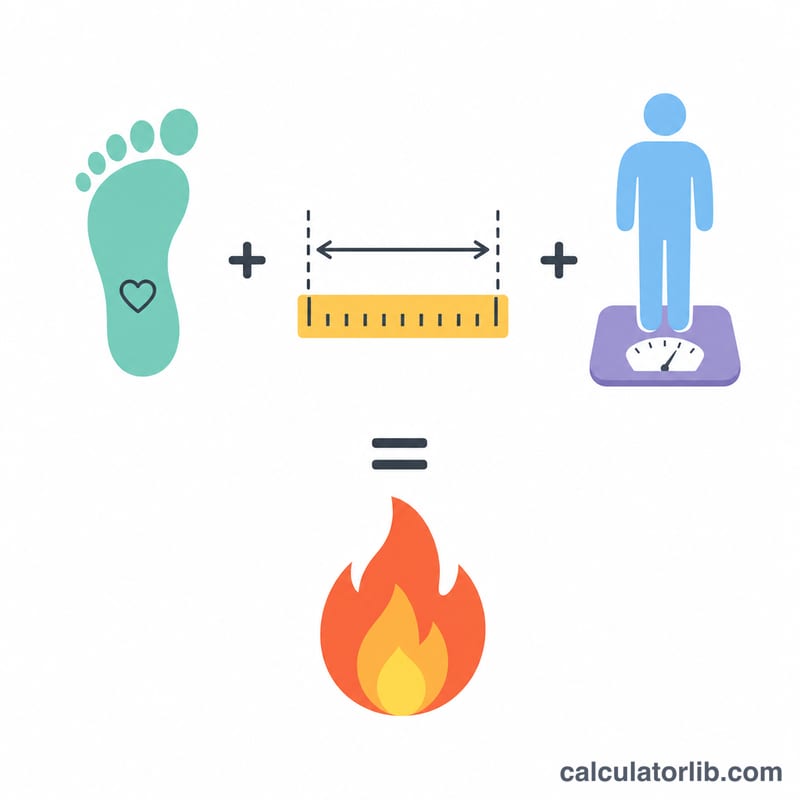
This tool estimates how many calories you burn while walking, based on three personal inputs: the number of steps you take, your body weight, and your stride length. Walking energy expenditure scales with how much mass you move and how far each step carries you, so heavier people and longer strides burn more per step. The calculator works for any country or measurement context since it relies on universal physics rather than region-specific data.
How to Use It
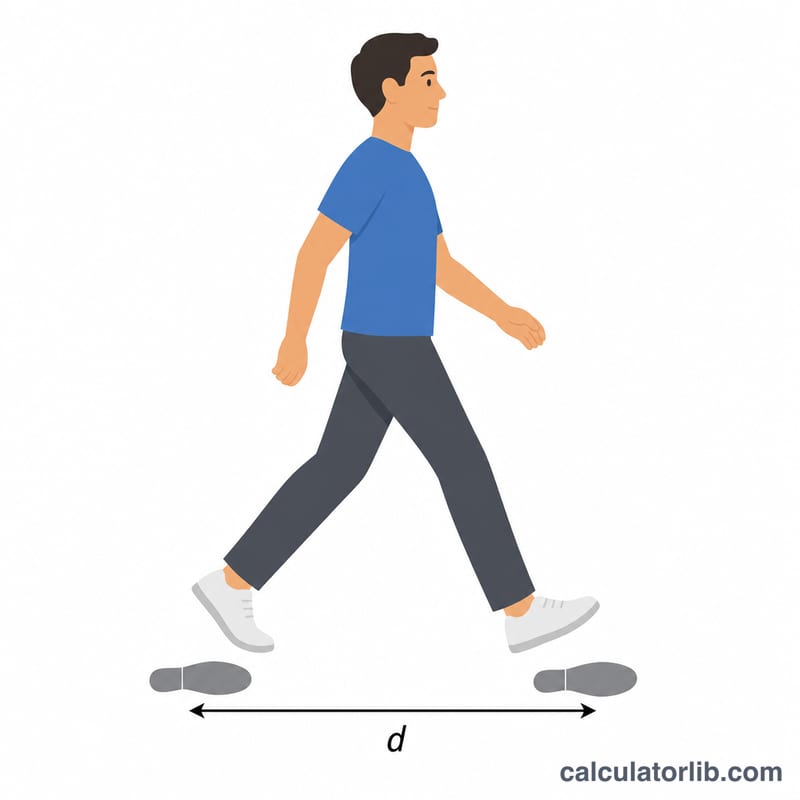
Enter your total step count (for example, from a fitness tracker), your body weight in kilograms, and your stride length in metres. A typical adult stride is roughly 0.65–0.80 m. The calculator returns total calories burned, the average calories per individual step, and the total distance you covered.
The Formula Explained
The estimate uses: $$\text{calories} = \text{steps} \times \text{stride (m)} \times \text{weight (kg)} \times 0.0005$$ The constant 0.0005 blends the metabolic cost of moving body mass over distance into a simple per-step coefficient. As a rule of thumb this yields about 0.04 kcal per step for an average walker, adjusted up or down by your weight and stride.
Worked Example
Suppose you walk 10,000 steps, weigh 70 kg, with a 0.75 m stride. $$\text{Calories} = 10{,}000 \times 0.75 \times 70 \times 0.0005 = \mathbf{262.5 \text{ kcal}}$$ $$\text{Distance} = 10{,}000 \times 0.75 \div 1000 = 7.5 \text{ km}$$ $$\text{Per step} = 262.5 \div 10{,}000 \approx 0.026 \text{ kcal}$$
FAQ
Is this exact? No. It is a practical estimate. Real energy use depends on terrain, pace, fitness and metabolism. Use it for tracking trends rather than precise nutrition planning.
How do I find my stride length? Walk 10 normal steps, measure the total distance in metres, then divide by 10.
Why does weight matter so much? Moving a heavier body over the same distance requires more energy, so calories scale roughly linearly with body mass.