
What Is the Area Moment of Inertia?
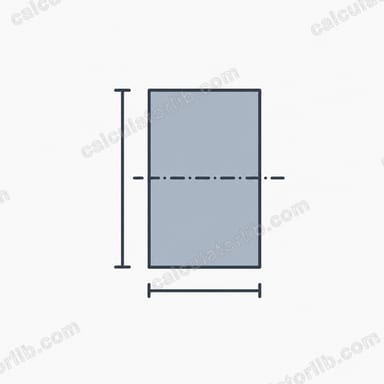
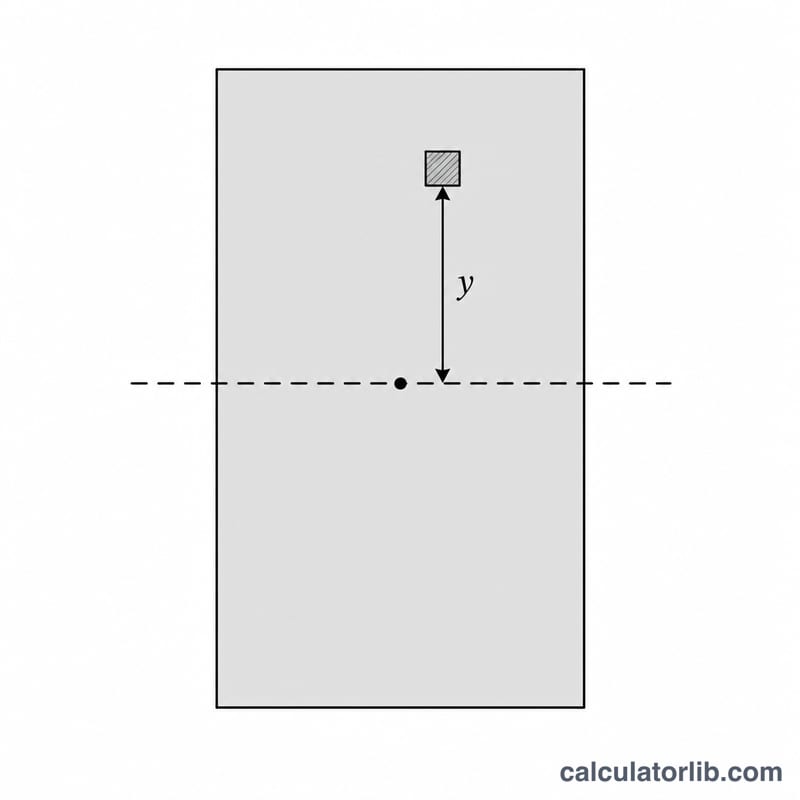
The area moment of inertia, also called the second moment of area, measures how a cross-section's material is distributed about a bending axis. A larger value means the section resists bending more stiffly. It is a purely geometric property (units of length⁴, here mm⁴) and is fundamental in beam deflection and bending-stress calculations. This calculator handles the two most common shapes: a solid rectangle and a solid circle, returning the moment of inertia about the centroidal (neutral) axis along with section modulus and radius of gyration.
How to Use This Calculator
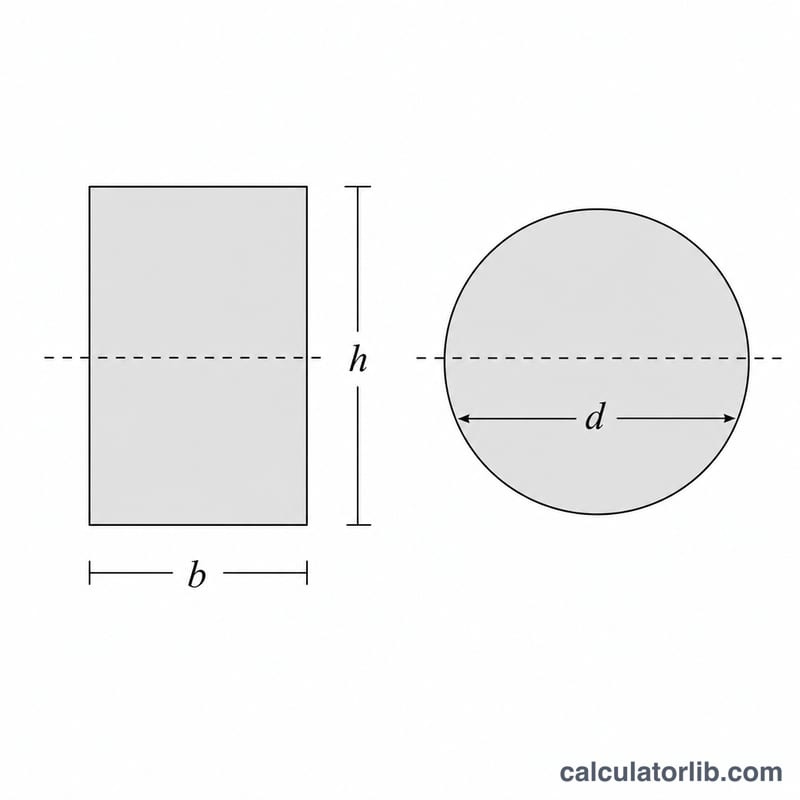
Pick your cross-section shape. For a rectangle, enter the width b (parallel to the bending axis) and the height h (perpendicular to it). For a solid circle, enter the diameter d. Click calculate to get I, the cross-sectional area A, the distance c to the extreme fiber, the section modulus \(S = I/c\), and the radius of gyration \(r = \sqrt{I/A}\). Keep all dimensions in millimetres so the inertia comes out in mm⁴.
The Formula Explained
For a rectangle the second moment of area about its horizontal centroidal axis is $$I = \frac{\text{Width } b \cdot \text{Height } h^{3}}{12}$$ Notice that height is cubed: doubling the depth of a beam increases its bending stiffness eightfold, while doubling the width only doubles it. For a solid circle, $$I = \frac{\pi \cdot \text{Diameter } d^{4}}{64}$$ about any diameter through the centre. The section modulus \(S = I/c\) (with \(c\) the distance to the outermost fibre) directly relates bending moment to maximum stress via \(\sigma = M/S\).
Worked Example
Consider a rectangle 50 mm wide and 100 mm tall. $$I = \frac{50 \times 100^{3}}{12} = \frac{50 \times 1{,}000{,}000}{12} = \frac{50{,}000{,}000}{12} \approx 4{,}166{,}666.67 \text{ mm}^4$$ The area is \(50 \times 100 = 5{,}000 \text{ mm}^2\), \(c = 50 \text{ mm}\), so \(S = 4{,}166{,}666.67 / 50 \approx 83{,}333.33 \text{ mm}^3\), and \(r = \sqrt{4{,}166{,}666.67 / 5{,}000} \approx 28.87 \text{ mm}\).
FAQ
Is this the same as mass moment of inertia? No. The area moment of inertia is geometric (length⁴) and governs bending stiffness; the mass moment of inertia (mass·length²) governs rotational dynamics.
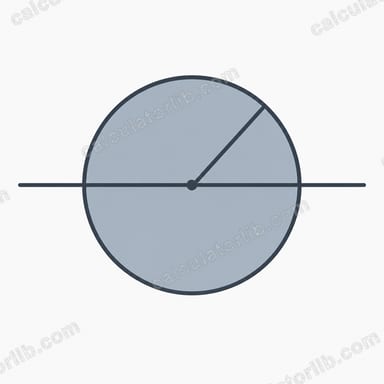
Which axis is used? The value is taken about the centroidal axis. For the rectangle it is the horizontal axis through the centre; for the circle any diameter gives the same result.
Can I use inches? Yes — the formulas are unit-agnostic. If you enter inches, the moment of inertia is in inches⁴ and the other quantities follow the same units.