
What Is Mass Moment of Inertia?
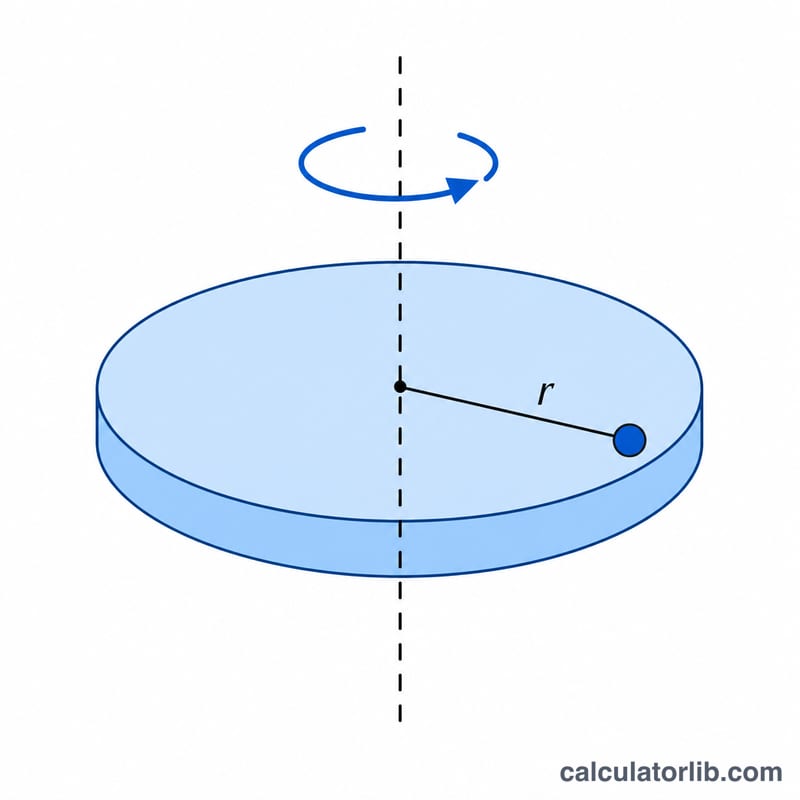
The mass moment of inertia (I) measures how strongly a rigid body resists changes to its rotational motion about a given axis. It is the rotational analog of mass in linear motion. The larger the moment of inertia, the more torque is required to angularly accelerate the object. Its SI unit is the kilogram-square-metre (\(\text{kg}\cdot\text{m}^2\)).
The Formula
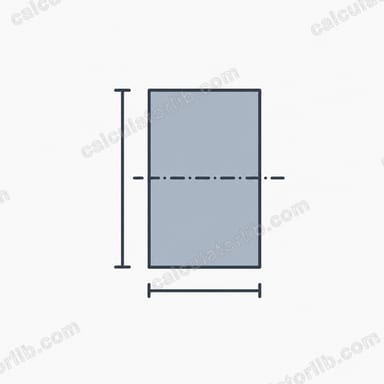
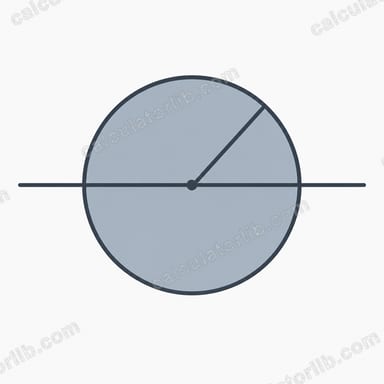
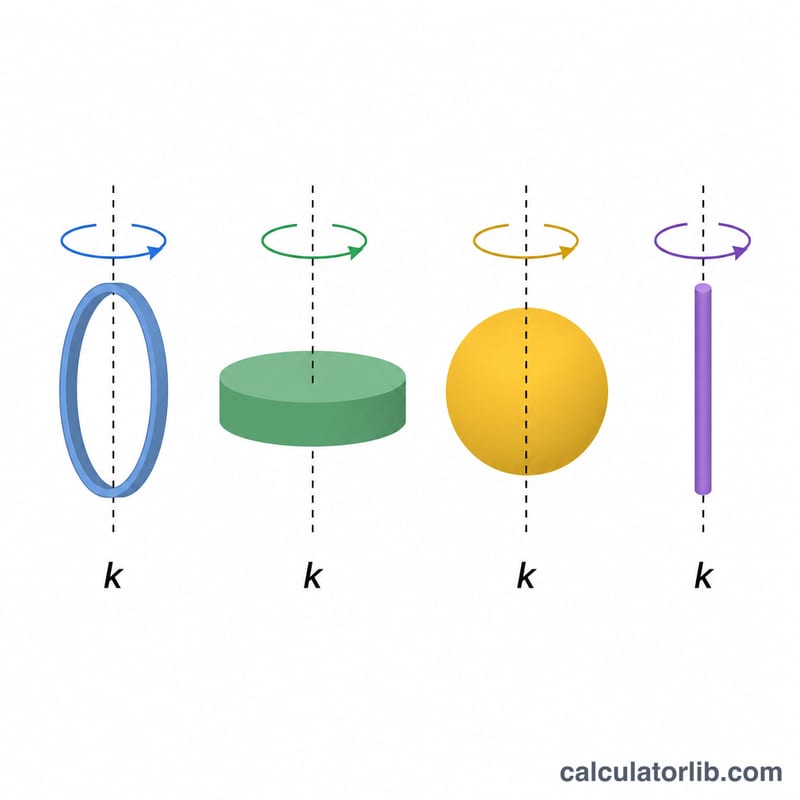
For many standard shapes the moment of inertia about the natural axis can be written compactly as \(I = k \cdot m \cdot r^2\), where m is the mass, r is the characteristic radius (or length for a rod), and k is a dimensionless shape factor. Choosing the correct k captures how the mass is distributed relative to the axis: mass farther from the axis raises k and therefore I.
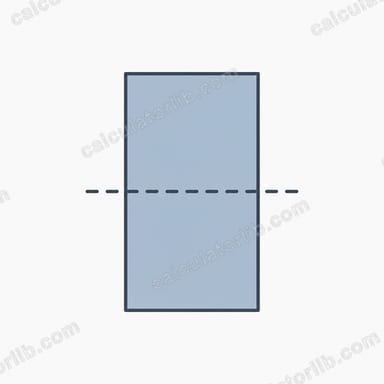
Common factors are: solid cylinder or disk \(k = \tfrac{1}{2}\), thin hoop or ring \(k = 1\), solid sphere \(k = \tfrac{2}{5}\), hollow (thin) sphere \(k = \tfrac{2}{3}\), and a thin rod rotating about its center \(k = \tfrac{1}{12}\) (where r is the rod's full length L).
How to Use the Calculator
Pick the shape that matches your object, enter the mass in kilograms and the radius (or length, for a rod) in metres, then read off the moment of inertia in \(\text{kg}\cdot\text{m}^2\). The calculator also reports the shape factor it used so you can verify the assumption.
Worked Example
A solid disk of mass 10 kg and radius 0.5 m has \(k = \tfrac{1}{2}\). So $$I = 0.5 \times 10 \times 0.5^2 = 0.5 \times 10 \times 0.25 = 1.25\ \text{kg}\cdot\text{m}^2.$$ If the same mass were arranged as a thin hoop (\(k = 1\)) the result would double to \(2.5\ \text{kg}\cdot\text{m}^2\), since all the mass sits at the rim.
FAQ
Does the axis matter? Yes. These shape factors assume rotation about the standard symmetry axis (e.g. through the center of a disk, or perpendicular through the center of a rod). For other axes use the parallel-axis theorem.
What value of r do I use for a rod? Use the full length L of the rod when selecting the rod option, since \(k = \tfrac{1}{12}\) is defined for \(I = \tfrac{1}{12} m L^2\).
Can I use other units? The formula is unit-consistent: enter mass and length in any consistent system and the result follows (e.g. kg and m give \(\text{kg}\cdot\text{m}^2\)).