
What Is a Simple Pendulum?
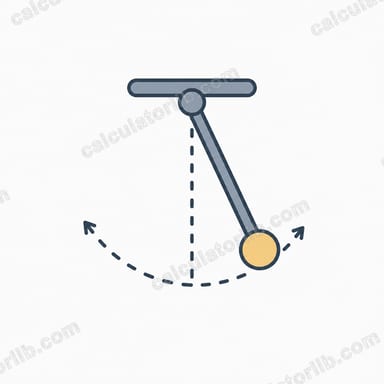
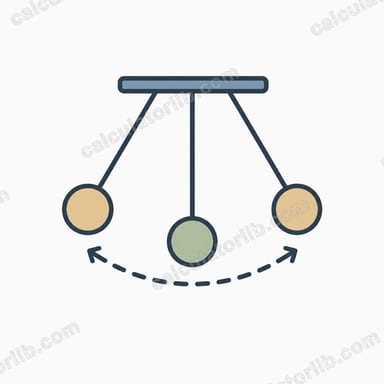
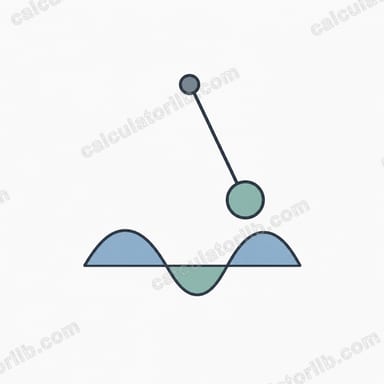
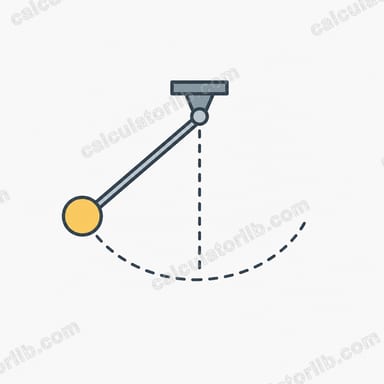
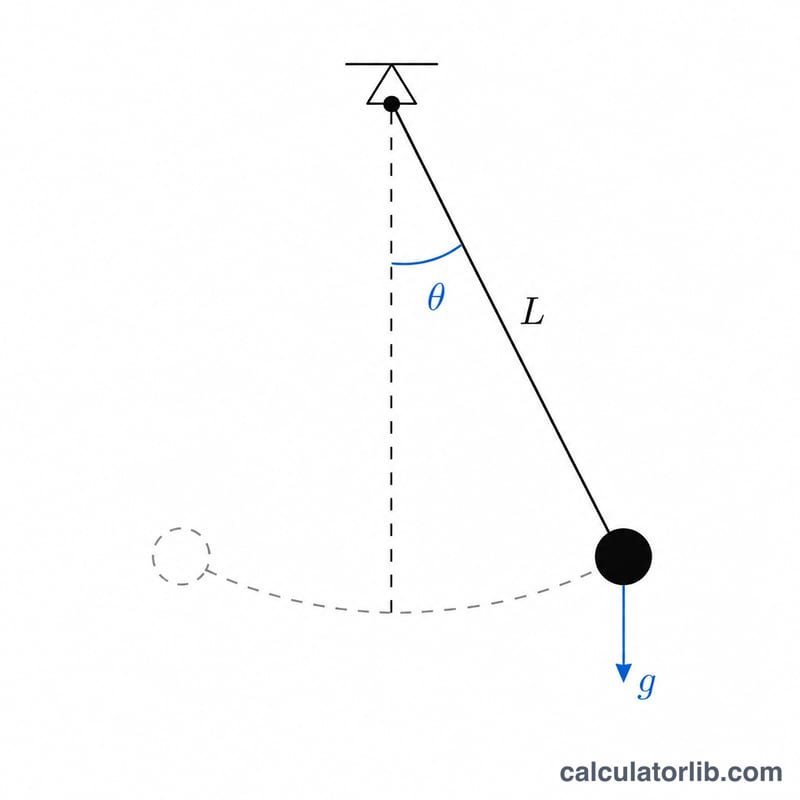
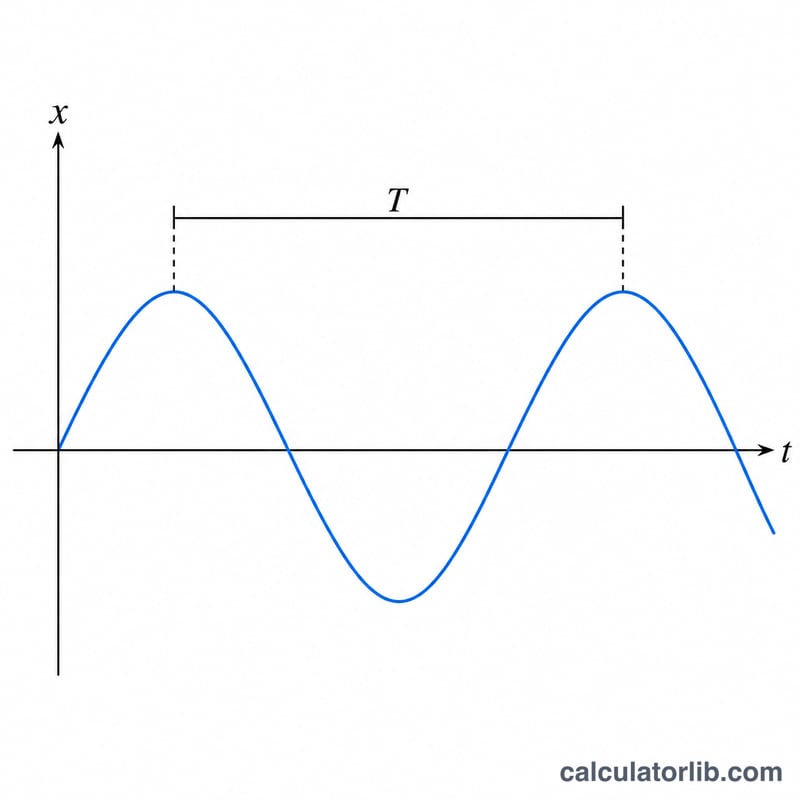
A simple pendulum is an idealized model consisting of a point mass (the bob) suspended from a fixed pivot by a massless, inextensible string. When pulled aside and released, it swings back and forth under gravity. This calculator finds the period (the time for one full back-and-forth swing) and the frequency from the pendulum's length and the local acceleration due to gravity. The result is universal physics — it applies anywhere as long as you supply the correct value of g.
How to Use the Calculator
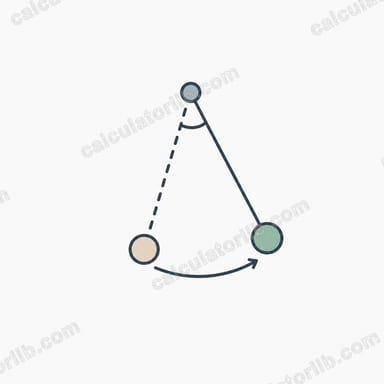
Enter the length of the pendulum in meters and the gravitational acceleration in m/s². On Earth, g is about 9.81 m/s² (use 1.62 for the Moon or 3.71 for Mars). The calculator instantly returns the period in seconds and the frequency in hertz. The formula assumes small swing angles (under roughly 15°), where the motion is very nearly simple harmonic.
The Formula Explained
The period is given by $$T = 2\pi \sqrt{\dfrac{L}{g}}$$ Notice that mass does not appear — a heavy bob and a light bob of the same length swing at the same rate. The period grows with the square root of the length, so quadrupling the length only doubles the period. Frequency is simply the reciprocal, \(f = \dfrac{1}{T}\).
Worked Example
For a 1-meter pendulum on Earth (g = 9.81 m/s²): $$T = 2\pi \sqrt{\dfrac{1}{9.81}} = 2\pi \times 0.31944 \approx 2.0071 \text{ seconds.}$$ The frequency is \(f = \dfrac{1}{2.0071} \approx 0.4982 \text{ Hz}\). So this pendulum completes roughly one swing every two seconds — the classic "seconds pendulum" is close to 0.994 m long.
FAQ
Does the bob's mass affect the period? No. For a simple pendulum, the period depends only on length and gravity, not on mass.
Why must the angle be small? The formula uses the small-angle approximation \(\sin\theta \approx \theta\). At larger amplitudes the true period is slightly longer.
What value of g should I use? Use 9.81 m/s² for typical Earth-surface calculations, or the local value for other planets or precise work.