
What this calculator does
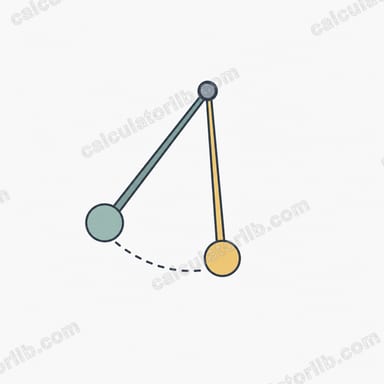
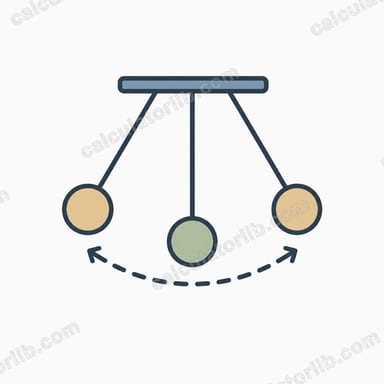
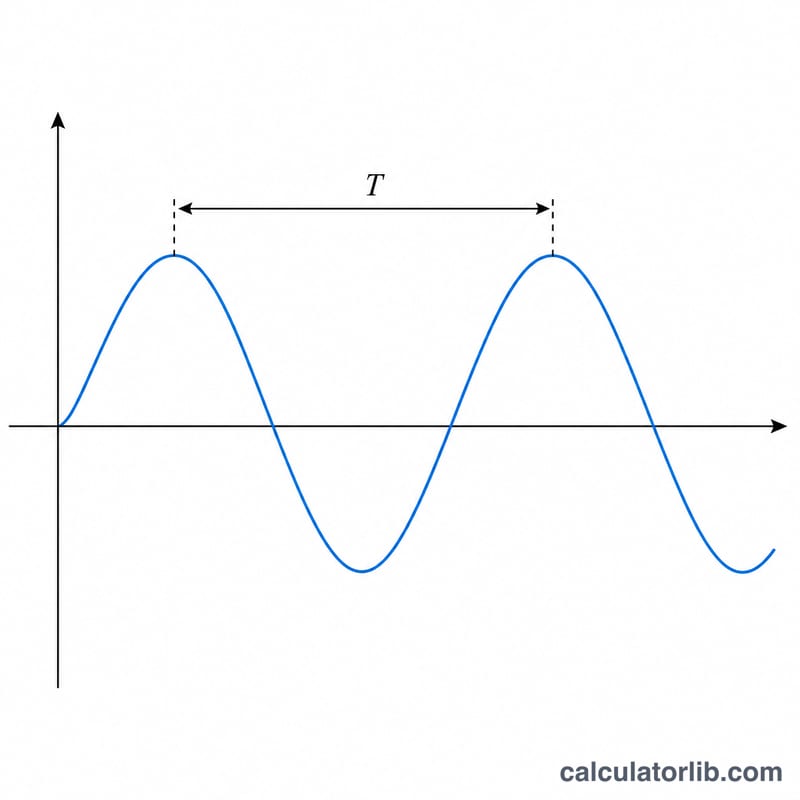
A pendulum clock keeps time by the steady swing of a weighted rod. This tool computes the period (the time for one complete back-and-forth swing) of a simple pendulum from its length, or works backwards to find the length needed for a desired period — for example the 1-second beat used in a "seconds pendulum." Gravity is adjustable so you can model any location on Earth or another planet.
The formula explained
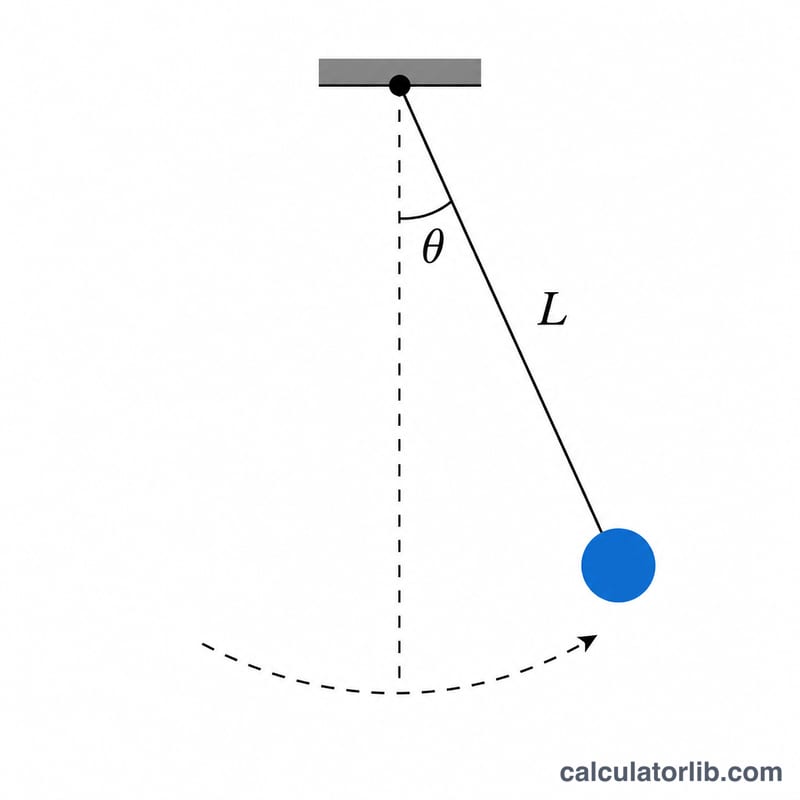
For small swing angles, the period of a simple pendulum is $$T = 2\pi \sqrt{\frac{L}{g}}$$ where L is the length in metres and g is gravitational acceleration (about 9.81 m/s² on Earth). Notice the period depends only on length and gravity — not on the mass of the bob or the swing amplitude (for small angles). Rearranging gives the length needed for a target period: $$L = g \cdot \left(\frac{T}{2\pi}\right)^{2}$$ Frequency is simply the inverse of the period, \(f = 1/T\), measured in hertz.
How to use it
Choose whether to solve for period or length. Enter the known value (length in metres, or target period in seconds), confirm the gravity value, and read the result. The result table also shows the frequency so you know how many swings occur each second.
Worked example
A 1 metre pendulum on Earth: $$T = 2\pi \sqrt{\frac{1}{9.81}} = 2\pi \times 0.3193 = 2.0064 \text{ seconds}$$ To build a clock with a 2-second period, you need $$L = 9.81 \times \left(\frac{2}{2\pi}\right)^{2} = 9.81 \times 0.10132 = 0.9939 \text{ metres}$$ — close to one metre, which is why the classic grandfather clock pendulum is roughly that length.
FAQ
Does the bob's weight change the period? No. For an ideal simple pendulum the period is independent of mass.
Why does my real clock differ slightly? The formula assumes small angles and a massless rod. Large swings, air resistance, and rod mass introduce small corrections.
What is a "seconds pendulum"? One whose period is 2 seconds (one second per swing each way), requiring a length near 0.994 m on Earth.