
What is the Orbital Period Calculator?
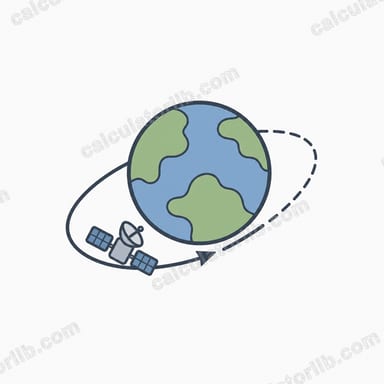
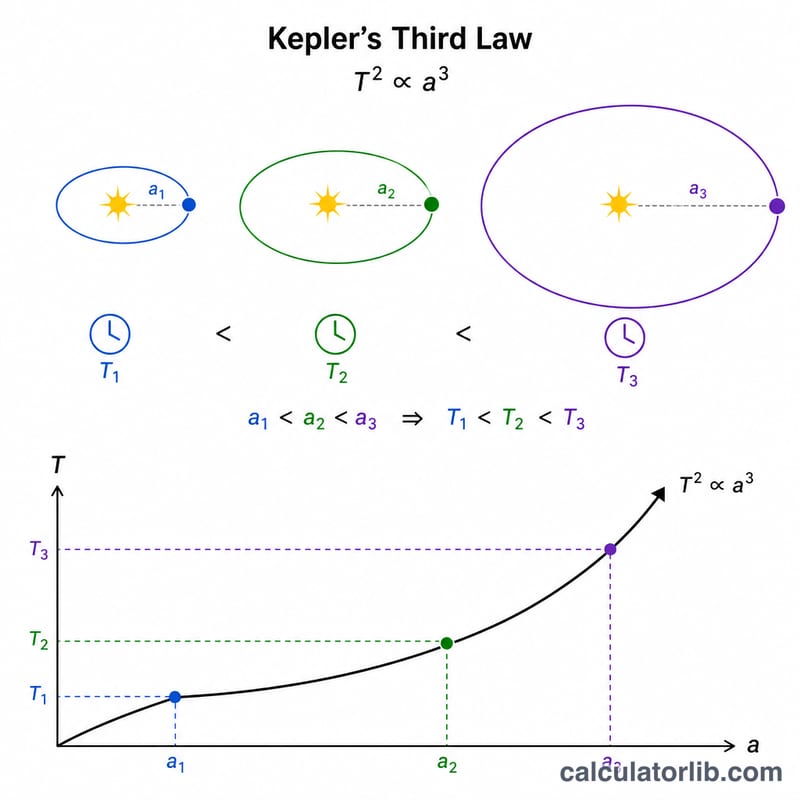
This tool computes the time a body takes to complete one full orbit around a much more massive central body, using Kepler's Third Law in its Newtonian form. Enter the orbit's semi-major axis (in meters) and the mass of the central object (in kilograms) — for example a planet orbiting a star, or a satellite orbiting Earth — and the calculator returns the orbital period in seconds, hours, days, and years.
How to use it
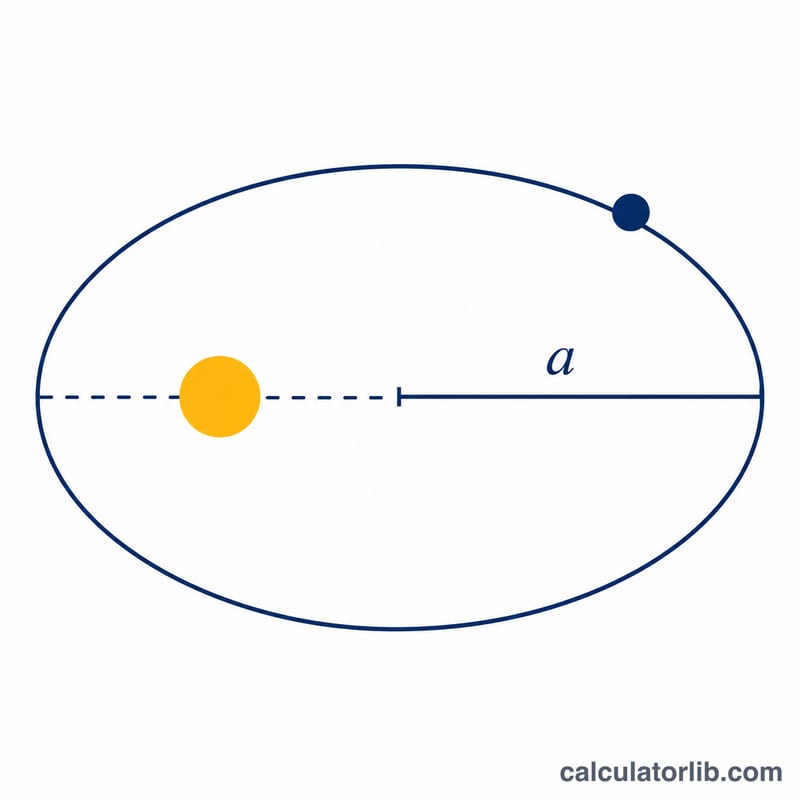
Provide two values: the semi-major axis a, which for a circular orbit is simply the orbital radius, and the central mass M. Both must be positive. The default values describe Earth's orbit around the Sun (a ≈ 1.496×10¹¹ m, M ≈ 1.989×10³⁰ kg), which yields about one year.
The formula explained
The period is given by $$T = 2\pi \sqrt{\dfrac{a^{3}}{G \cdot M}}$$ The cube of the orbital size divided by the product of the gravitational constant and the central mass determines how long gravity takes to pull the orbiting body around. Notice the orbiting body's own mass does not appear — it cancels out for the common case where it is far lighter than the central mass.
Worked example
For a low Earth orbit at \(a = 6.771\times10^{6}\) m around Earth (\(M = 5.972\times10^{24}\) kg): $$T = 2\pi \sqrt{\frac{(6.771\times10^{6})^{3}}{6.674\times10^{-11} \times 5.972\times10^{24}}} \approx 5{,}545 \text{ seconds}$$ or about 92 minutes — matching the orbital period of the International Space Station.
FAQ
What units should I use? Use SI units: meters for the axis and kilograms for the mass. The constant G is fixed at \(6.674\times10^{-11}\).
Does the orbiting object's mass matter? Only negligibly when it is far lighter than the central body, so this formula ignores it.
Can I use it for elliptical orbits? Yes — use the semi-major axis (the average of perihelion and aphelion distances), not the instantaneous radius.