
What Is Kepler's Third Law?
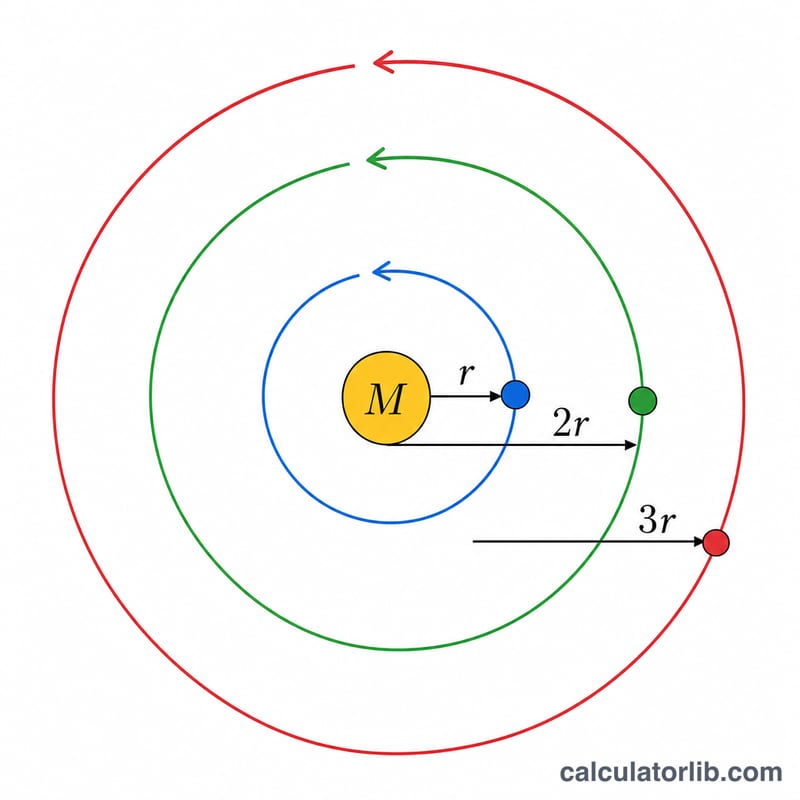
Kepler's Third Law of planetary motion states that the square of a body's orbital period is proportional to the cube of the semi-major axis of its orbit. In its Newtonian form, the constant of proportionality depends on the gravitational constant G and the mass M of the central body being orbited. This calculator uses that physical form so you can compute the orbital period of any satellite, moon, planet, or star from just two inputs.
How to Use This Calculator
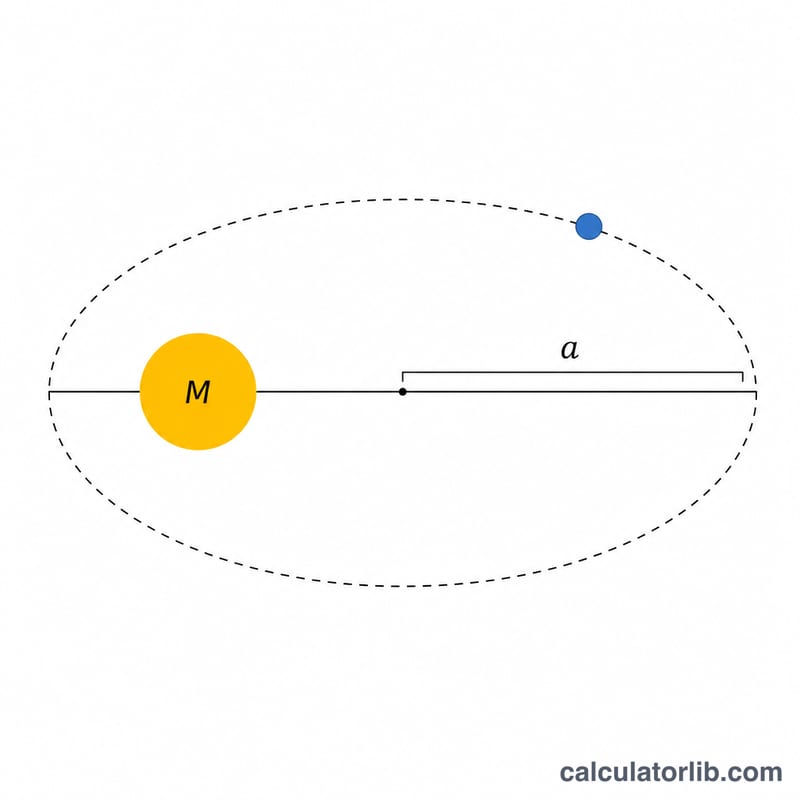
Enter the mass of the central body in kilograms (for example, the Sun is about \(1.989 \times 10^{30}\) kg, and Earth is about \(5.972 \times 10^{24}\) kg). Then enter the semi-major axis of the orbit in meters — for a near-circular orbit this is simply the orbital radius. The calculator returns the orbital period in seconds, days, and years. You can type values in scientific notation such as 1.496e11.
The Formula Explained
The full equation is $$T^{2} = \frac{4\pi^{2}}{G\cdot M}\cdot a^{3},$$ which rearranges to $$T = 2\pi\cdot\sqrt{\frac{a^{3}}{G\cdot M}}.$$ Here \(G = 6.674 \times 10^{-11}\ \text{N}\cdot\text{m}^{2}/\text{kg}^{2}\). Because period scales with the square root of the cube of distance, doubling the orbital radius increases the period by a factor of about \(2.83\).
Worked Example
For Earth orbiting the Sun: \(M = 1.989 \times 10^{30}\) kg and \(a = 1.496 \times 10^{11}\) m. Computing \(a^{3} = 3.348 \times 10^{33}\), and \(G\cdot M = 1.328 \times 10^{20}\), gives $$T = 2\pi\cdot\sqrt{2.522 \times 10^{13}} \approx 3.155 \times 10^{7}\ \text{seconds},$$ or about \(365.2\) days — exactly one year.
FAQ
What units should I use? Use SI units: mass in kilograms and semi-major axis in meters. The result is in seconds (also shown in days and years).
Does this work for any orbit? Yes, as long as the orbiting body's mass is small compared to the central body. For two comparable masses you would replace \(M\) with the combined mass \(M_{1} + M_{2}\).
Is the semi-major axis the same as orbital radius? For a circular orbit, yes. For an elliptical orbit, the semi-major axis is the average of the closest and farthest distances.