
What this calculator does
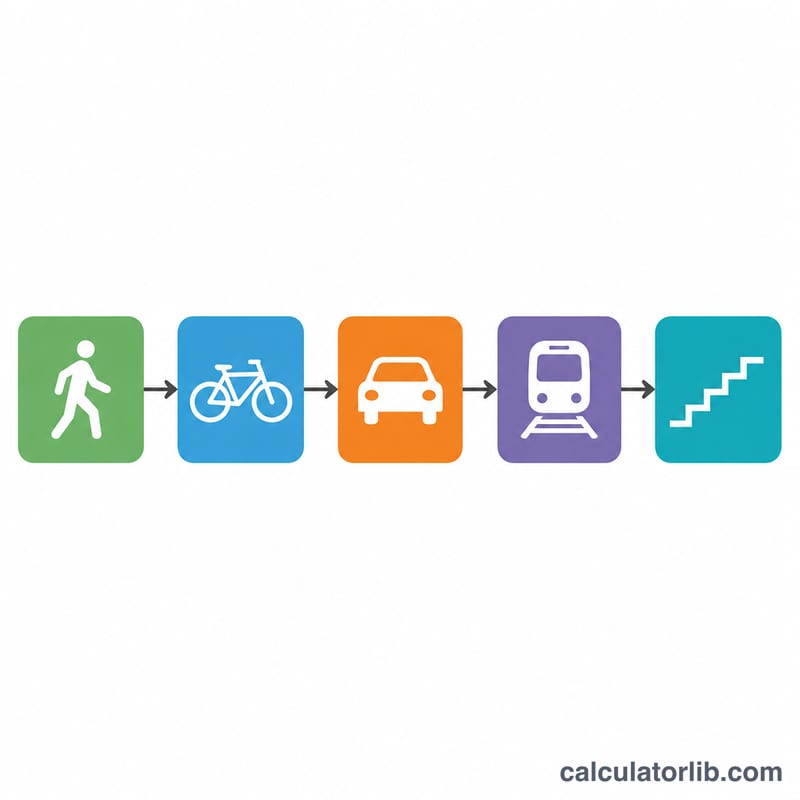
This tool estimates how many calories you burn during a daily commute to work or school. It adds up the energy expenditure of each part of your trip — walking, cycling, driving, standing on a train, sitting on a train and climbing stairs — using the standard METs (metabolic equivalent) energy formula. The MET values follow Japan's Ministry of Health, Labour and Welfare "Physical Activity Standards for Health 2013", but the underlying physics is universal and applies anywhere.
How to use it
Enter your body weight in kilograms, then type how many minutes you spend on each activity during one commute. Leave any segment at 0 if it does not apply. Press calculate to see the total kcal plus a breakdown by activity. The defaults model a typical commute: 30 min walking, 70 min standing on a train and 3 min of fast stair climbing.
The formula explained
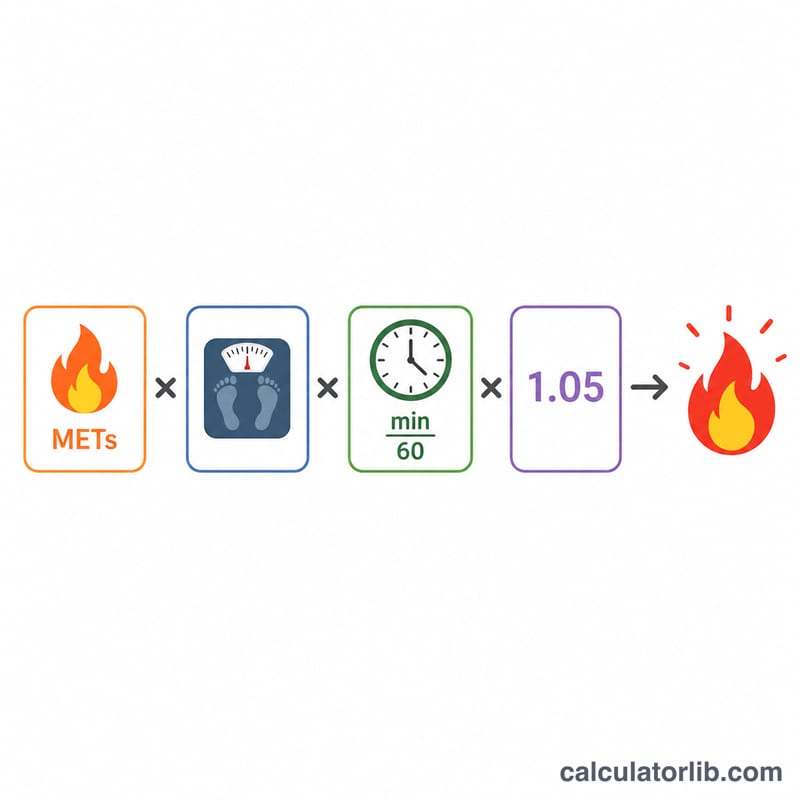
For each segment the calories burned are $$\text{kcal} = \text{METs} \times \text{weight(kg)} \times \frac{\text{minutes}}{60} \times 1.05$$. METs is a ratio of activity intensity to resting metabolism; 1.05 is the standard conversion constant for one \(\text{MET}\cdot\text{kg}\cdot\text{hour}\). Because the constant assumes time in hours, each minute input is divided by 60. The MET values used are: walking 3.0, cycling under 16 km/h 4.0, driving a car 1.0, train standing 2.0, train sitting 1.3, and fast stair climbing 8.8.
Worked example
For a 60 kg person walking 30 min, standing on a train 70 min and climbing stairs 3 min: walking $$= 3.0 \times 60 \times 0.5 \times 1.05 = 94.5 \text{ kcal};$$ train standing $$= 2.0 \times 60 \times 1.1667 \times 1.05 = 147.0 \text{ kcal};$$ stairs $$= 8.8 \times 60 \times 0.05 \times 1.05 = 27.72 \text{ kcal}.$$ Total \(\approx 269\) kcal.
FAQ
Why is driving only 1 MET? Driving a car is a low-effort, mostly seated activity, so a value of 1.0 MET (driving 30 min for a 60 kg person \(\approx 32\) kcal) is a deliberate, conservative assumption. Some sites use higher values.
Are these numbers exact? No. METs are population averages; your real expenditure varies with pace, terrain, load and physiology. Treat this as an estimate, not medical advice.
Why divide minutes by 60? The 1.05 constant is defined per hour, so minutes must be converted to hours or the result would be 60 times too large.