
What Is Hubble's Law?
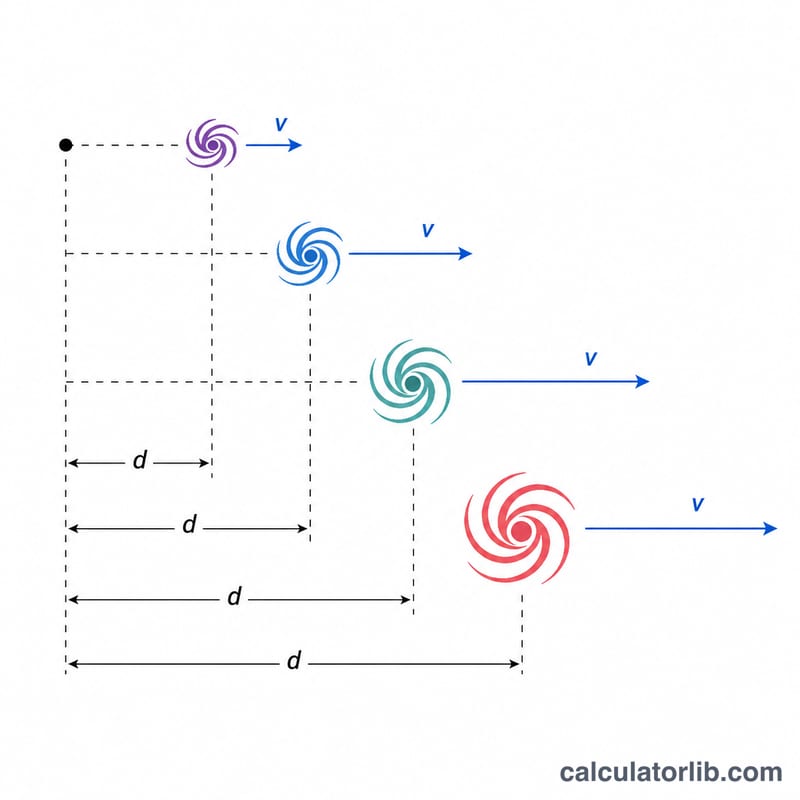
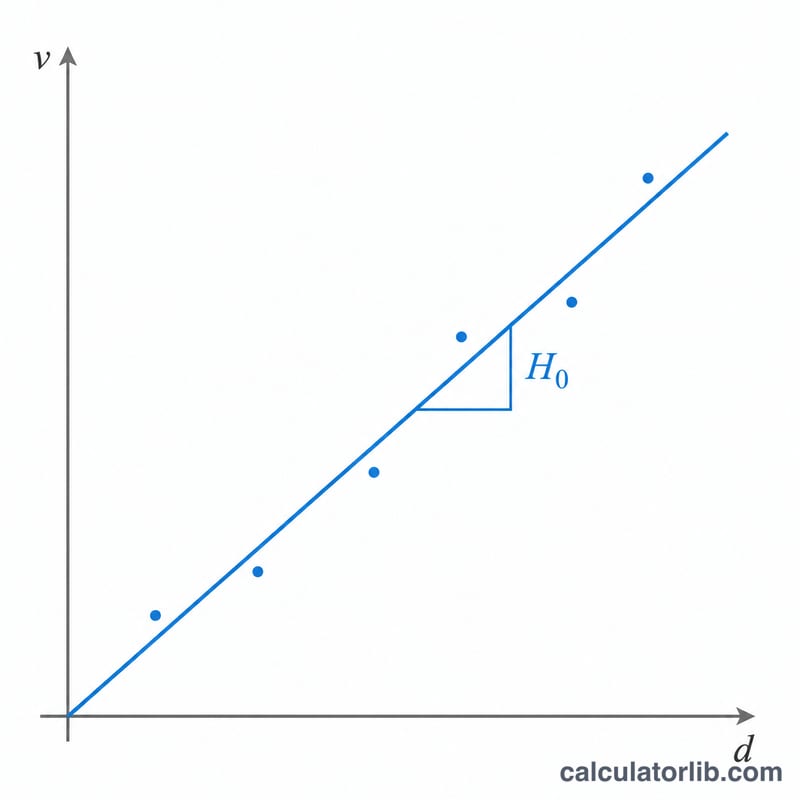
Hubble's Law is one of the foundational discoveries of modern cosmology. It states that the farther away a galaxy is, the faster it appears to recede from us. The relationship is linear: a galaxy's recessional velocity (v) is proportional to its distance (d), with the proportionality constant being the Hubble constant (H₀). This calculator rearranges the law to solve for distance given an observed recessional velocity.
How to Use This Calculator
Enter the galaxy's recessional velocity in kilometers per second (km/s) — usually derived from its redshift. Then enter the Hubble constant in km/s per megaparsec (km/s/Mpc). Modern estimates of \(H_0\) range from about 67 to 74; a common textbook value is 70. The calculator returns the distance in megaparsecs (Mpc), million light-years (Mly), and light-years (ly).
The Formula Explained
The equation is $$D = \frac{\text{Velocity (km/s)}}{\text{H}_0\ \text{(km/s/Mpc)}}$$ Velocity in km/s divided by \(H_0\) in km/s/Mpc yields distance directly in megaparsecs because the km/s units cancel. To convert to light-years, multiply by 3.2615638 million, since one megaparsec equals about 3.2615638 million light-years.
Worked Example
Suppose a galaxy recedes at 1,400 km/s and we use \(H_0 = 70\) km/s/Mpc. Then $$D = \frac{1400}{70} = 20\ \text{Mpc}$$ Converting: \(20 \times 3.2615638 \approx 65.23\) million light-years, or about 65,231,276 light-years away.
FAQ
Why does the Hubble constant vary? Different measurement methods (cosmic microwave background vs. local distance ladder) give slightly different values, a discrepancy called the "Hubble tension."
Is Hubble's Law accurate for nearby galaxies? For very close galaxies, local gravitational motions ("peculiar velocities") dominate, so the law is most reliable for distant galaxies.
What is a megaparsec? A megaparsec (Mpc) is one million parsecs, roughly 3.26 million light-years — a standard unit for intergalactic distances.