
What is Poiseuille's Law?
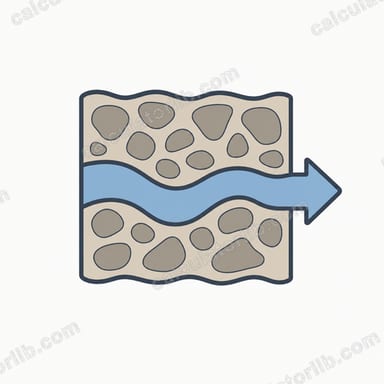
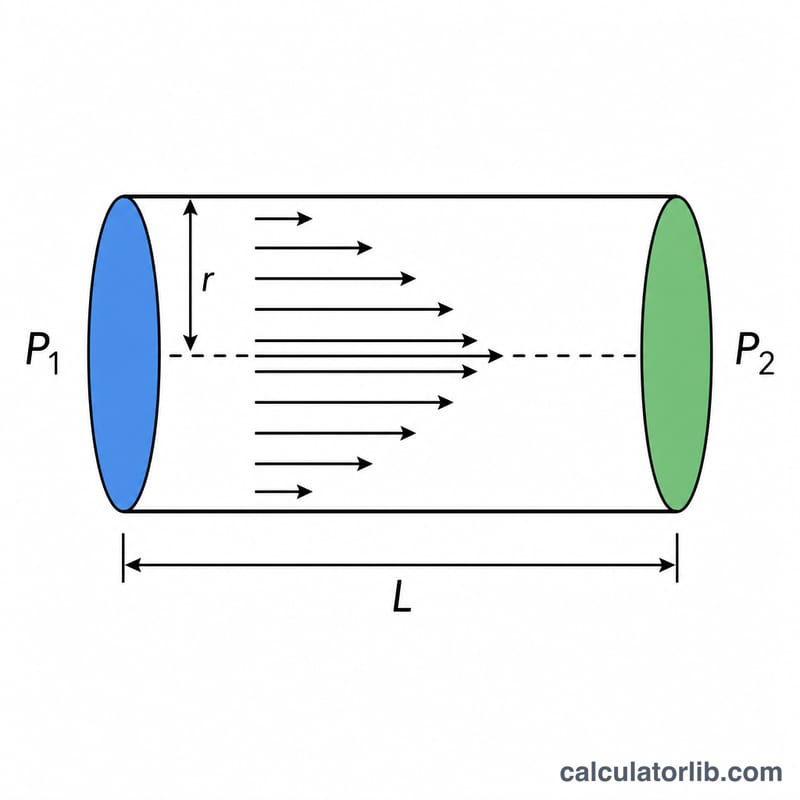
Poiseuille's Law (the Hagen–Poiseuille equation) describes the steady, laminar flow of an incompressible Newtonian fluid through a long cylindrical pipe of constant cross-section. It tells you how fast a fluid will flow given the pressure pushing it, the pipe's geometry, and the fluid's viscosity. The law is fundamental in fluid mechanics, hydraulics, and physiology (for example, blood flow through vessels).
How to use this calculator
Enter the pressure difference ΔP (in pascals) between the two ends of the pipe, the internal radius r (in metres), the dynamic viscosity μ (in pascal-seconds), and the pipe length L (in metres). The calculator returns the volumetric flow rate Q in cubic metres per second, and also converts it to litres per second for convenience.
The formula explained
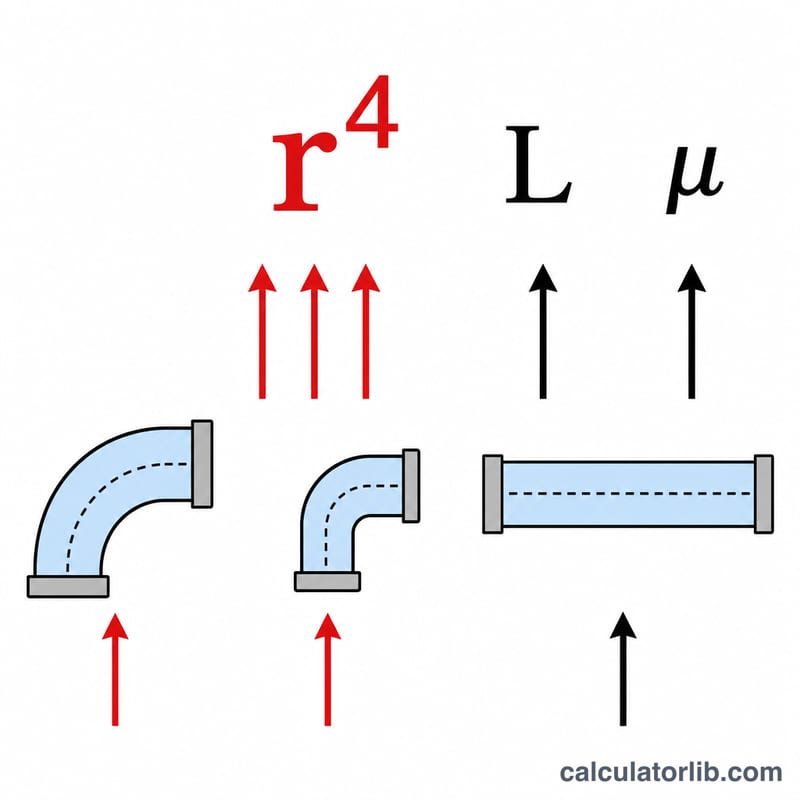
The equation is $$Q = \frac{\pi \cdot \Delta P \cdot r^{4}}{8 \cdot \mu \cdot L}$$. The most striking feature is the radius raised to the fourth power: doubling the radius increases flow rate by a factor of 16. Flow rises linearly with the pressure difference and falls as viscosity or pipe length increases. The law assumes laminar (non-turbulent) flow, a Newtonian fluid, and a rigid, straight pipe.
Worked example
Suppose \(\Delta P = 1000 \text{ Pa}\), \(r = 0.01 \text{ m}\), \(\mu = 0.001 \text{ Pa}\cdot\text{s}\), and \(L = 1 \text{ m}\). Then \(r^{4} = 1\times10^{-8}\), the numerator is \(\pi \times 1000 \times 1\times10^{-8} \approx 3.1416\times10^{-5}\), and the denominator is \(8 \times 0.001 \times 1 = 0.008\). So $$Q \approx 0.003927 \ \text{m}^3/\text{s}$$ or about 3.927 litres per second.
FAQ
Does this work for turbulent flow? No. Poiseuille's Law only applies to laminar flow (low Reynolds number). For turbulent flow you need different correlations.
What units should I use? Use SI units: pascals, metres, pascal-seconds. The result will then be in cubic metres per second.
Why is radius so important? Because flow scales with \(r^{4}\), even small changes in pipe radius cause large changes in flow — a key insight in both engineering and medicine.