
What Is Porosity?
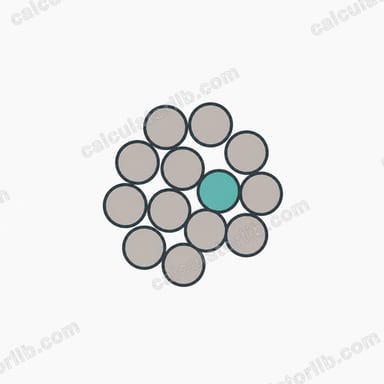
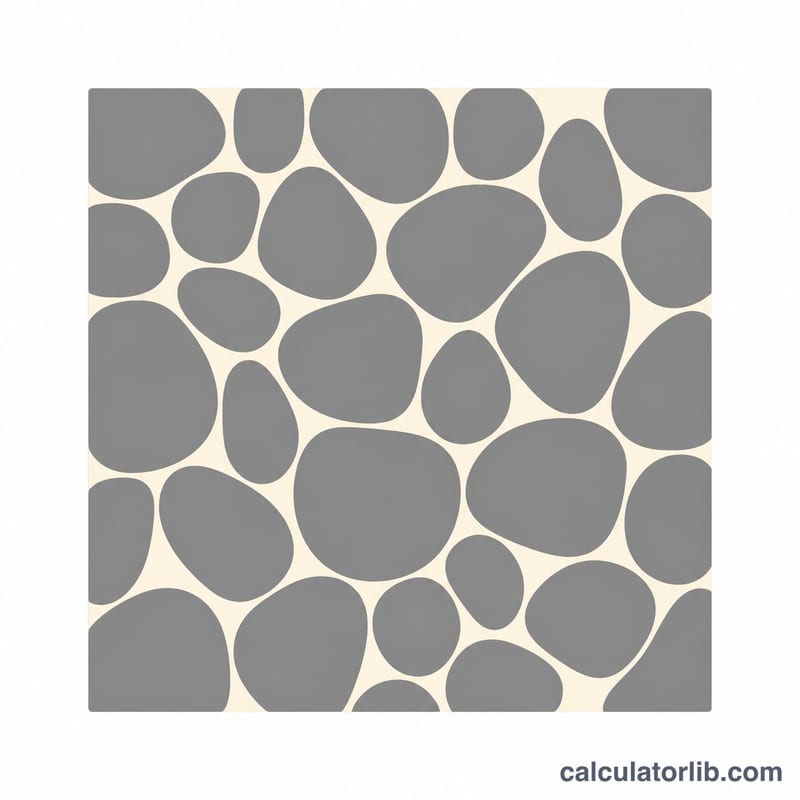
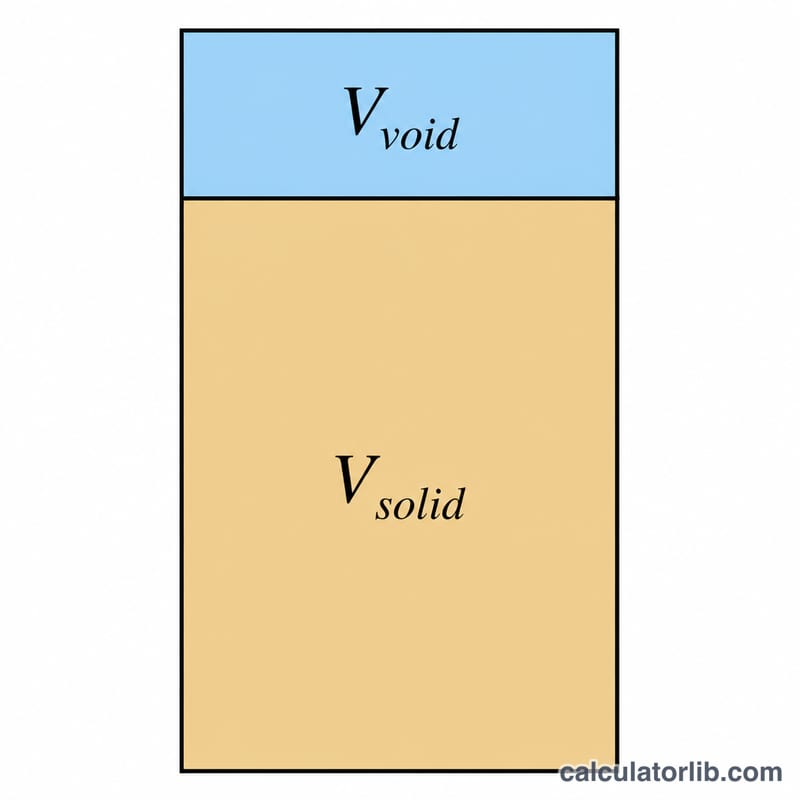
Porosity (symbol \(\phi\)) measures the fraction of a material's volume that is empty space — the pores or voids between solid grains. It is a dimensionless quantity, usually expressed as a decimal between 0 and 1 or as a percentage. Porosity is fundamental in geology, soil science, ceramics, materials engineering, and petroleum reservoir analysis because it controls how much fluid a material can hold.
How to Use This Calculator
Enter the void volume (the total volume of pores) and the total volume (the bulk volume of the sample) using any consistent unit such as cm³, mL, or m³. The calculator divides the two values to return the porosity as both a fraction and a percentage, and also reports the solid volume that fills the rest of the sample.
The Formula Explained
The volume-based definition is $$\phi = \frac{V_{\text{void}}}{V_{\text{total}}}$$ The same value can be obtained from densities: $$\phi = 1 - \frac{\rho_{\text{bulk}}}{\rho_{\text{particle}}}$$ where bulk density includes the empty space and particle density is the density of just the solid grains. Both expressions describe the same physical fraction of empty space.
Worked Example
Suppose a rock core has a total volume of 100 cm³ and the connected pore space measures 30 cm³. Then $$\phi = \frac{30}{100} = 0.30,$$ or 30% porosity. The remaining 70 cm³ is solid material. This sample could store fluid equal to 30% of its bulk volume.
FAQ
What is a typical porosity value? Sandstone reservoirs are often 10–30%, loose sand can exceed 40%, and dense crystalline rock may be under 1%.
Can porosity be over 100%? No. Void volume cannot exceed total volume, so porosity ranges from 0 to 1 (0–100%).
Does this measure connected porosity? The volume-based formula gives total porosity. If you supply only the connected (effective) void volume, you get effective porosity instead.