
What this calculator does
This tool estimates the calories you burn while mountain climbing or hiking. It uses the standard METs (Metabolic Equivalent of Task) energy-expenditure formula, where the activity intensity depends on how heavy a pack you carry. The METs values used here come from Japan's Ministry of Health, Labour and Welfare "Physical Activity Reference for Health Promotion 2013" METs table, but the underlying formula is universal and used worldwide.
How to use it
Pick the option that matches the load you carry: heavier packs select a higher METs value. Enter your exercise time in minutes and your body weight in kilograms, then read off the estimated calories burned. You do not need to add the pack weight to your body weight — the chosen METs value already accounts for the load.
The formula explained
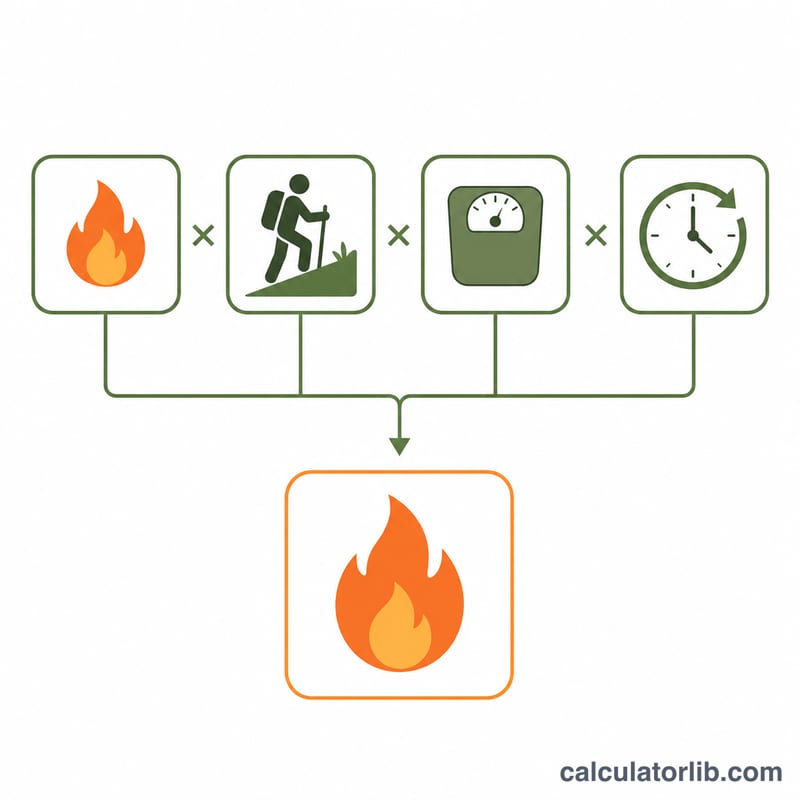
The classic METs equation is: $$\text{kcal} = \text{METs} \times \text{body weight (kg)} \times \text{time (hours)} \times 1.05$$. One MET is your resting metabolic rate; multiplying by METs scales it to the effort of the activity. The constant 1.05 is the conventional factor for kilocalories per kilogram per MET-hour (some references use 1.0; this tool uses 1.05). Because the formula needs hours, minutes are divided by 60 first.
Worked example
Suppose you hike for 90 minutes carrying a 0–4.1 kg load (6.5 METs) at a body weight of 60 kg. Convert the time: \(90 \div 60 = 1.5\) hours. Then: $$6.5 \times 60 \times 1.5 \times 1.05 = 614.25 \text{ kcal}.$$
FAQ
Should I add my backpack weight to my body weight? No. The heavier load brackets already raise the METs value, so enter only your own body weight.
How accurate is this? It is an approximation. It ignores terrain slope, altitude, individual fitness and age, so treat the number as a guide rather than an exact measurement.
Why 1.05 instead of 1.0? \(1.05 \text{ kcal}/(\text{kg}\cdot\text{h})\) per MET is a common simplification that slightly accounts for the resting metabolic baseline; both factors appear in the literature.