
What this calculator does
The Firefighter Calorie Burn Calculator estimates how many kilocalories (kcal) a person burns while performing firefighting-related tasks. It uses the universal MET (metabolic equivalent) energy-expenditure formula, so it applies to anyone worldwide. The MET values for each activity are drawn from a revised Compendium of Physical Activities, but the underlying calorie math is not specific to any country, calendar, or legal rule.
How to use it
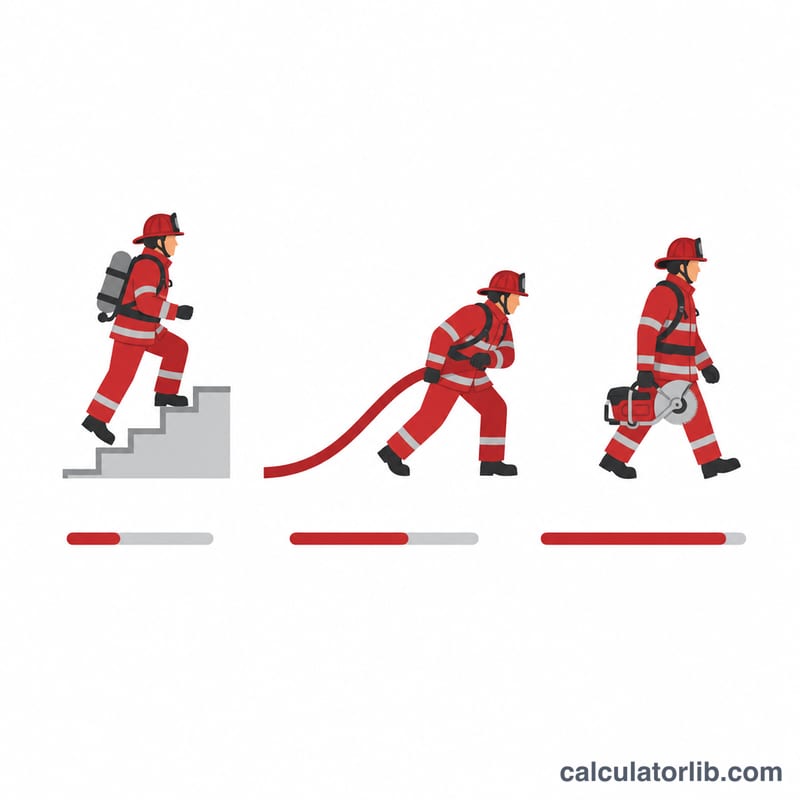
Pick the firefighting activity that best matches what you did. Each option maps to a MET value (a measure of intensity relative to rest): rescue with a hook at a vehicle accident is 6.8 METs; general firefighting, ladder climbing, and suppression training are 8.0 METs; carrying hose, hoisting equipment, or breaking down walls in full turnout gear are 9.0 METs. Enter the time in minutes and your body weight (kg or lb). The calculator returns the exercise intensity and the estimated calories burned.
The formula explained
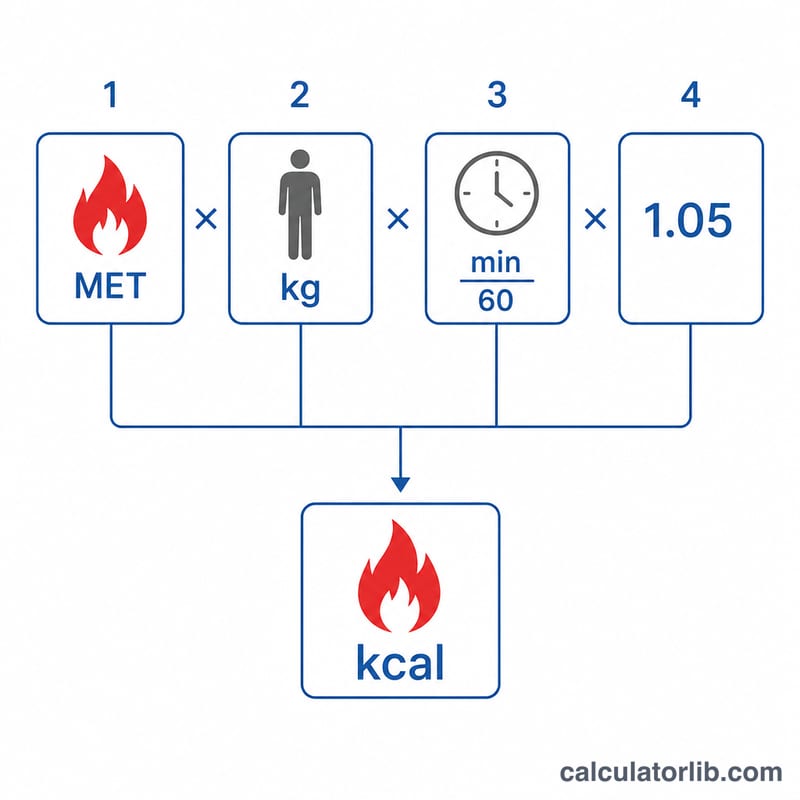
The standard equation is: $$\text{kcal} = \text{MET} \times \text{body weight (kg)} \times \text{exercise time (hours)} \times 1.05$$ The factor 1.05 represents kilocalories burned per kilogram of body weight per MET-hour. Because minutes are entered, the time is first converted to hours by dividing by 60. This is a gross estimate — it does not subtract your resting metabolic rate, so it slightly overstates the calories beyond what you would burn sitting still.
Worked example
Suppose you performed general firefighting (8.0 METs) for 90 minutes at a body weight of 70 kg. First convert time: \(90 / 60 = 1.5\) hours. Then: $$8.0 \times 70 \times 1.5 \times 1.05 = 882 \text{ kcal}$$ The exercise intensity is 8.0 METs and the calories burned is 882 kcal.
FAQ
Does this subtract resting calories? No. It uses gross METs \(\times\) 1.05, so it includes the energy you would have burned at rest. Some references subtract 1 MET for net active calories; this tool does not.
Can I use pounds? Yes. Select "lb" and the weight is converted to kilograms (\(\times\) 0.45359237) before the formula is applied.
Why is it only an estimate? MET tables average across many people. Your real burn depends on fitness, gear weight, terrain, and effort, so treat the result as a reasonable approximation rather than an exact figure.