
What this calculator does
This tool estimates how many calories a police officer burns while performing a specific work activity. It uses the MET (metabolic equivalent) method, where each activity is assigned an intensity value relative to resting metabolism. By combining that MET value with your body weight and how long you spent on the task, you get an estimate of total energy expenditure in kilocalories. The physiology is universal, so the formula applies anywhere; only the activity labels are themed for policing.
How to use it
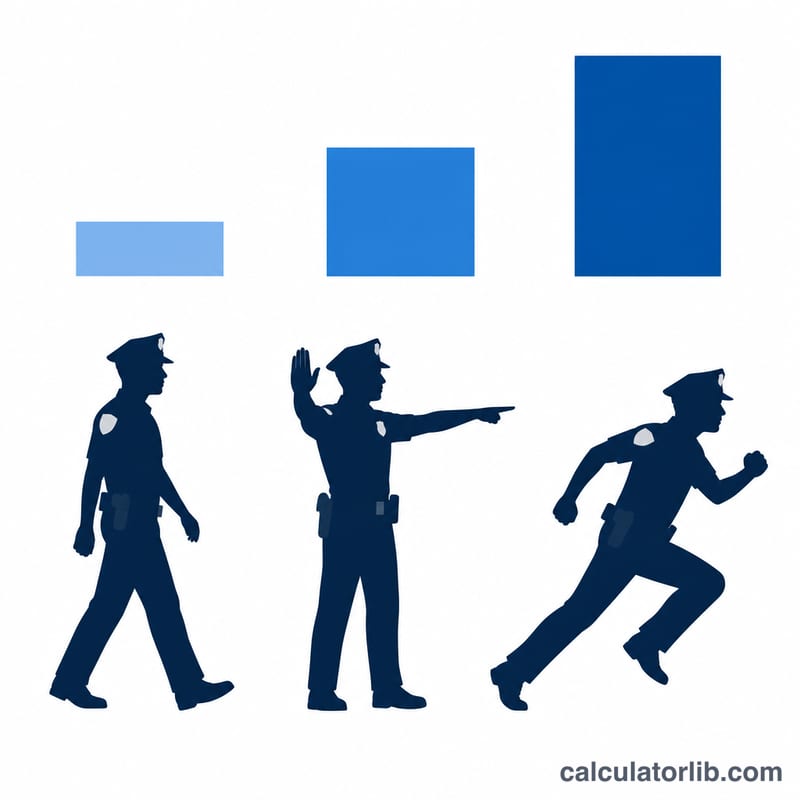
Pick the police activity from the dropdown (riding in a patrol car, driving, directing traffic, or making an arrest). Enter the duration in minutes and your body weight in kilograms. The calculator shows the activity's exercise intensity in METs and the estimated calories burned. Body weight has no default, so you must enter a positive value.
The formula explained
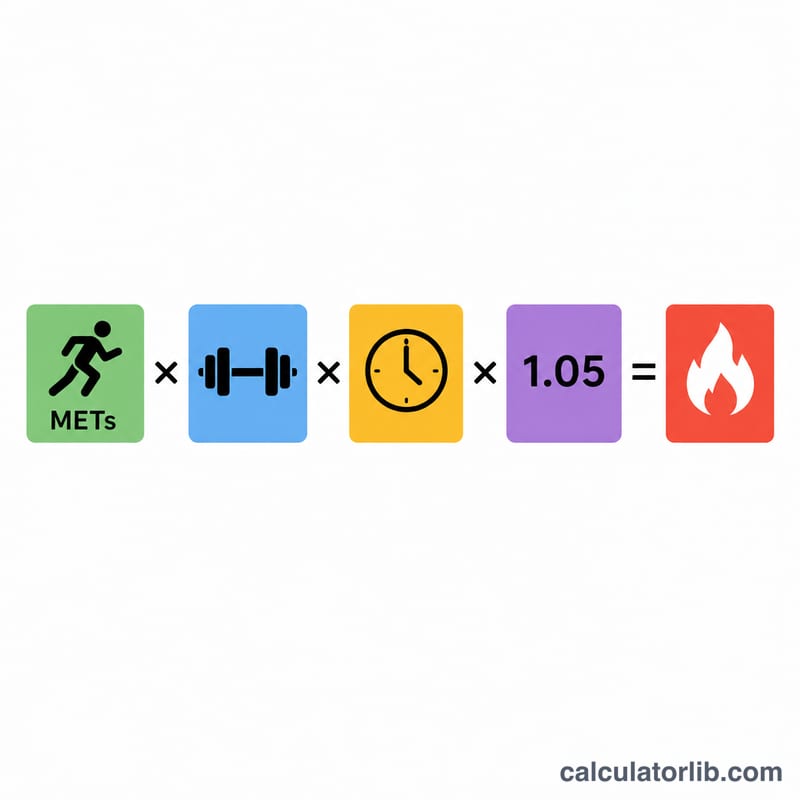
The calculation is $$\text{kcal} = \text{METs} \times \text{weight(kg)} \times \text{hours} \times 1.05$$, where hours equals the minutes you entered divided by 60. A MET of 1 represents your resting metabolic rate; an activity at 4 METs burns roughly four times the energy of sitting quietly. The 1.05 constant is the widely used simplified conversion factor (kilocalories per kilogram per MET-hour). The result is gross energy expended, which already includes resting metabolism rather than only the "extra" calories above rest.
Worked example
Suppose an officer drives a patrol car (MET = 2.5) for 90 minutes weighing 70 kg. Hours = \(90 / 60 = 1.5\). Calories = \(2.5 \times 70 \times 1.5 \times 1.05 = 275.6\) kcal. Exercise intensity displays as 2.5 METs.
FAQ
Why do driving and directing traffic share 2.5 METs? Both are assigned the same intensity in the reference MET table, yet they are kept as separate labels for clarity.
Where do the MET values come from? They follow the revised Physical Activity METs Table published by Japan's National Institute of Health and Nutrition, based on the international Compendium of Physical Activities.
Is this exact? No. MET-based estimates are approximations that ignore individual fitness, terrain, equipment load and efficiency. Treat the number as a useful ballpark, not a precise measurement.