What Is the Stairs Calorie Calculator?
This calculator estimates how many calories you burn while climbing stairs. Stair climbing is a high-intensity, weight-bearing activity that strengthens the legs and elevates the heart rate quickly. The estimate is based on your body weight, how long you climb, and the intensity of the effort expressed as a MET (Metabolic Equivalent of Task) value.
How to Use It
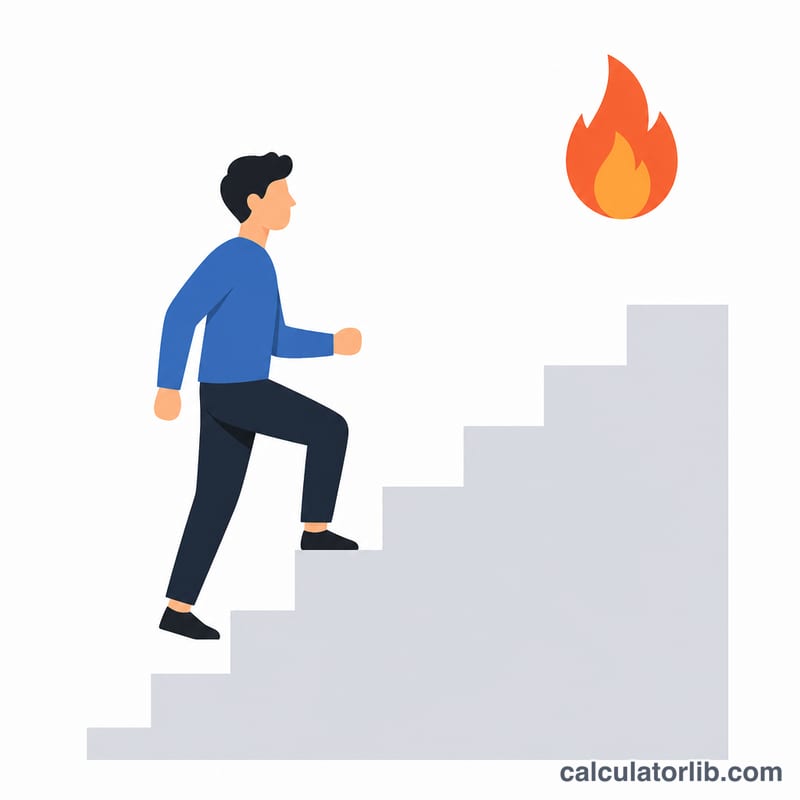
Enter your body weight in kilograms, the number of minutes you spent climbing, and choose an intensity. General stair climbing uses a MET of about 6.8, while a slow climbing pace is closer to 4.5, descending is about 3.5 and a fast, vigorous climb can reach 15.0. The tool returns total calories burned plus a per-minute breakdown.
The Formula Explained
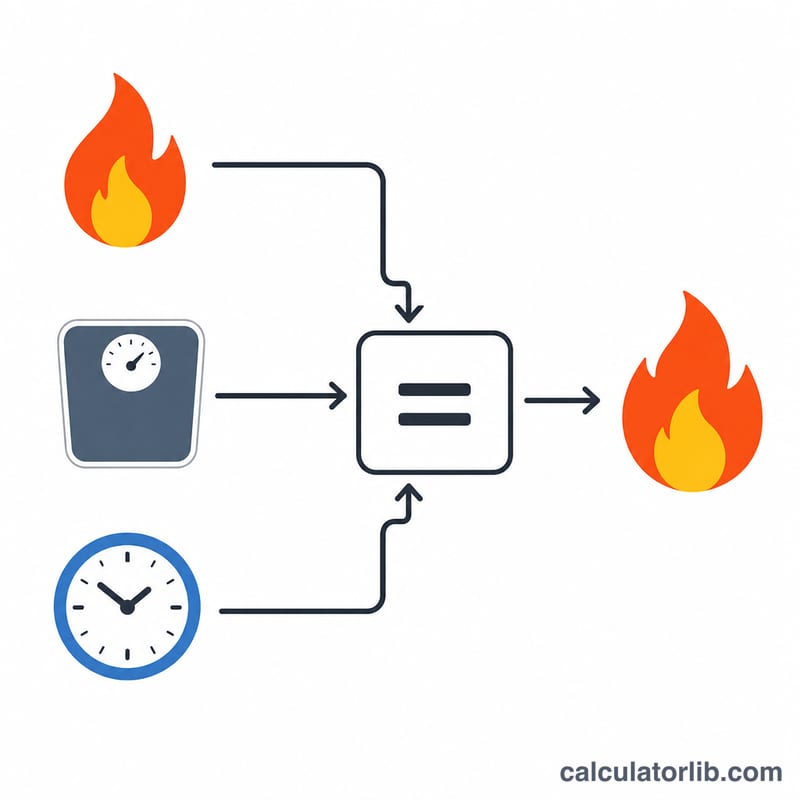
The MET method estimates energy use as:
$$\text{Calories} = \frac{\text{MET} \times 3.5 \times \text{weight(kg)}}{200} \times \text{minutes}$$
The constant 3.5 ml/kg/min is the resting oxygen consumption (1 MET), and dividing by 200 converts oxygen use into kilocalories. Multiplying by the MET value scales it to your activity intensity.
Worked Example
A 70 kg person climbs stairs for 10 minutes at a general pace (MET 6.8):
$$\text{Calories} = \frac{6.8 \times 3.5 \times 70}{200} \times 10 = 83.3 \text{ kcal}$$ or about 8.3 kcal per minute.
MET Values for Stair Climbing and Related Activities
A MET (metabolic equivalent of task) expresses the energy cost of an activity as a multiple of resting metabolism, where 1 MET is conventionally defined as an oxygen uptake of 3.5 mL per kilogram of body mass per minute. The values below are drawn from the Compendium of Physical Activities (Ainsworth et al.), the reference list used in most research and in this calculator. The kcal/min column is computed for a 70 kg adult with the same formula the calculator uses:
$$\text{kcal/min} = \frac{\text{MET} \times 3.5 \times 70}{200}$$| Activity | Compendium code | MET | kcal/min (70 kg) |
|---|---|---|---|
| Walking down stairs | 17070 | 3.5 | 4.3 |
| Walking up stairs, slow pace | 17131 | 4.5 | 5.5 |
| Stair climbing, general (also climbing a ladder) | 17133 | 6.8 | 8.3 |
| Climbing stairs carrying a moderate load (roughly 11–22 kg / 25–50 lb) | — | 8.0–9.0 | 9.8–11.0 |
| Stair-treadmill / stepper machine, general effort | — | 9.0 | 11.0 |
| Running up stairs, fast/vigorous | 12150 | 15.0 | 18.4 |
Notes on reading this table:
- Compendium codes are shown only where the entry maps to a single well-established code; dashes mark activities whose listing is split across several load or speed categories.
- Heavier loads push the cost higher still — the Compendium lists carrying progressively heavier loads upstairs at rising MET values, so a very heavy load can exceed 10 METs.
- These are population averages for healthy adults, not individual measurements. They were derived largely from adults of average body composition and do not account for children, very low or very high body mass, or clinical conditions.
- This calculator's selector offers 3.5, 4.5, 6.8 and 15.0 METs as representative descending, slow climbing, general and vigorous intensities.
Interpreting Your Result
The number is gross energy expenditure, not extra energy. The MET formula counts total energy used during the activity, including the roughly 1 MET your body would have spent simply resting over the same minutes. If you want the net cost — the energy attributable to the stair climbing itself — subtract that resting baseline:
$$\text{Net kcal} \approx \frac{(\text{MET} - 1) \times 3.5 \times \text{Weight (kg)}}{200} \times \text{Duration (min)}$$For a 70 kg person climbing for 10 minutes at 6.8 METs, the gross estimate is 83.3 kcal, while the net figure is:
$$\frac{(6.8 - 1) \times 3.5 \times 70}{200} \times 10 = \frac{1421}{200} \times 10 = 71.05 \approx 71\ \text{kcal}$$The gap is about 12 kcal here, and it grows with body weight and duration. Gross values are the convention in activity logs and on cardio machines, so the calculator's output is directly comparable to those — just be aware you are not seeing a pure "bonus" above doing nothing.
A useful rate of thumb. At 6.8 METs the formula reduces to a fixed rate per kilogram per minute, since 6.8 × 3.5 ÷ 200 = 0.119. So general stair climbing costs roughly 0.119 kcal per kilogram of body mass per minute — about 6 kcal/min for a 50 kg person and 12 kcal/min for a 100 kg person. At 4.5 METs the rate is 0.07875 kcal/kg/min, and at 15.0 METs it is 0.2625 kcal/kg/min.
Putting kilocalories in perspective. A commonly cited energy equivalent is approximately 7,700 kcal per kilogram of body fat (about 3,500 kcal per pound). That figure is a simple thermodynamic approximation of stored adipose tissue, not a prediction of how a body will respond over time: real changes in body mass also involve appetite, fluid balance, non-exercise movement and adaptations in resting metabolism, which is why static arithmetic tends to overstate long-run effects.
What the MET model deliberately ignores. A single MET value stands for steady, continuous effort at a representative pace. It does not capture:
- Rest and interruptions — if you entered 20 minutes but spent 6 of them standing on landings, the true cost is lower. Enter only active minutes.
- Step geometry and technique — riser height, step depth, skipping steps, and whether you pull on a handrail all change the mechanical work per flight.
- Load carried — a backpack or carried object raises the effective MET, as the Compendium's separate load categories show.
- Fitness and body composition — a trained climber moves more economically, while the MET definition's fixed 3.5 mL/kg/min resting baseline fits average adults less well at very high or very low body-fat levels.
- Environment — altitude, heat, humidity and stairwell ventilation all shift the physiological cost of the same pace.
- Descent — going down stairs is eccentric work and costs roughly 3.5 METs, about half the cost of going up.
Treat the output as an estimate with a band around it. It is a population-average calculation, not a measurement of your metabolism. Individual energy cost for the same activity commonly varies by on the order of ±10–20% from the compendium average, so the result is best read as an approximate magnitude — "about 80 kcal" rather than "exactly 83 kcal" — and is most reliable when used to compare your own sessions with each other, where the same assumptions apply on both sides.
This section is general information for interpreting a calculation, not medical or professional advice. For guidance about your own health, activity or energy needs, consult a qualified professional.
FAQ
Is stair climbing good exercise? Yes — it burns calories efficiently and builds lower-body strength and cardiovascular fitness in a short time.
How accurate is this estimate? MET-based figures are population averages. Individual fitness, technique and body composition can shift the real number by 10–20%.
Which MET should I pick? Use 6.8 for a typical steady climb, 4.5 for slow climbing, 3.5 for going down stairs, and 15.0 only for sustained fast climbing.