
What this calculator does
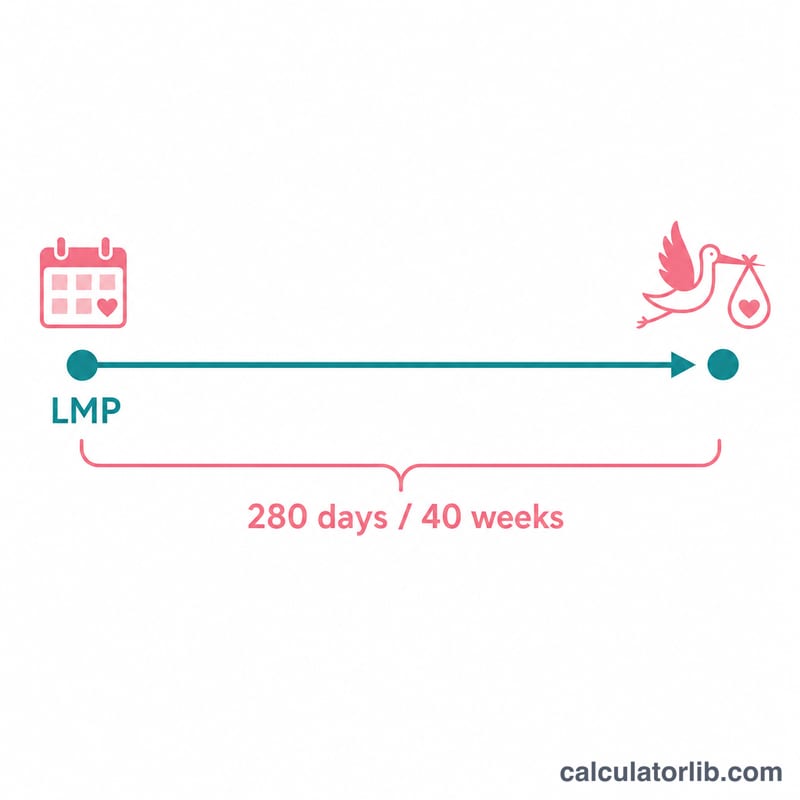
This tool estimates a pregnancy due date — the estimated date of delivery (EDD) — from the first day of the woman's last menstrual period (LMP). It adds exactly 280 days (40 weeks) to the LMP date, which is the standard method used internationally and is equivalent to Naegele's rule. Because the calculation uses ordinary Gregorian calendar arithmetic, it works the same way in every country and locale; no region-specific rules apply.
How to use it
Enter the year, month and day of the first day of your last menstrual period. The calculator treats this as gestational week 0, day 0, adds 280 days while correctly handling month boundaries and leap years, and returns the estimated due date along with the weekday.
The formula explained
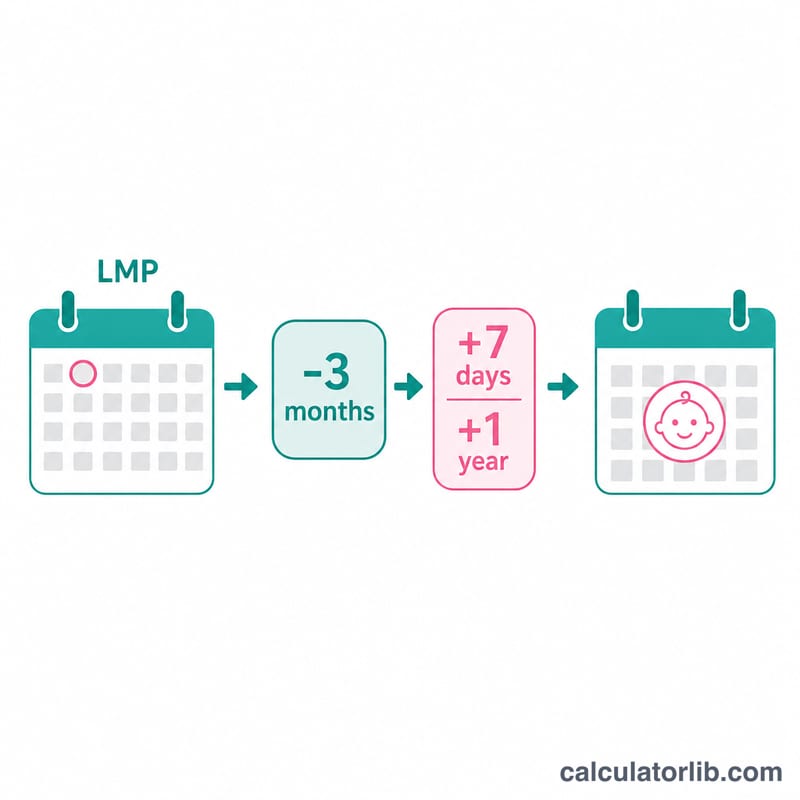
The core rule is simply $$\text{Due Date} = \text{LMP}\left(\text{Year},\ \text{Month},\ \text{Day}\right) + 280\ \text{days}$$ Forty weeks of gestation is measured from the LMP rather than from conception, because the LMP is an observable date while ovulation is not. The method assumes a typical 28-day cycle with ovulation around day 14. Naegele's rule gives the same answer using calendar shorthand: add one year, subtract three months, then add seven days.
Worked example
Suppose the LMP is 15 June 2024. Adding 280 days carries through the rest of June, July, August, September, October, November and December of 2024, then January and February of 2025 (28 days, since 2025 is not a leap year), landing on 22 March 2025. Checking with Naegele's rule: \(\text{2024-06-15} + 1\ \text{year} = \text{2025-06-15}\); minus 3 months \(= \text{2025-03-15}\); plus 7 days \(= \text{2025-03-22}\). Both methods agree.
FAQ
Is the due date exact? No. Only about 4% of babies arrive on their estimated due date; it is a planning estimate based on a regular 28-day cycle.
What if my cycle isn't 28 days? The LMP method may be off by several days for longer or shorter cycles. An ultrasound dating scan is more accurate.
Does this work for IVF or known conception dates? The LMP method is a rough estimate only. If you know your conception or ovulation date, that should be dated differently. Always confirm with your healthcare provider.