What Is the Swimming Calorie Calculator?
Swimming is one of the most effective full-body workouts, engaging nearly every major muscle group while being gentle on the joints. This calculator estimates how many calories you burn in the pool based on the stroke you swim, your body weight, and how long you swim. It uses the standard MET (Metabolic Equivalent of Task) method recognized in exercise science, so the results are comparable across activities.
How to Use It
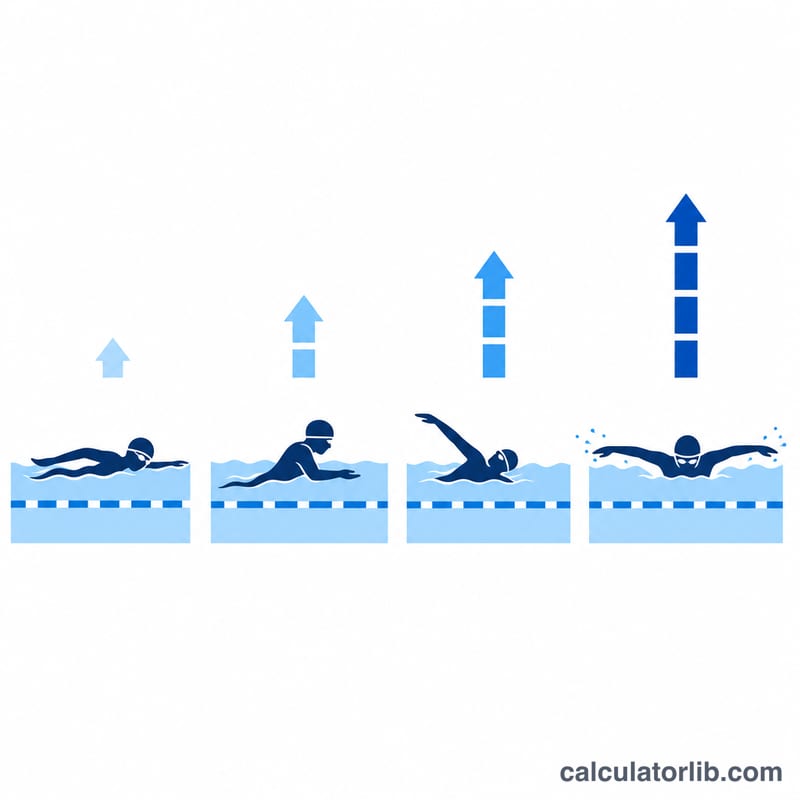
Choose your swimming stroke or intensity from the dropdown — each option carries a published MET value (a leisurely swim is about 6.0 MET, vigorous freestyle around 9.8, and butterfly around 13.8). Enter your body weight in kilograms and the number of minutes you swam. The calculator returns your total calories burned plus your average burn rate per minute.
The Formula Explained
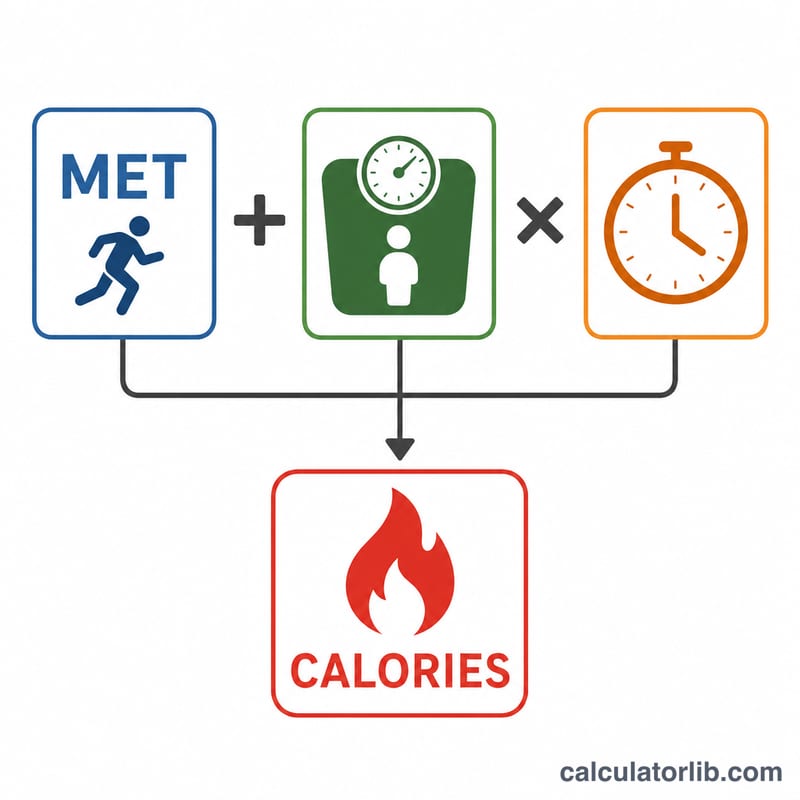
The calculation is: $$\text{Calories} = \frac{\text{MET} \times 3.5 \times \text{weight (kg)}}{200} \times \text{minutes}$$. One MET equals an oxygen consumption of roughly 3.5 ml per kg of body weight per minute at rest. Multiplying by your weight and time, then dividing by 200, converts oxygen use into kilocalories. A higher-intensity stroke has a higher MET, so it burns more calories for the same time spent swimming.
Worked Example
Suppose you weigh 70 kg and swim moderate freestyle (5.8 MET) for 30 minutes. $$\text{Calories} = 5.8 \times 3.5 \times 70 \div 200 \times 30 = 213.15 \text{ kcal}$$ That's about \(7.1\) kcal per minute.
Swimming MET Values by Stroke and Intensity
A MET (metabolic equivalent of task) expresses exercise intensity as a multiple of resting energy use. The values below are approximate figures from the 2024 Adult Compendium of Physical Activities, a widely used US-based research reference. Sources and calculators round and group them differently.
| Activity | Approx. MET | Intensity note |
|---|---|---|
| Swimming, leisurely, not lap swimming | 6.0 | General recreational swimming with frequent pauses |
| Backstroke, recreational | 4.8 | Easy pace, general effort |
| Backstroke, laps | 9.5 | Continuous lap swimming at a steady, hard effort |
| Breaststroke | 10.3 | Lap swimming at a training effort |
| Freestyle (front crawl), light to moderate | 5.8 | Slow to moderate continuous laps |
| Freestyle (front crawl), vigorous | 9.8 | Fast, sustained laps |
| Butterfly | 13.8 | Highest-demand stroke, usually sustained only briefly |
| Treading water, moderate effort | 3.5 | Gentle, general effort |
| Treading water, fast and vigorous | 9.8 | Hard effort, for example with high body lift |
Caveat: MET values vary by source, edition of the Compendium and calculator option. This calculator offers presets (4.8, 5.3, 5.8, 6.0, 9.5, 9.8, 10.3 and 13.8), so its figures will not exactly match every table. Choose the preset closest to your actual effort, and treat the result as an estimate.
Calories Burned by Stroke, Body Weight and Duration
For 30 minutes, the formula \(\text{Calories} = \frac{ \text{MET} \times 3.5 \times \text{kg}}{200} \times \text{minutes}\) simplifies to \(\text{MET} \times \text{kg} \times 0.525\). For example, 9.8 MET at 60 kg gives \(\frac{9.8 \times 3.5 \times 60}{200} \times 30 = 308.7\) kcal.
| Effort (MET) | 60 kg | 70 kg | 85 kg |
|---|---|---|---|
| Leisurely swimming (6.0) | 189 kcal | ≈221 kcal | ≈268 kcal |
| Moderate freestyle (5.8) | ≈183 kcal | ≈213 kcal | ≈259 kcal |
| Vigorous freestyle (9.8) | 309 kcal | ≈360 kcal | ≈437 kcal |
| Butterfly (13.8) | ≈435 kcal | ≈507 kcal | ≈616 kcal |
Figures are rounded to the nearest kcal. Calories scale linearly with time, so 60 minutes doubles each value. They scale with body weight too: a heavier swimmer at the same MET burns proportionally more.
Interpreting Your Result
The result is a gross estimate. It includes the energy your body would use at rest during those minutes (1 MET is about 1 kcal per kg per hour), not just the extra energy from swimming. The factor 3.5 is the oxygen use at 1 MET (3.5 mL per kg per minute), and dividing by 200 converts that to kilocalories per minute, at roughly 5 kcal per litre of oxygen.
Intensity categories. By the common convention used in public-health guidance, moderate-intensity activity is 3.0–5.9 METs and vigorous activity is 6.0 METs or more. Most lap swimming therefore counts as vigorous, while gentle recreational swimming and easy treading water fall in the moderate range.
Comparison with other activities. Compendium values for comparison are about 4.8 for brisk walking (around 3.5 mph), 8.5 for running at 5 mph, and 9.3 for running at 6 mph. Swimming at 9.8 MET is therefore similar in energy cost to running at a moderate-to-fast pace, though perceived effort and joint loading differ.
Why real-world results differ:
- Technique efficiency: skilled swimmers move farther for the same energy, so they may burn fewer calories per lap than beginners, who tend to burn more at the same speed.
- Water temperature: cooler water can raise energy use through heat loss, while warm water may lower it.
- Rest intervals: time spent hanging on the wall lowers the average MET. Entering the full session time as continuous swimming overestimates the burn.
- Individual differences: body composition, age, drag and swim speed all shift true energy use.
Treat the number as a rough guide, not a precise measurement. This is general information, not medical or professional advice.
FAQ
Are these numbers exact? No — MET values are population averages. Your real burn depends on fitness, technique, water temperature and effort, but the estimate is a solid planning figure.
How do I convert pounds to kilograms? Divide your weight in pounds by 2.205. For example, \(154 \text{ lb} \div 2.205 \approx 70 \text{ kg}\).
Why does butterfly burn the most? Butterfly demands powerful, continuous whole-body movement, giving it the highest MET value of the common strokes at around 13.8.