

What Is a Bowling Average?
In cricket, a bowler's average is one of the key statistics used to measure performance. It tells you how many runs a bowler concedes for every wicket they take. A lower bowling average is better, because it means the bowler is taking wickets while giving away fewer runs. Elite Test bowlers typically maintain averages in the low 20s.
How to Use This Calculator
Enter the total number of runs the bowler has conceded across the innings, matches, or career you are measuring, then enter the total number of wickets they have taken. Click calculate and the tool instantly divides runs by wickets to give the bowling average.
The Formula Explained
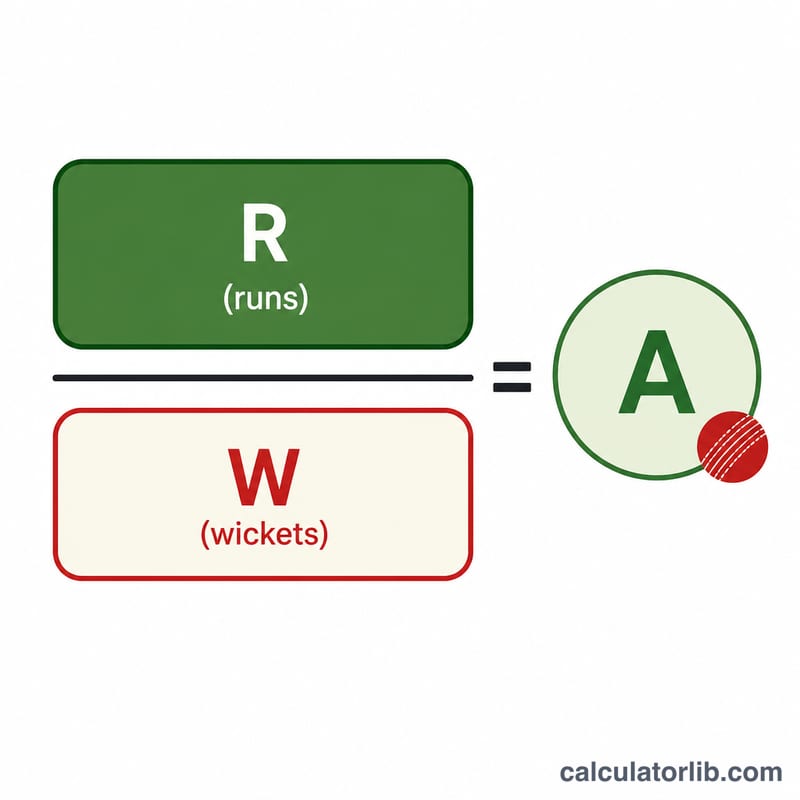
The formula is simply:
Bowling Average = Runs Conceded ÷ Wickets Taken
Runs conceded includes all runs scored off the bowler (including extras such as wides and no-balls in most scoring systems). Wickets taken counts only dismissals credited to the bowler. If a bowler has taken zero wickets, an average cannot be calculated (division by zero), so the result is shown as 0.
Worked Example
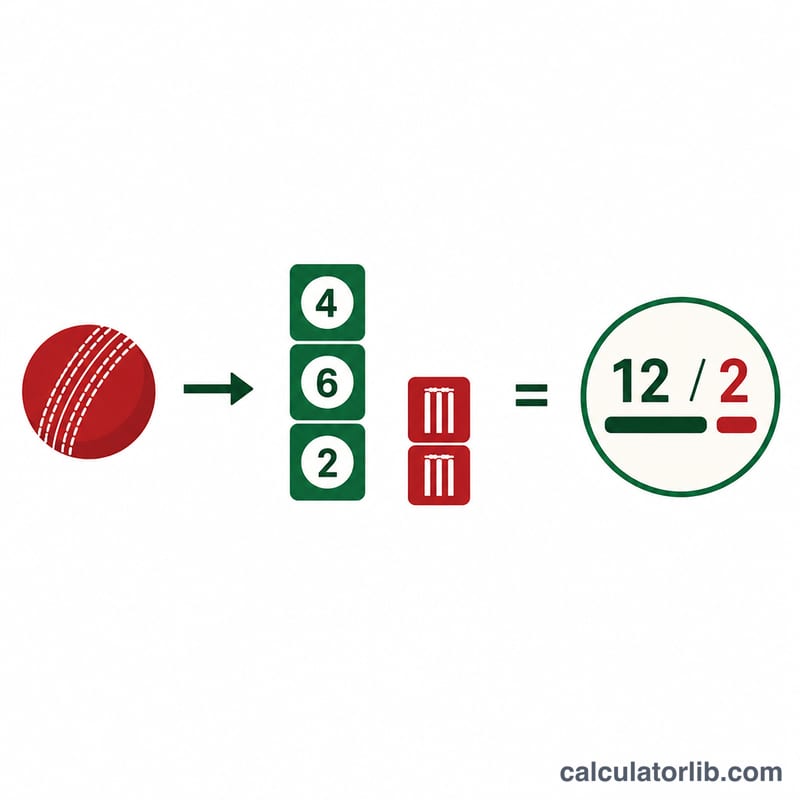
Suppose a bowler has conceded 300 runs and taken 20 wickets. Their bowling average is 300 ÷ 20 = 15.00. This is an outstanding average, indicating the bowler is taking a wicket roughly every 15 runs.
Key Cricket Bowling Terms
Bowling statistics measure how effective a bowler is at dismissing batters and restricting runs. The three headline numbers — average, strike rate and economy rate — each describe a different aspect of performance, so they are best read together rather than in isolation.
- Bowling average — the number of runs a bowler concedes for each wicket they take, calculated as \(\text{Average} = \dfrac{\text{Runs Conceded}}{\text{Wickets Taken}}\). It reflects the overall cost of a wicket, combining both how many runs are leaked and how often a batter is dismissed. A lower average is better.
- Bowling strike rate — the average number of balls bowled per wicket taken, calculated as \(\text{Strike Rate} = \dfrac{\text{Balls Bowled}}{\text{Wickets Taken}}\). It measures how quickly a bowler takes wickets, regardless of how many runs are conceded. Especially valued in Test cricket, where taking 20 wickets is essential. A lower strike rate is better.
- Economy rate — the average number of runs conceded per over (six legal balls), calculated as \(\text{Economy} = \dfrac{\text{Runs Conceded}}{\text{Overs Bowled}}\). It measures how miserly a bowler is, regardless of whether wickets fall. Crucial in limited-overs formats such as ODIs and T20s. A lower economy rate is better.
- Runs conceded — the total number of runs scored off a bowler's deliveries, including boundaries, runs taken, and extras such as wides and no-balls credited to the bowler. This is the numerator in both the average and economy calculations.
- Wickets taken — the number of batters dismissed and credited to the bowler (for example bowled, caught, lbw, stumped or hit wicket). Run-outs are generally not credited to the bowler. This is the denominator in both the average and strike rate calculations.
How they differ: the average blends both run-economy and wicket-taking into a single figure, while the strike rate isolates wicket-taking speed (balls per wicket) and the economy rate isolates run restriction (runs per over). The three are linked: average equals strike rate multiplied by economy rate divided by six, i.e. \(\text{Average} = \dfrac{\text{Strike Rate} \times \text{Economy}}{6}\). A bowler can have a strong economy but a weak average if they rarely take wickets, or a fine strike rate but a poor average if they concede many runs while doing so.
FAQ
Is a low or high bowling average better? A low average is better — it means fewer runs are conceded per wicket.
What is a good bowling average? In Test cricket, an average below 25 is considered very good and below 22 is world-class.
Does this include extras? It uses whatever total runs you enter. Official figures usually include extras conceded off the bowler.