
What Is a Cricket Batting Average?
A batting average is the single most widely used statistic to measure a batsman's run-scoring ability in cricket. It tells you, on average, how many runs a player scores before getting out. The higher the average, the more reliable and productive the batsman. A Test average above 50 is considered excellent, while 40+ is very good.
How to Use This Calculator
Enter the player's total runs scored across all the innings you want to measure, then enter the number of times the player was out (dismissals). Not-out innings do not count as a dismissal, so they are excluded from the divisor. Click calculate and you'll get the batting average rounded to two decimal places.
The Formula Explained
The formula is simple:
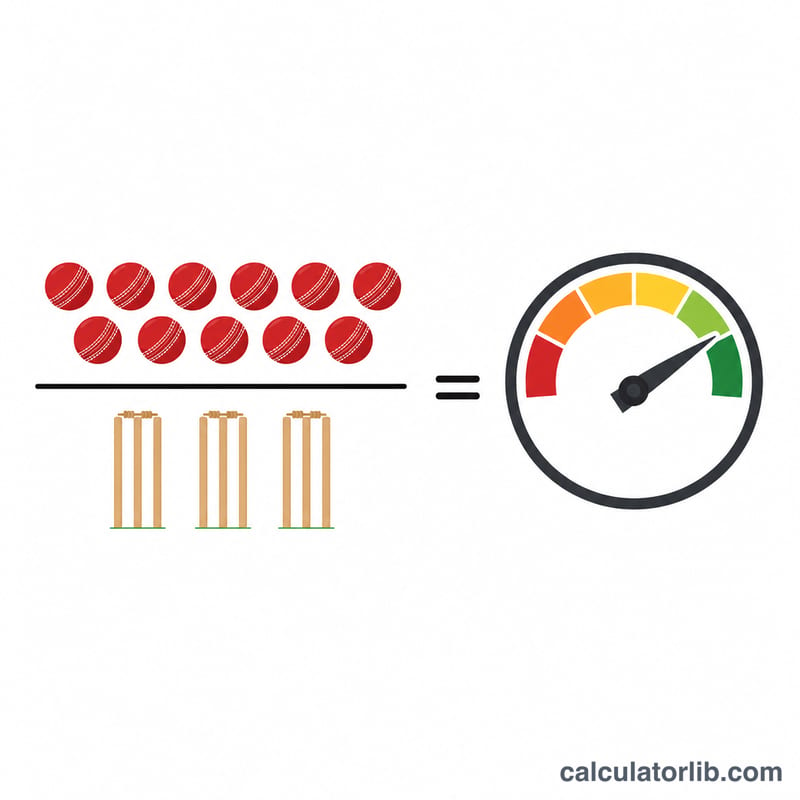
$$\text{Batting Average} = \frac{\text{Total Runs}}{\text{Number of Times Out}}$$
Crucially, the denominator is the number of dismissals, not the number of innings played. Innings where a batsman remains not out still add runs to the total but do not increase the times-out count, which is why consistent not-out batsmen often have inflated averages.
Worked Example
Suppose a player scored 850 runs and was dismissed 20 times. Their batting average is \(850 \div 20 = \textbf{42.50}\). If the same player scored those 850 runs but was out only 17 times (3 not-outs), the average rises to \(850 \div 17 = \textbf{50.00}\).
FAQ
Do not-out innings count? No. Not-out innings add to total runs but are not counted as a dismissal, so they only count toward the runs total.
What if a batsman has never been out? The average is mathematically undefined (division by zero). This calculator returns 0 in that case; conventionally a player's runs are simply listed without an average.
What is a good batting average? In Test cricket, anything above 40 is strong and above 50 is elite. In limited-overs formats, averages are read alongside strike rate.