What is the NIH Stroke Scale (NIHSS)?
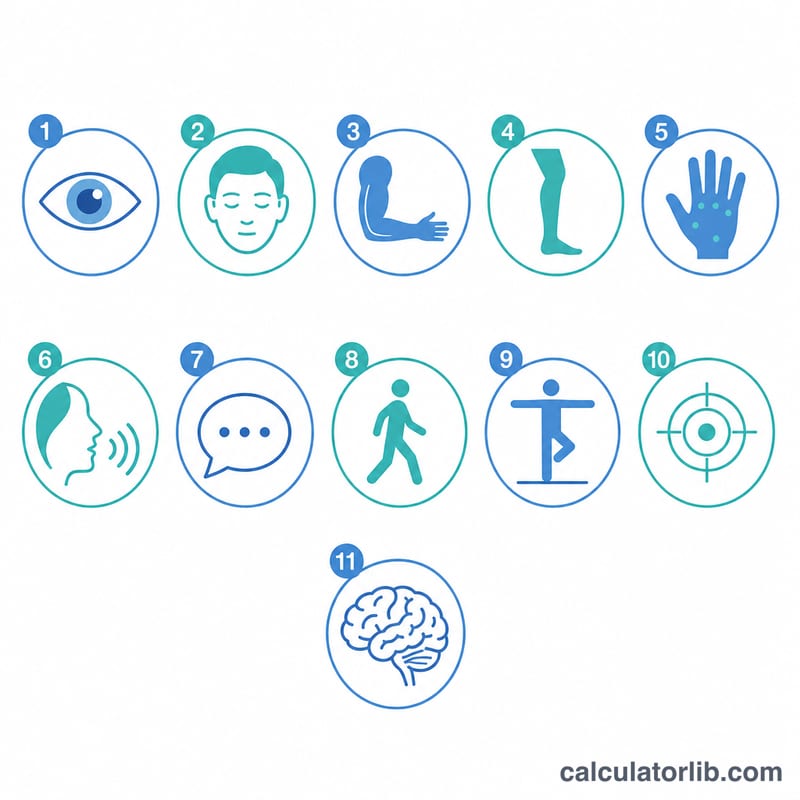
The National Institutes of Health Stroke Scale (NIHSS) is a standardized, 11-item clinical tool used worldwide to quantify the neurological impairment caused by an acute stroke. Each item assesses a specific function — consciousness, gaze, vision, facial and limb movement, sensation, language, speech, and attention. The scores are added together to give a single number from 0 (no deficit) to 42 (severe stroke). This calculator is a clinical education and documentation aid; it does not replace examination by a trained clinician.
How to use this calculator
Examine the patient and select the appropriate score for each of the 11 items from the dropdown menus. Score motor arm and motor leg separately for each side: 5a left arm, 5b right arm, 6a left leg, 6b right leg. Submit the form and the calculator sums every item to produce the total NIHSS score and a severity category.
The formula explained
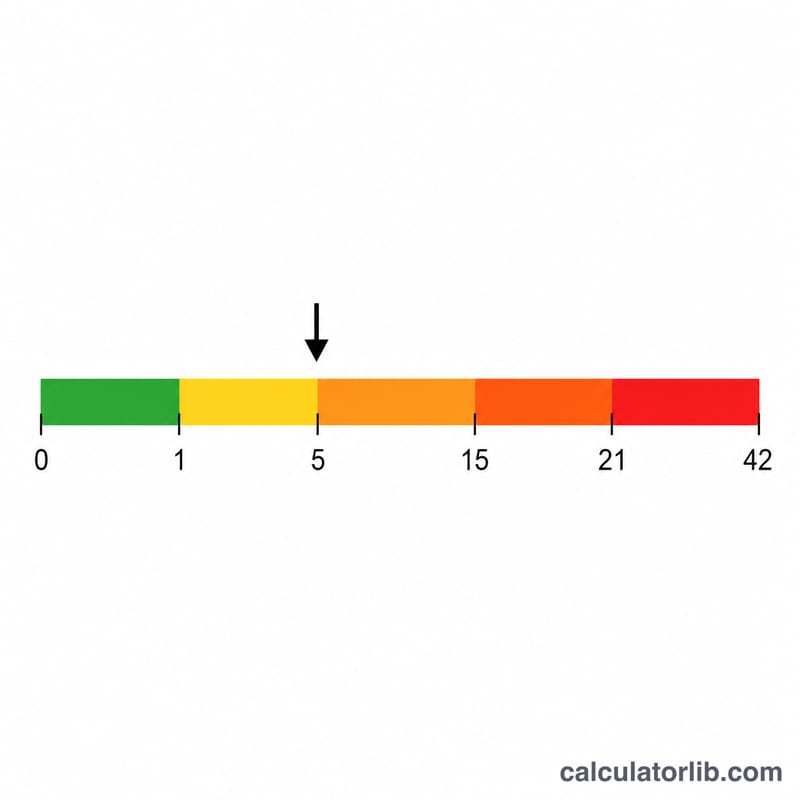
The calculation is a straightforward addition: $$\text{NIHSS} = \text{1a} + \text{1b} + \text{1c} + \text{2} + \text{3} + \text{4} + \text{5a} + \text{5b} + \text{6a} + \text{6b} + \text{7} + \text{8} + \text{9} + \text{10} + \text{11}$$ There is no weighting — each item simply contributes its raw point value. Common severity bands are: 0 = no stroke symptoms, 1–4 = minor, 5–15 = moderate, 16–20 = moderate to severe, and 21–42 = severe stroke.
Worked example
Suppose a patient scores: LOC 1, LOC questions 1, LOC commands 0, gaze 1, visual fields 1, facial palsy 2, left arm 3, right arm 0, left leg 2, right leg 0, ataxia 0, sensory 1, language 1, dysarthria 1, neglect 1. The total is $$1+1+0+1+1+2+3+0+2+0+0+1+1+1+1 = 15$$ placing the patient in the moderate stroke category.
NIHSS Items and Scoring Options
The National Institutes of Health Stroke Scale (NIHSS) is a 15-line bedside examination built from 11 items. Each item is scored from 0 (normal) upward, and the item scores are added together.
| Item | Name | Max points | Scoring options (brief) |
|---|---|---|---|
| 1a | Level of consciousness | 3 | 0 alert; 1 arousable with minor stimulation; 2 needs repeated or strong stimulation; 3 reflex responses only or unresponsive |
| 1b | LOC questions | 2 | Patient states the month and their age. 0 both correct; 1 one correct; 2 neither correct |
| 1c | LOC commands | 2 | Open/close eyes and grip/release the non-paretic hand. 0 both correct; 1 one correct; 2 neither correct |
| 2 | Best gaze | 2 | 0 normal; 1 partial gaze palsy; 2 forced deviation or total gaze paresis |
| 3 | Visual fields | 3 | 0 no visual loss; 1 partial hemianopia; 2 complete hemianopia; 3 bilateral hemianopia or blindness |
| 4 | Facial palsy | 3 | 0 normal; 1 minor paralysis; 2 partial paralysis; 3 complete paralysis of one or both sides |
| 5 | Motor arm (scored for left and right) | 4 each side (8 total) | 0 no drift; 1 drift before 10 seconds; 2 some effort against gravity; 3 no effort against gravity; 4 no movement |
| 6 | Motor leg (scored for left and right) | 4 each side (8 total) | 0 no drift; 1 drift before 5 seconds; 2 some effort against gravity; 3 no effort against gravity; 4 no movement |
| 7 | Limb ataxia | 2 | 0 absent; 1 present in one limb; 2 present in two limbs |
| 8 | Sensory | 2 | 0 normal; 1 mild to moderate sensory loss; 2 severe or total sensory loss |
| 9 | Best language | 3 | 0 no aphasia; 1 mild to moderate aphasia; 2 severe aphasia; 3 mute or global aphasia |
| 10 | Dysarthria | 2 | 0 normal articulation; 1 mild to moderate slurring; 2 severe, near unintelligible or mute |
| 11 | Extinction / inattention | 2 | 0 none; 1 inattention or extinction in one sensory modality; 2 profound hemi-inattention or more than one modality |
Note on item numbering and the maximum: the standard scale scores motor arm and motor leg separately for the left and right sides, giving 15 scored lines. The maximum of 42 depends on that: 3 + 2 + 2 + 2 + 3 + 3 + (4 + 4) + (4 + 4) + 2 + 2 + 3 + 2 + 2 = 42. The form on this page has all 15 lines (5a, 5b, 6a and 6b included), so its maximum is the full 42.
Items that cannot be tested (for example, a limb with amputation or joint fusion) are recorded as untestable (UN) under the official NIHSS guidance. In this calculator choose UN for such an item: it is not added to the total and is listed under the result. Follow the official scoring instructions and training materials.
NIHSS Severity Categories
| Total score | Category |
|---|---|
| 0 | No stroke symptoms |
| 1–4 | Minor stroke |
| 5–15 | Moderate stroke |
| 16–20 | Moderate to severe stroke |
| 21–42 | Severe stroke |
These bands are conventional groupings used in clinical practice and research. The cut-offs and labels may vary slightly between sources, so treat them as general guides rather than fixed definitions.
Interpreting Your NIHSS Score
The total score reflects the degree of neurological impairment: the higher the score, the greater the impairment. A score of 0 means no measurable deficit on this scale.
- Severity and outcome: in published studies, NIHSS scores are associated with stroke severity and with likely outcome, particularly when measured early.
- Baseline and change over time: the scale is used to document baseline severity and to track improvement or worsening through repeated assessments.
- Posterior circulation strokes: the NIHSS may under-represent these strokes, because symptoms such as dizziness, imbalance, or vision and coordination problems are weighted lightly. A low score does not rule out a serious stroke.
Limitations:
- Scores can differ between examiners (inter-rater variability), even with trained raters.
- The NIHSS is not a diagnosis. Imaging and clinical evaluation are needed to diagnose a stroke and its cause.
- The score alone is not a treatment decision. Treatment depends on many other factors, such as timing, imaging, and medical history.
- Language and motor items carry more weight than some other deficits. Left- and right-hemisphere strokes of similar size can therefore score differently.
Disclaimer: this is general educational information, not medical advice. The NIHSS should be performed and interpreted by trained healthcare professionals, and all clinical decisions belong to them. If you suspect a stroke, call your local emergency number immediately.
FAQ
What is the maximum NIHSS score? The maximum is 42, reflecting a very severe stroke.
What score indicates a severe stroke? Scores of 21 and above are generally classified as severe.
Can this replace clinical judgment? No. The NIHSS supports assessment and communication but must be applied by appropriately trained healthcare professionals alongside imaging and clinical context.