
What is the CGPA Calculator?
The Cumulative Grade Point Average (CGPA) calculator finds your overall academic standing on a 10-point scale used by many universities and boards (such as Indian universities and CBSE). Instead of treating every subject equally, it weights each subject's grade point by the number of credits it carries, so high-credit courses influence your CGPA more than low-credit electives.
How to use it
For each subject, enter the grade point (typically 0 to 10) and the number of credits. Leave any rows you don't need blank. The calculator multiplies each grade point by its credits, adds these products, and divides by the total credits. It also shows an approximate percentage using the popular CGPA \(\times\) 9.5 rule.
The formula explained
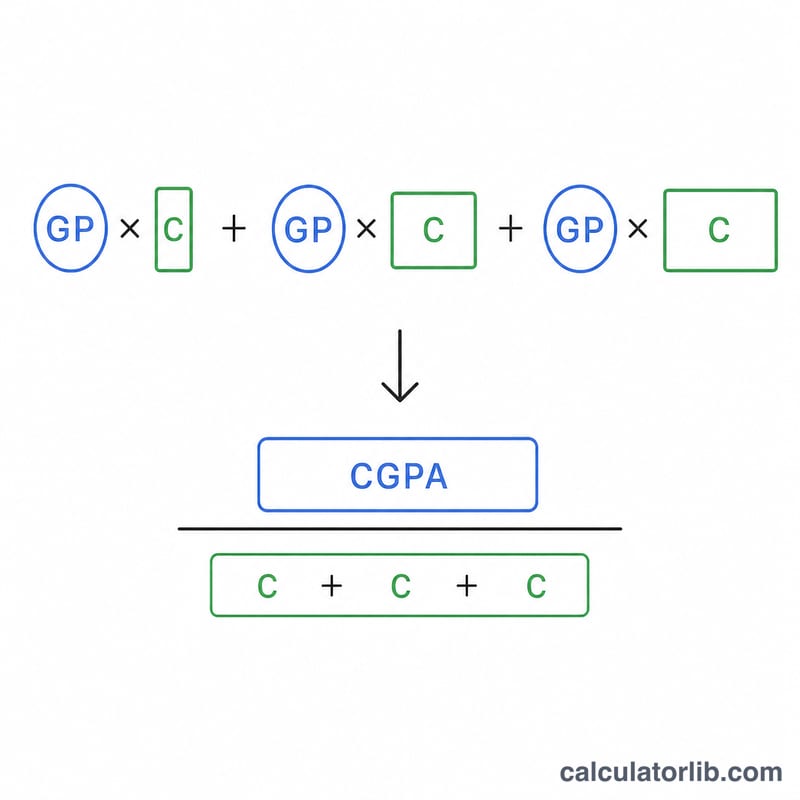
The core equation is $$\text{CGPA} = \dfrac{\sum (\text{GP}_i \times \text{C}_i)}{\sum \text{C}_i}$$ Here \(\text{GP}_i\) is the grade point earned in subject i, and \(\text{C}_i\) is the credit value of that subject. The numerator is the total weighted grade points; the denominator is the total credits. Dividing gives a credit-weighted average rather than a simple mean.
Worked example
Suppose you have three subjects: 9 grade points / 4 credits, 8 / 3 credits, and 7 / 3 credits. Weighted points = $$(9\times4) + (8\times3) + (7\times3) = 36 + 24 + 21 = 81.$$ Total credits = \(4 + 3 + 3 = 10\). CGPA = \(81 \div 10 =\) 8.1. The percentage estimate is \(8.1 \times 9.5 = 76.95\%\).
FAQ
Is CGPA the same as GPA? GPA usually refers to a single term, while CGPA is the cumulative figure across all completed terms or subjects.
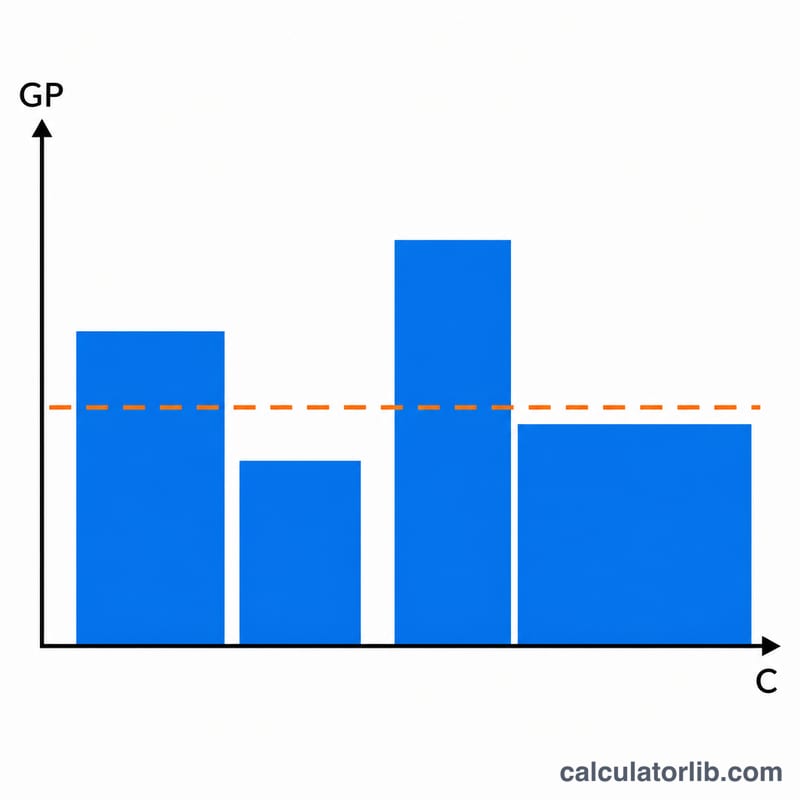
Why weight by credits? A 4-credit core course represents more work than a 1-credit lab, so weighting reflects effort and importance more fairly than a plain average.
How accurate is the percentage conversion? The \(\times 9.5\) rule is a widely used approximation (notably by CBSE). Your institution may use a different conversion, so check official guidelines for exact figures.