What Is the Epworth Sleepiness Scale?
The Epworth Sleepiness Scale (ESS) is a widely used self-administered questionnaire that measures your general level of daytime sleepiness. Developed by Dr. Murray Johns in 1991, it asks how likely you are to doze off in eight common everyday situations. It is used worldwide as a quick screening aid for excessive daytime sleepiness, which can be associated with conditions such as obstructive sleep apnea, narcolepsy, and insufficient sleep.
How to Use This Calculator
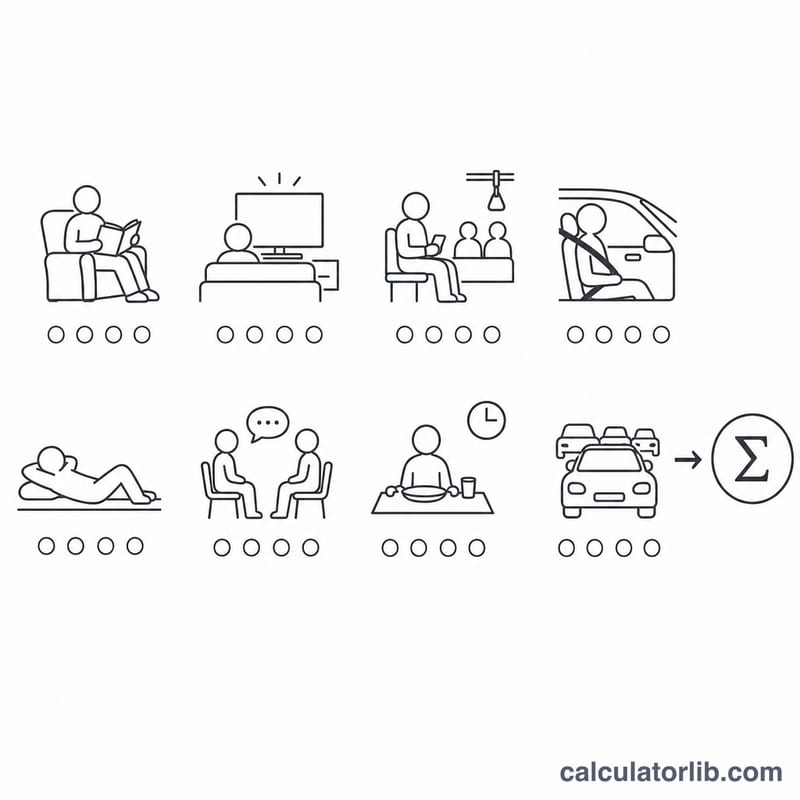
For each of the eight situations, choose the number that best describes your chance of dozing off, not just feeling tired: 0 = would never doze, 1 = slight chance, 2 = moderate chance, 3 = high chance. The calculator adds your eight answers to produce a total score between 0 and 24, then shows an interpretation band.
The Formula Explained
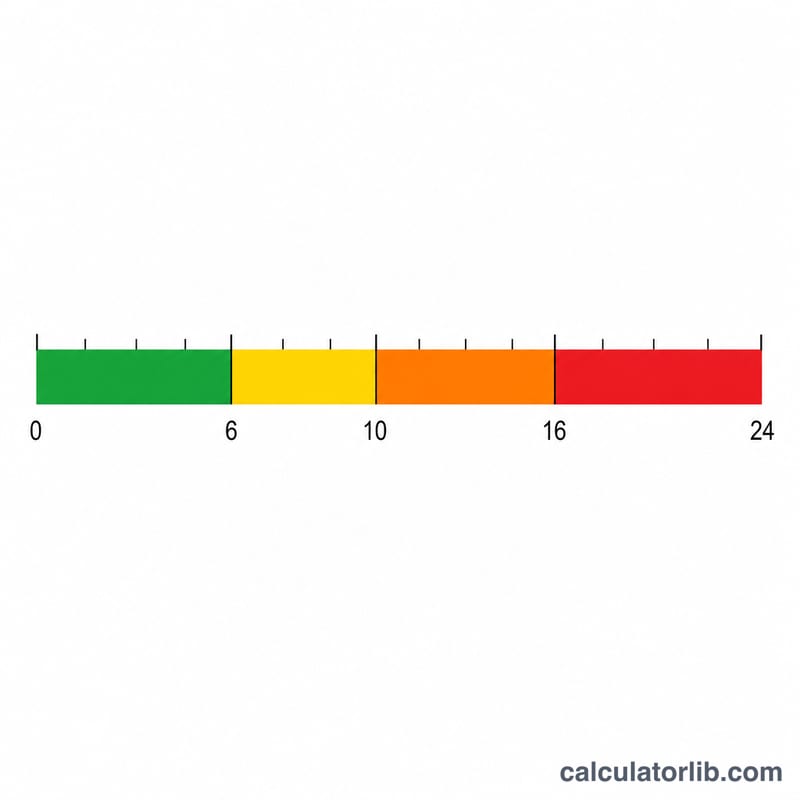
The calculation is a simple sum: $$\text{Score} = x_1 + x_2 + \dots + x_8$$ where each \(x_i\) is your 0–3 rating. Because there are eight items each capped at 3, the minimum is 0 and the maximum is 24. Common interpretation bands are: 0–5 lower normal sleepiness, 6–10 higher normal, 11–12 mild excessive, 13–15 moderate excessive, and 16–24 severe excessive daytime sleepiness.
Worked Example
Suppose you answer: reading 2, watching TV 2, sitting in public 1, car passenger 2, lying down in afternoon 3, talking 0, after lunch 2, stopped in traffic 0. The total is $$2 + 2 + 1 + 2 + 3 + 0 + 2 + 0 = 12$$ which falls in the "mild excessive daytime sleepiness" band, suggesting it may be worth discussing with a doctor.
FAQ
What score is considered normal? A score of 10 or below is generally considered within the normal range, while 11 or higher suggests excessive daytime sleepiness.
Does a high score mean I have sleep apnea? No. The ESS is only a screening tool, not a diagnosis. A high score indicates you should seek professional evaluation, which may include a sleep study.
How should I rate situations I haven't experienced recently? Estimate how you would likely respond based on your usual lifestyle, even if you haven't done some of them lately.