
What Is the Excavation Volume Calculator?
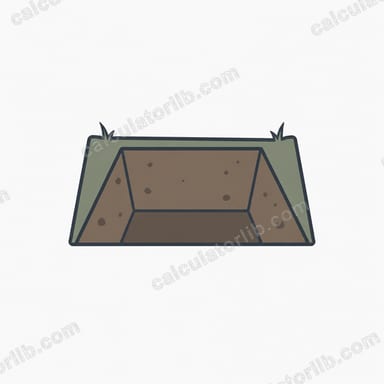
This calculator estimates how much soil or material you need to dig out for a project such as a foundation, trench, footing, pool, or pond. By entering the length, width, and depth of the excavation in feet, you instantly get the volume in cubic yards — the unit most often used by contractors and dump trucks — along with cubic feet and cubic meters.
How to Use It
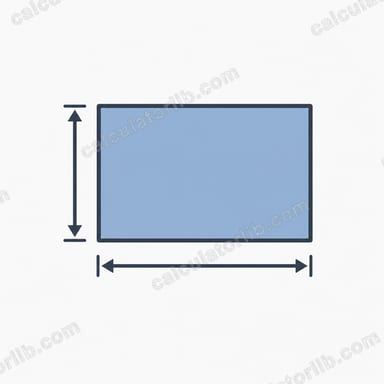
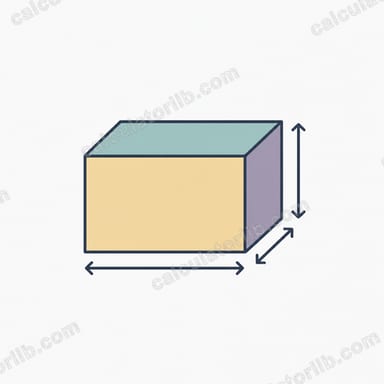
Measure the rectangular pit you plan to dig. Enter the length, width, and depth in feet. The tool multiplies the three dimensions to find the total cubic feet, then divides by 27 to convert to cubic yards. Use the cubic-yard figure when ordering removal trucks or estimating disposal costs.
The Formula Explained
Volume is length \(\times\) width \(\times\) depth. Because all three are in feet, the product is in cubic feet. A cubic yard is \(3\ \text{ft} \times 3\ \text{ft} \times 3\ \text{ft} = 27\) cubic feet, so dividing the cubic feet by 27 gives cubic yards.
$$\text{Cubic Yards} = \frac{\text{Length (ft)} \times \text{Width (ft)} \times \text{Depth (ft)}}{27}$$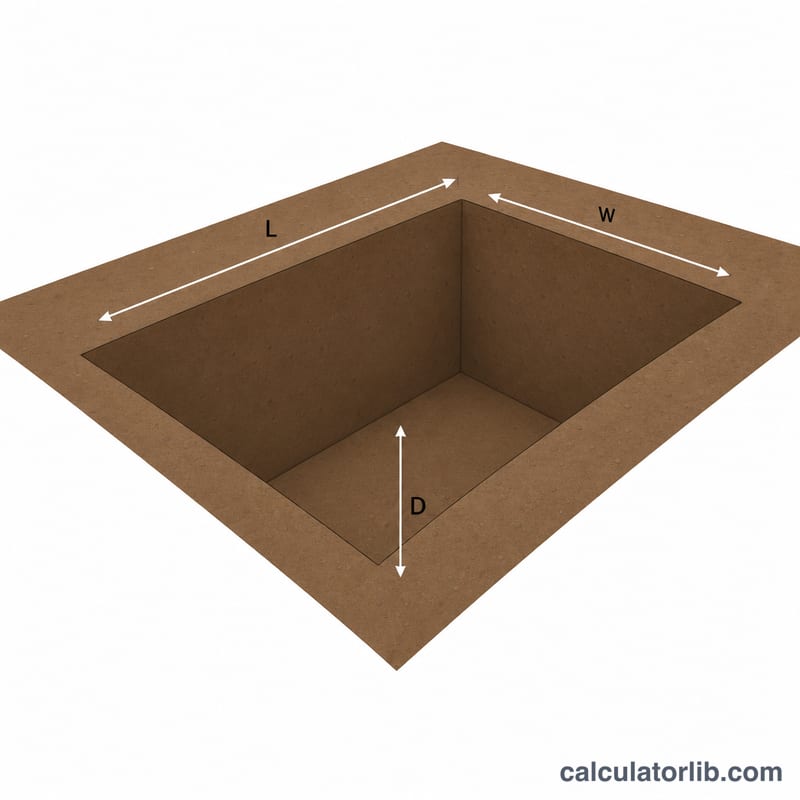
Worked Example
Suppose you dig a foundation 20 ft long, 10 ft wide, and 3 ft deep. Volume = \(20 \times 10 \times 3 = 600\) cubic feet. Cubic yards = \(600 \div 27 \approx\) 22.22 cubic yards. You would need to remove roughly 22.2 yards of soil.
$$\text{Cubic Yards} = \frac{20 \times 10 \times 3}{27} = \frac{600}{27} \approx 22.22$$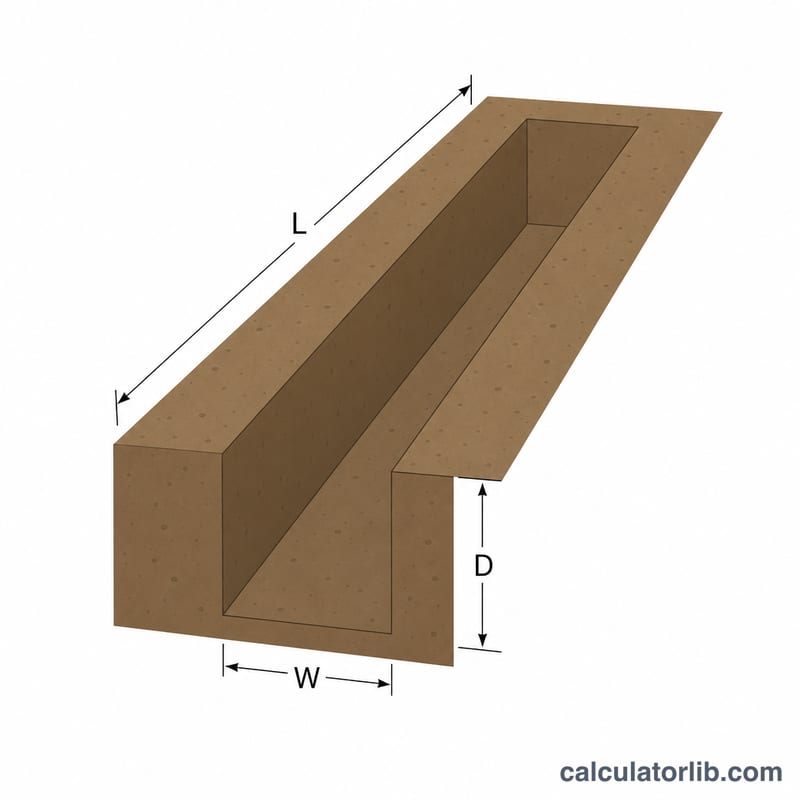
FAQ
Do I need to add for soil swell? Yes — excavated soil expands. Add 15–30% extra volume when ordering trucks to account for "bulking" of loosened earth.
Can I use inches? Convert inches to feet first (divide by 12). For example, \(18\) inches \(= 1.5\) ft.
How many cubic yards fit in a dump truck? A standard tandem dump truck holds about 10–14 cubic yards, so a 22-yard job needs two loads.