What is a Pipe Volume Calculator?
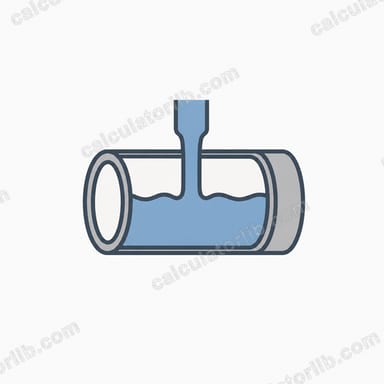
A pipe volume calculator is a tool that helps determine the internal volume of a cylindrical pipe based on its diameter and length. This calculation is essential for various applications in plumbing, construction, engineering, and fluid dynamics.
When to Use a Pipe Volume Calculator
A pipe volume calculator is useful in several scenarios:
- Plumbing installations to determine fluid capacity and flow requirements
- Engineering projects to calculate material requirements and weight considerations
- Industrial applications to estimate the amount of liquid or gas a pipe system can contain
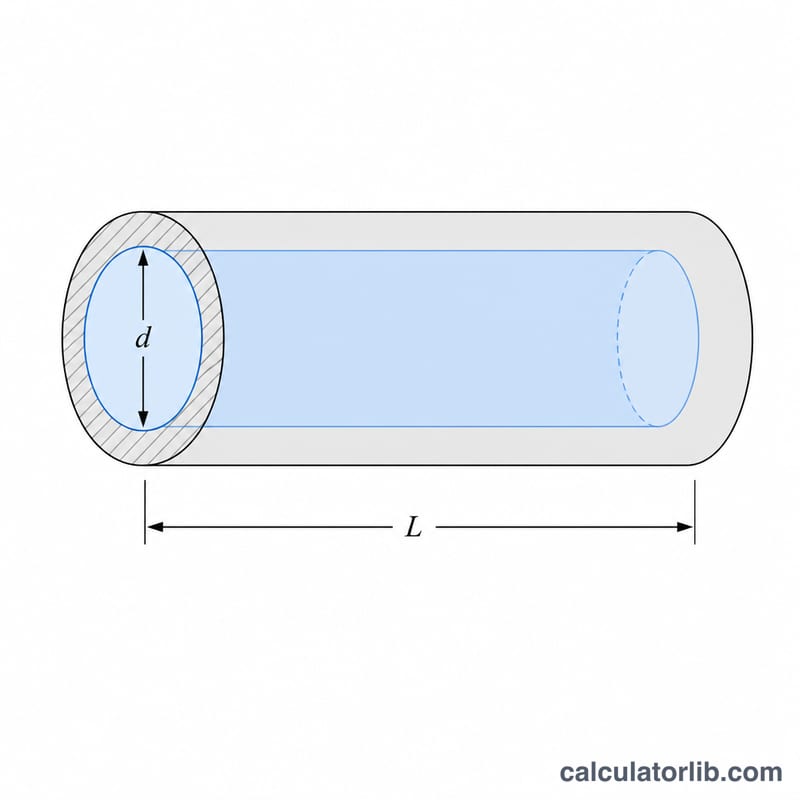
How to Calculate Pipe Volume
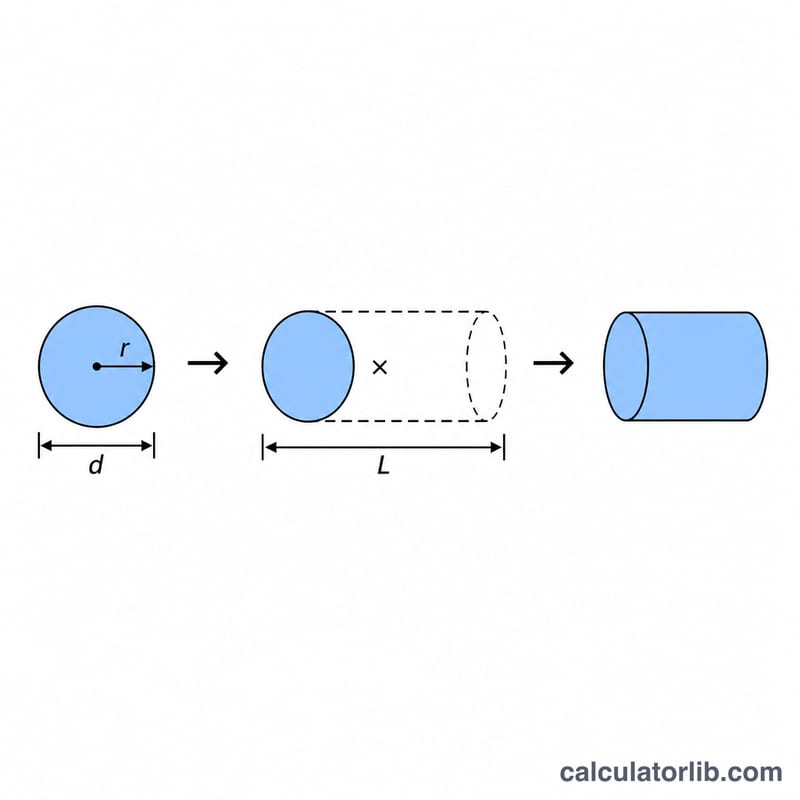
The volume of a pipe is calculated using the cylinder volume formula:
V = π × r² × L
Where:
- V = Volume of the pipe
- π = Pi (approximately 3.14159)
- r = Radius of the pipe (diameter ÷ 2)
- L = Length of the pipe
The cross-sectional area of the pipe is calculated as:
A = π × r²
Where:
- A = Cross-sectional area
- π = Pi (approximately 3.14159)
- r = Radius of the pipe (diameter ÷ 2)
Examples
Example 1: Small Plumbing Pipe
Calculate the volume of a plumbing pipe with a diameter of 2 inches and a length of 10 feet.
| Parameter | Value |
|---|---|
| Diameter | 2 inches |
| Length | 10 feet |
| Volume | 0.22 cubic feet or 1.64 gallons |
Example 2: Industrial Pipe
Calculate the volume of an industrial pipe with a diameter of 30 centimeters and a length of 5 meters.
| Parameter | Value |
|---|---|
| Diameter | 30 centimeters |
| Length | 5 meters |
| Volume | 0.35 cubic meters or 353 liters |
Example 3: Large Water Main
Calculate the volume of a water main with a diameter of 1.2 meters and a length of 100 meters.
| Parameter | Value |
|---|---|
| Diameter | 1.2 meters |
| Length | 100 meters |
| Volume | 113.1 cubic meters or 113,097 liters |
Unit Conversions
When working with pipe volumes, you may need to convert between different units:
| Volume Unit | Conversion Factor (from cubic meters) |
|---|---|
| Cubic inches (in³) | 61,023.7 |
| Cubic feet (ft³) | 35.3147 |
| Cubic centimeters (cm³) | 1,000,000 |
| Liters (L) | 1,000 |
| Gallons (gal) | 264.172 |
Related Calculators
For other volume and fluid calculations, you might find these calculators useful:
Nominal Pipe Size vs. Actual Inside Diameter
A pipe's nominal size is a trade name, not a measurement you can measure. For volume you need the inside diameter (ID), because that is the space that holds fluid. The table below lists common steel pipe sizes to the US standard ASME B36.10M, Schedule 40. The ID equals the outside diameter minus two wall thicknesses: \(\text{ID} = \text{OD} - 2t\). For 2 in Schedule 40, that gives \(2.375 - 2 \times 0.154 = 2.067\) in. Millimetre values are converted at 1 in = 25.4 mm and rounded to two decimals.
| Nominal size (in) | OD (in) | Wall (in) | ID (in) | OD (mm) | Wall (mm) | ID (mm) |
|---|---|---|---|---|---|---|
| 1/2 | 0.840 | 0.109 | 0.622 | 21.34 | 2.77 | 15.80 |
| 3/4 | 1.050 | 0.113 | 0.824 | 26.67 | 2.87 | 20.93 |
| 1 | 1.315 | 0.133 | 1.049 | 33.40 | 3.38 | 26.64 |
| 1-1/4 | 1.660 | 0.140 | 1.380 | 42.16 | 3.56 | 35.05 |
| 1-1/2 | 1.900 | 0.145 | 1.610 | 48.26 | 3.68 | 40.89 |
| 2 | 2.375 | 0.154 | 2.067 | 60.33 | 3.91 | 52.50 |
| 3 | 3.500 | 0.216 | 3.068 | 88.90 | 5.49 | 77.93 |
| 4 | 4.500 | 0.237 | 4.026 | 114.30 | 6.02 | 102.26 |
| 6 | 6.625 | 0.280 | 6.065 | 168.28 | 7.11 | 154.05 |
| 8 | 8.625 | 0.322 | 7.981 | 219.08 | 8.18 | 202.72 |
| 10 | 10.750 | 0.365 | 10.020 | 273.05 | 9.27 | 254.51 |
| 12 | 12.750 | 0.406 | 11.938 | 323.85 | 10.31 | 303.23 |
Note: These values apply only to ASME B36.10 Schedule 40 steel pipe. A pipe with the same nominal size and outside diameter can have a different wall thickness, and so a different inside diameter. Schedule 80 has a thicker wall and a smaller ID. PVC pipe (for example ASTM D1785 Schedule 40/80 in the US), copper tube Types K, L and M (ASTM B88), stainless pipe to ASME B36.19, and metric pipe made to EN or ISO standards all have their own dimensions. Before you calculate volume, check the inside diameter in the manufacturer's specification or the standard that applies to your pipe.
Pipe Capacity per Foot and per Meter
This table shows how much liquid a straight pipe holds per unit of length, based on its inside diameter. The values come from the cylinder formula. To get US gallons per foot, divide the cubic inches in a 12-inch length by 231, since one US liquid gallon is exactly 231 in³:
$$\text{gal/ft} = \frac{\pi}{4} \times d^{2} \times \frac{12}{231} \approx 0.0408 \times d^{2}$$Here \(d\) is the inside diameter in inches. For liters per meter, convert \(d\) to meters (\(d \times 0.0254\)), work out the cross-sectional area, and multiply by 1 m and by 1000 L/m³. That gives \(\text{L/m} \approx 0.5067 \times d^{2}\). For example, a 2 in inside diameter gives \(\frac{\pi}{4} \times 2^{2} \times \frac{12}{231} = 3.1416 \times 0.051948 \approx\) 0.1632 gal per foot. A 4 in inside diameter gives \(\frac{\pi}{4} \times (0.1016\ \text{m})^{2} \times 1\ \text{m} \times 1000 \approx\) 8.107 L per meter.
| Inside diameter (in) | US gallons per foot | Liters per meter |
|---|---|---|
| 0.5 | 0.0102 | 0.127 |
| 0.75 | 0.0230 | 0.285 |
| 1 | 0.0408 | 0.507 |
| 1.5 | 0.0918 | 1.14 |
| 2 | 0.163 | 2.03 |
| 3 | 0.367 | 4.56 |
| 4 | 0.653 | 8.11 |
| 6 | 1.47 | 18.2 |
| 8 | 2.61 | 32.4 |
| 10 | 4.08 | 50.7 |
| 12 | 5.88 | 73.0 |
The diameters in this table are exact inside diameters, not nominal pipe sizes. A 2 in Schedule 40 steel pipe has an ID of 2.067 in, so it holds slightly more than the 2 in row: \(0.0408 \times 2.067^{2} \approx 0.174\) gal/ft. The gallons are US liquid gallons (231 in³ ≈ 3.785 L), not imperial gallons (≈ 4.546 L), which are used in the UK and some other countries. To get the total volume, multiply the per-length value by the pipe length. These figures cover straight pipe only and do not include fittings, valves or tanks.