What the Pipe Slope Calculator Does
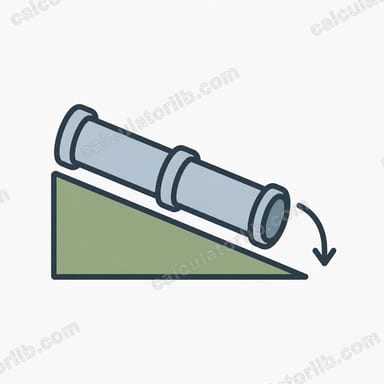
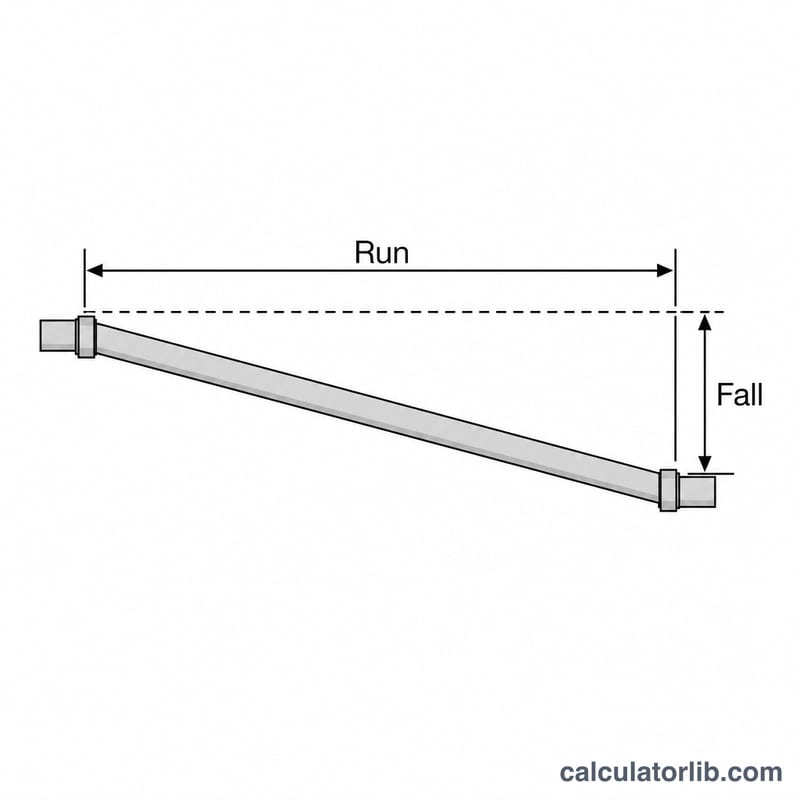
Drainage, sewer and waste pipes must be laid at a controlled slope so that water flows fast enough to carry solids but not so fast that liquid outruns the solids. This calculator converts a slope you enter — as a percent, a 1 : N ratio, or inches per foot — into the total fall (vertical drop) over a given horizontal run, and reports the equivalent grade, ratio and angle.
How to Use It
Enter the horizontal run (the length of the pipe measured flat) in whatever length unit you like — feet or metres. Then enter the slope and pick its units. The result shows the fall in the same unit as the run (or in inches when you choose inch-per-foot with a run in feet), plus the slope expressed several other ways so you can check it against a spec.
The Formula
The core relationship is simply the grade multiplied by the run:
$$\text{Fall} = \text{Run} \times \text{Grade}$$where \(\text{Grade}\) is the dimensionless fall per unit run. A percent slope is \(\text{Grade} = \tfrac{\text{percent}}{100}\); a 1 : N ratio is \(\text{Grade} = \tfrac{1}{N}\); an inch-per-foot slope of \(s\) gives \(\text{Grade} = \tfrac{s}{12}\). The pipe angle from horizontal is \(\theta = \arctan(\text{Grade})\).
Worked Example
Suppose a 100 ft run of pipe is laid at a 2% slope. The grade is \(0.02\), so:
$$\text{Fall} = 100 \times 0.02 = 2\ \text{ft}$$That 2% slope also equals a ratio of \(1 : 50\), an inch-per-foot value of \(0.02 \times 12 = 0.24\ \text{in/ft}\), and an angle of \(\arctan(0.02) \approx 1.146^{\circ}\).
Slope Conversion Table (Percent · Ratio · In/Ft · Angle)
Pipe slope is expressed several ways depending on the trade and the document: percent grade (fall per 100 units of run), a 1:N ratio (1 unit of fall per N units of run), inches per foot (common on plumbing drawings), and occasionally an angle from horizontal. They all describe the same thing. The relationships are:
$$\text{Percent} = \frac{\text{Fall}}{\text{Run}} \times 100 \qquad N = \frac{100}{\text{Percent}} \qquad \text{in/ft} = \text{Percent} \times 0.12 \qquad \text{Angle} = \arctan\!\left(\frac{\text{Percent}}{100}\right)$$
| Percent | Ratio (1:N) | Inch per Foot | Angle (°) |
|---|---|---|---|
| 1.00% | 1:100 | 0.120 in/ft | 0.57° |
| 1.04% | 1:96 | ⅛ in/ft (0.125) | 0.60° |
| 2.00% | 1:50 | 0.240 in/ft | 1.15° |
| 2.08% | 1:48 | ¼ in/ft (0.250) | 1.19° |
| 2.50% | 1:40 | 0.300 in/ft | 1.43° |
| 5.00% | 1:20 | 0.600 in/ft | 2.86° |
Quick conversions: 1% grade equals exactly 0.12 in/ft; ¼ in/ft equals 2.083% (1:48); ⅛ in/ft equals 1.042% (1:96). Angles for drainage slopes are small — even a fairly aggressive 5% grade is under 3° from level — which is why fall is almost always measured as rise-over-run rather than with a protractor.
FAQ
What slope should a drain pipe have? A common rule of thumb for building drains is about 1/4 inch per foot (roughly 2%), but always follow your local plumbing code and pipe-size tables.
What does 1 : 40 mean? It means the pipe drops 1 unit for every 40 units of run — a grade of \(\tfrac{1}{40} = 0.025\), or 2.5%.
Can I use metric units? Yes. For percent and ratio the fall comes out in the same length unit as the run, so metres in gives metres of fall out.