
What is the Degrees to Slope Percent Calculator?
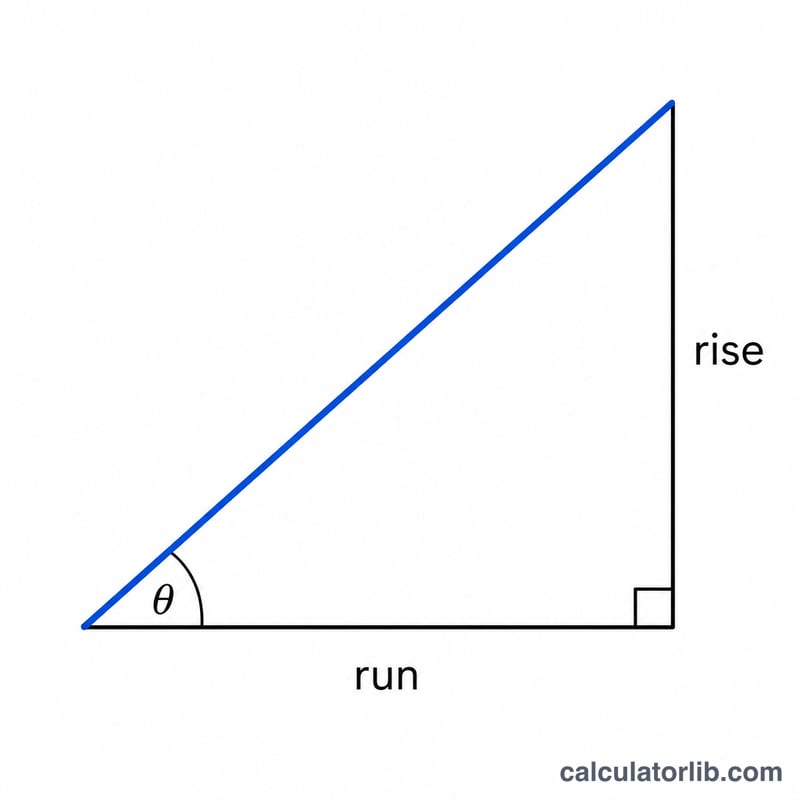
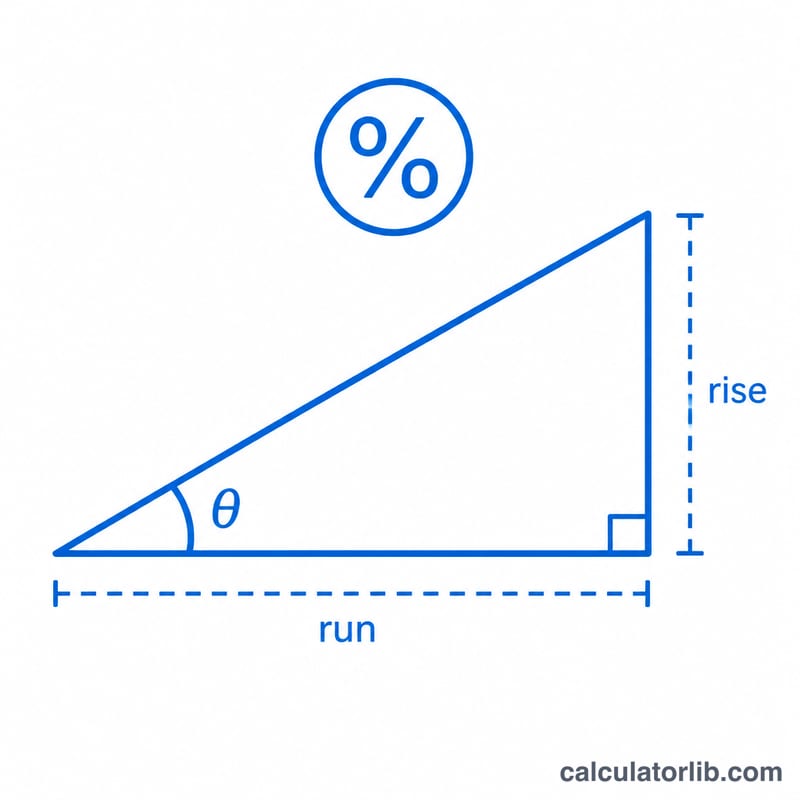
This tool converts a slope measured as an angle in degrees into a slope grade percentage. Grade percent describes how many units a surface rises (or falls) for every 100 units travelled horizontally. It is the standard way roads, ramps, roofs, drainage lines, and trails are described, and it differs from the angle in degrees because grade follows the tangent function rather than a linear scale.
How to use it
Enter the slope angle in degrees and read off the grade percent and the equivalent "1 in N" ratio. A 45° angle equals exactly 100% grade because the rise equals the run. Note that grade percent grows toward infinity as the angle approaches 90°, so very steep angles produce very large percentages.
The formula explained
The conversion uses the tangent of the angle: $$\text{Slope \%} = \tan\!\left(\text{Angle (}^\circ\text{)} \times \frac{\pi}{180}\right) \times 100$$. The angle is first converted from degrees to radians by multiplying by \(\pi/180\), the tangent gives the rise-over-run ratio, and multiplying by 100 turns that ratio into a percentage. The "1 in N" ratio is simply the reciprocal of the tangent.
Worked example
For a 30° angle: \(\tan(30^\circ) \approx 0.57735\). Multiplying by 100 gives a grade of about 57.74%. The reciprocal, \(1 \div 0.57735 \approx 1.732\), means the slope is roughly 1 in 1.73.
FAQ
Is 100% grade the same as vertical? No. 100% grade is a 45° angle, where rise equals run. A vertical drop is 90°, which is an infinite grade.
Why isn't 10° equal to 10%? Because grade follows the tangent curve, not a straight line. \(\tan(10^\circ) \approx 0.176\), so 10° is about 17.6% grade.
Can I enter negative angles? Yes — a negative angle represents a downward slope and returns a negative grade percent.