
What Is the Angle to Percent Grade Calculator?
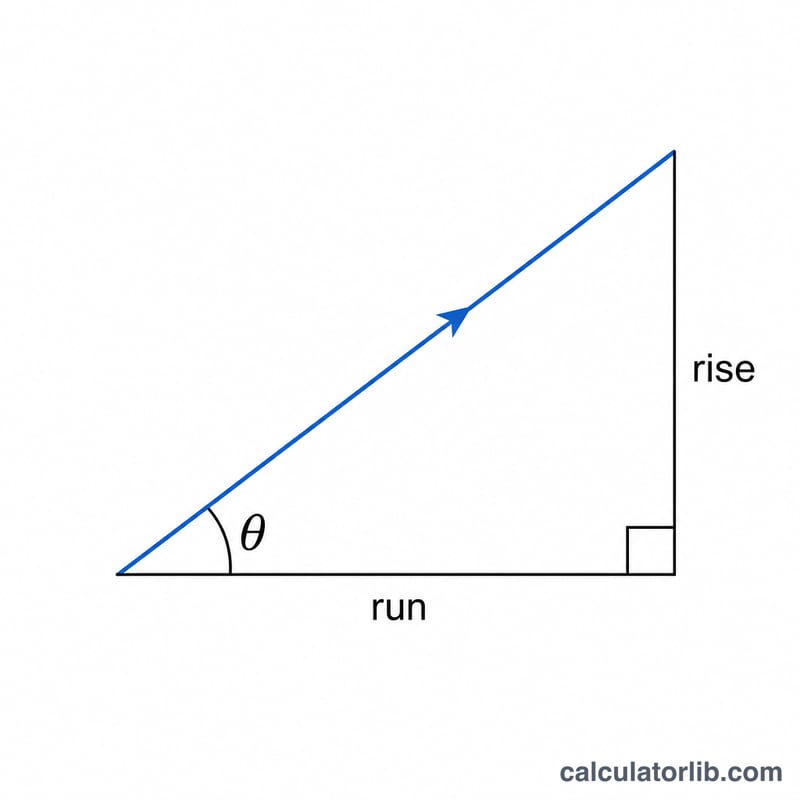
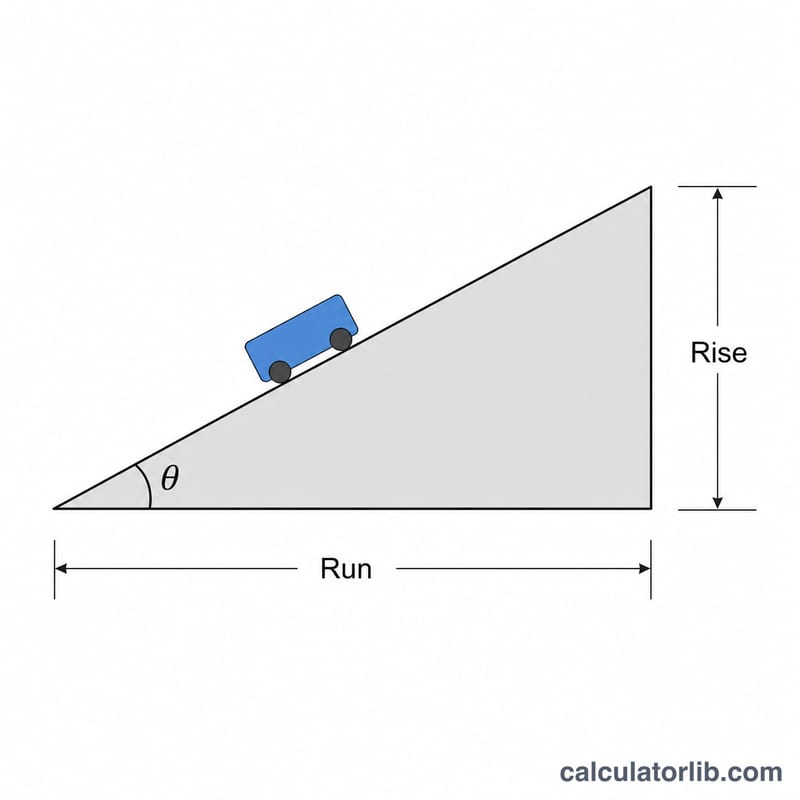
This tool converts a slope measured in degrees into a percent grade — the way road signs, ramps, trails and roofs commonly express steepness. A percent grade represents the vertical rise over the horizontal run, multiplied by 100. So a 100% grade means the surface rises one unit for every unit traveled horizontally, which corresponds to a 45° angle, not a vertical wall.
How to Use It
Enter the slope angle in degrees (for example 10 for a 10° incline) and the calculator returns the equivalent percent grade and the rise-per-run ratio. Angles between -89° and 89° are supported; positive values describe an uphill slope and negative values a downhill slope.
The Formula Explained
The conversion uses the tangent function: $$\text{Grade} = \tan\left(\text{Angle} \times \frac{\pi}{180}\right) \times 100\%$$, where \(\theta\) is the angle in degrees converted to radians. The tangent of an angle equals the opposite side (rise) divided by the adjacent side (run), so multiplying by 100 turns that ratio into a percentage. To reverse the process, use \(\theta = \arctan(\text{grade} / 100)\).
Worked Example
Suppose a trail climbs at 30°. Then \(\tan(30°) \approx 0.5774\), and the grade is $$0.5774 \times 100 \approx 57.74\%$$ The rise-per-run ratio is about \(0.5774 : 1\), meaning the path gains roughly 0.58 m of height for every 1 m forward.
FAQ
Is 100% grade the same as vertical? No. A 100% grade is a 45° angle. A truly vertical surface (90°) has an infinite percent grade.
What's the difference between grade and angle? Angle is measured in degrees of rotation; grade is the tangent of that angle expressed as a percentage. They are not linearly related.
Can I enter a negative angle? Yes — a negative angle returns a negative grade, representing a downhill slope.