
What Is Percentage Yield?
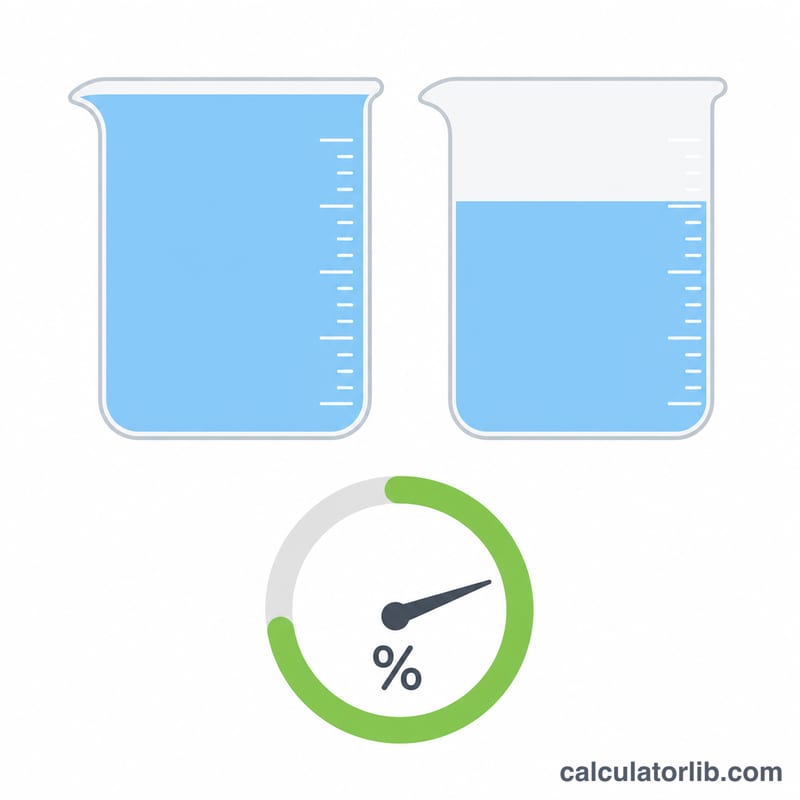
Percentage yield measures how efficient a chemical reaction is by comparing the amount of product you actually obtained (the actual yield) to the maximum amount the reaction could theoretically produce (the theoretical yield). It is one of the most important calculations in chemistry, used in labs, industry, and exams to judge how well a reaction performed. A value close to 100% means very little product was lost; lower values point to side reactions, incomplete reactions, or losses during purification.
How to Use This Calculator
Enter the actual yield — the mass of product you measured after the reaction — and the theoretical yield — the mass predicted from stoichiometry assuming the reaction goes to completion. Make sure both values use the same units (grams are standard). The calculator instantly returns the percentage yield.
The Formula Explained
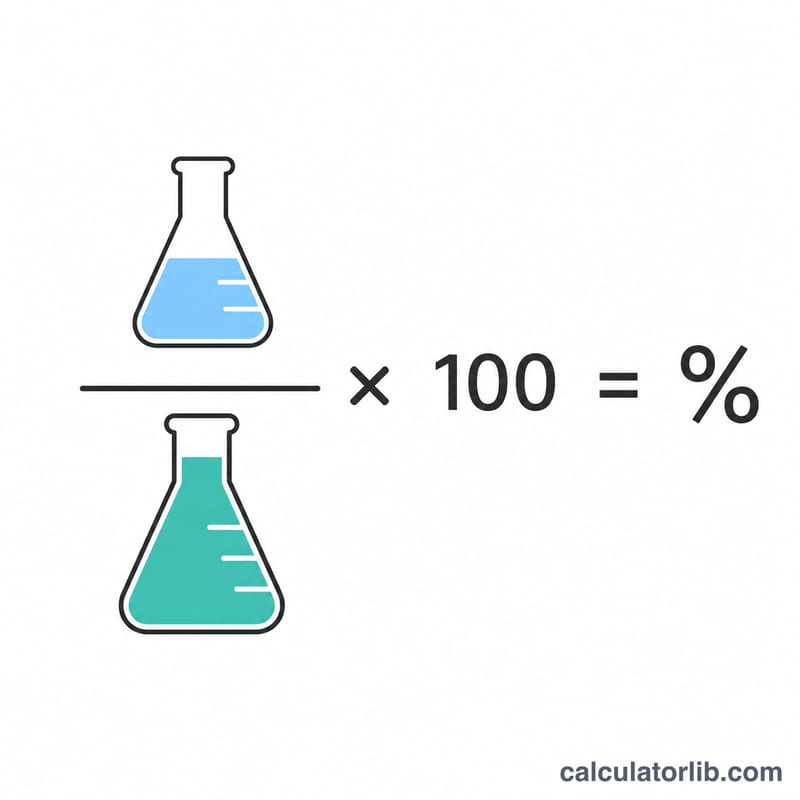
The equation is simply:
$$\text{Percentage Yield} = \frac{\text{Actual Yield (g)}}{\text{Theoretical Yield (g)}} \times 100\%$$
The ratio of actual to theoretical gives a decimal fraction, and multiplying by 100 converts it to a percentage. Theoretical yield is found beforehand from a balanced chemical equation and the moles of limiting reagent.
Worked Example
Suppose a reaction is expected to produce 10 g of product (theoretical yield), but you actually collect 8.5 g. The percentage yield is $$(8.5 \div 10) \times 100 = 85\%$$ This is a strong yield, indicating the reaction was efficient with only minor losses.
FAQ
Can percentage yield be over 100%? In principle no — you cannot make more product than theory allows. A value above 100% usually means the product is impure, still wet with solvent, or that measurements were inaccurate.
What is a good percentage yield? It depends on the reaction, but yields above 80% are generally considered good in a teaching lab, while industrial processes may target even higher.
Why is actual yield usually less than theoretical? Losses occur from incomplete reactions, competing side reactions, reversible equilibria, and product lost during filtration, transfer, or purification.