
What this calculator does
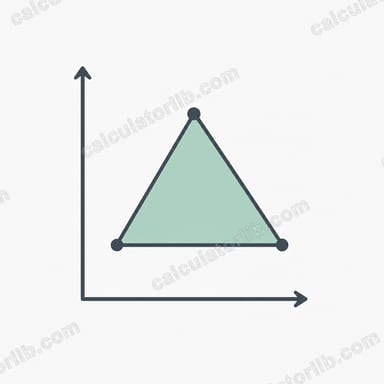
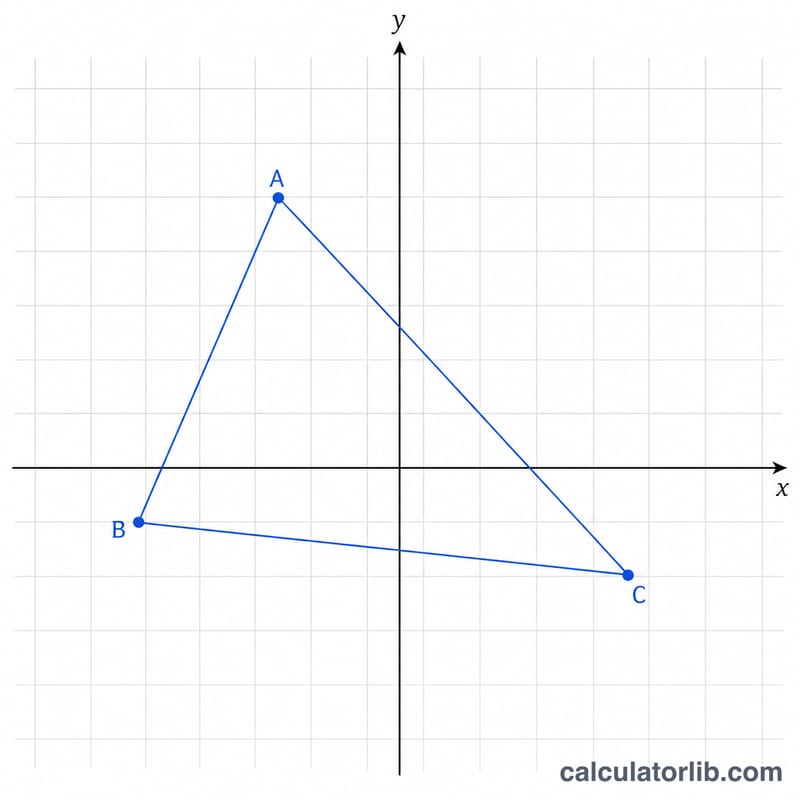
This tool computes the area of a triangle when you know the coordinates of its three corners (vertices) on the Cartesian plane. Instead of measuring a base and a height, you simply enter each point as an (x, y) pair, and the calculator applies the Shoelace formula to return an exact area in square units.
How to use it
Enter the coordinates of the three vertices: \((x_1, y_1)\), \((x_2, y_2)\) and \((x_3, y_3)\). Click calculate to see the area. The result also reports the signed area, which tells you the orientation of the points: a positive value means the vertices are listed counter-clockwise, a negative value means clockwise, and zero means the three points lie on a straight line (a degenerate triangle with no area).
The formula explained
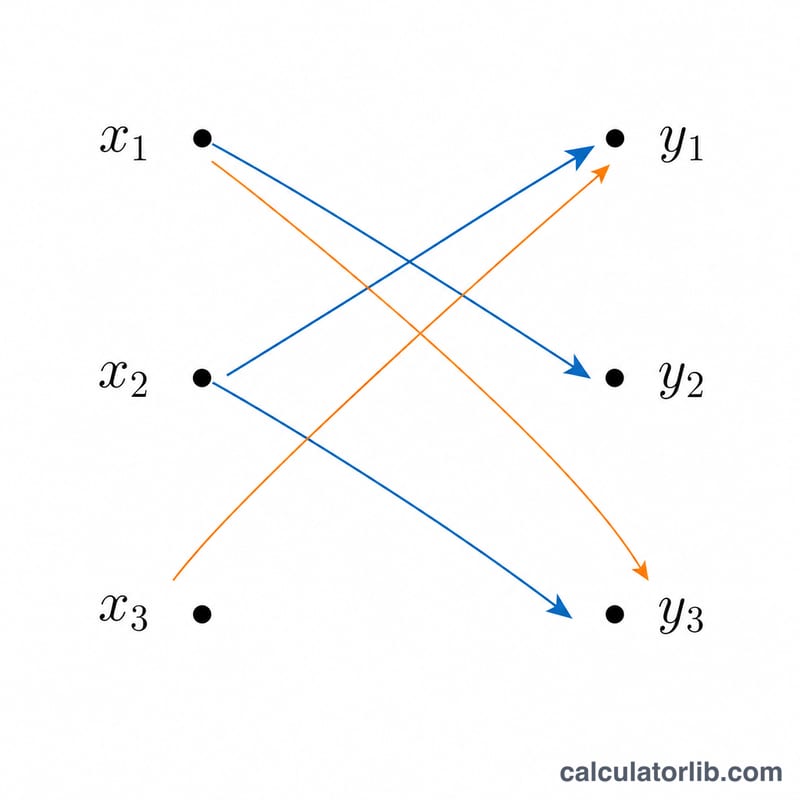
The Shoelace (or Gauss area) formula calculates area by cross-multiplying coordinates in a crisscross pattern, like lacing a shoe:
$$\text{A} = \frac{1}{2}\left|\, x_1\left(y_2 - y_3\right) + x_2\left(y_3 - y_1\right) + x_3\left(y_1 - y_2\right) \right|$$
Each term pairs one vertex's x with the difference of its neighbours' y values. Summing them and halving gives twice the directed area; taking the absolute value yields the geometric area regardless of how the points are ordered.
Worked example
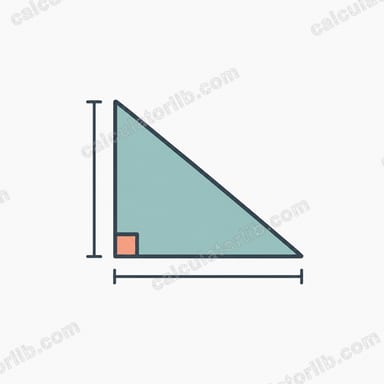
Take a right triangle with vertices A(0, 0), B(4, 0) and C(0, 3). Plugging in: $$\text{A} = \frac{1}{2}\left|\, 0(0-3) + 4(3-0) + 0(0-0) \right| = \frac{1}{2}\left| 0 + 12 + 0 \right| = \frac{1}{2} \times 12 = \textbf{6 square units}.$$ This matches the simple \(\text{base} \times \text{height} \div 2 = 4 \times 3 \div 2 = 6\), confirming the formula.
More Worked Examples
Each example uses the Shoelace formula \(\text{Area} = \frac{1}{2}\left|\,x_1(y_2-y_3) + x_2(y_3-y_1) + x_3(y_1-y_2)\right|\). The expression inside the bars (before taking the absolute value) is the signed area; its sign tells you the orientation of the vertices.
Example 1 — Negative coordinates
Vertices \(A(-4,-2)\), \(B(1,-3)\), \(C(-1,4)\), listed counter-clockwise.
$$\begin{aligned}\text{Area} &= \tfrac12\left|\,(-4)(-3-4) + (1)(4-(-2)) + (-1)((-2)-(-3))\right|\\ &= \tfrac12\left|\,(-4)(-7) + (1)(6) + (-1)(1)\right|\\ &= \tfrac12\left|\,28 + 6 - 1\right| = \tfrac12(33)\end{aligned}$$
The area is 16.5 square units. Because the signed value \(+33/2\) is positive, the vertices are ordered counter-clockwise.
Example 2 — Decimal coordinates
Vertices \(A(1.5,\,2.0)\), \(B(4.5,\,3.5)\), \(C(2.0,\,6.0)\).
$$\begin{aligned}\text{Area} &= \tfrac12\left|\,1.5(3.5-6.0) + 4.5(6.0-2.0) + 2.0(2.0-3.5)\right|\\ &= \tfrac12\left|\,1.5(-2.5) + 4.5(4.0) + 2.0(-1.5)\right|\\ &= \tfrac12\left|\,-3.75 + 18.0 - 3.0\right| = \tfrac12(11.25)\end{aligned}$$
The area is 5.625 square units.
Example 3 — Clockwise order (negative signed area)
Take a triangle whose vertices happen to be listed clockwise: \(A(0,0)\), \(B(0,4)\), \(C(6,0)\).
$$\begin{aligned}\text{signed area} &= \tfrac12\left[\,0(4-0) + 0(0-0) + 6(0-4)\right]\\ &= \tfrac12\left[\,0 + 0 + 6(-4)\right] = \tfrac12(-24) = -12\end{aligned}$$
The signed area is \(-12\), and the negative sign confirms the vertices are ordered clockwise. Taking the absolute value gives the geometric area, 12 square units. Since this is a right triangle with legs 6 and 4, the same answer comes from \(\tfrac12\,bh = \tfrac12(6)(4) = \) 12.
How to Calculate It by Hand
- List the vertices in order. Write the three points as \((x_1,y_1)\), \((x_2,y_2)\), \((x_3,y_3)\), going around the triangle in one consistent direction (either clockwise or counter-clockwise). The starting vertex does not matter, but the order does.
- Substitute into the Shoelace terms. Form the three products \(x_1(y_2-y_3)\), \(x_2(y_3-y_1)\), and \(x_3(y_1-y_2)\). Compute each parenthesis (a difference of two \(y\)-values) first, then multiply by the matching \(x\).
- Sum the cross products. Add the three terms together, keeping all signs:
\(S = x_1(y_2-y_3) + x_2(y_3-y_1) + x_3(y_1-y_2)\). - Halve to get the signed area. Compute \(\dfrac{S}{2}\). This number can be positive or negative — it is the signed (directed) area.
- Take the absolute value for the geometric area. The triangle's actual area is \(\left|\dfrac{S}{2}\right|\), always a non-negative number expressed in square units.
Interpreting the sign: a positive signed area means the vertices were listed counter-clockwise; a negative signed area means they were listed clockwise. If \(S = 0\), the three points are collinear and the "triangle" is degenerate (zero area). The geometric area is identical regardless of order — only the sign before the absolute value changes.
Definitions & Glossary
- Vertex
- A corner point of the triangle. A triangle has three vertices, each given here as an \((x,y)\) coordinate pair.
- Cartesian coordinate pair
- An ordered pair \((x,y)\) locating a point on a plane, where \(x\) is the horizontal distance and \(y\) the vertical distance from the origin \((0,0)\).
- Signed (directed) area
- The value \(\tfrac12\,S\) from the Shoelace formula before taking the absolute value. Its magnitude is the area; its sign encodes the direction in which the vertices are listed.
- Orientation (CW / CCW)
- The rotational direction of the listed vertices. Counter-clockwise (CCW) gives a positive signed area; clockwise (CW) gives a negative signed area.
- Collinear
- Three or more points lying on a single straight line. Collinear vertices produce a Shoelace sum of zero.
- Degenerate triangle
- A "triangle" whose three vertices are collinear, so it collapses to a line segment and has zero area.
- Square units
- The unit of area, equal to the unit of the coordinates squared (e.g., if coordinates are in metres, the area is in square metres, m\(^2\)).
FAQ
Does the order of the points matter? Not for the area — the absolute value removes any sign. The order only affects the signed area, which indicates orientation.
What if I get an area of zero? The three points are collinear, so they don't form a real triangle.
Can I use negative or decimal coordinates? Yes. The formula works for any real-number coordinates, including negatives and fractions.