
What is a 30-60-90 Triangle?
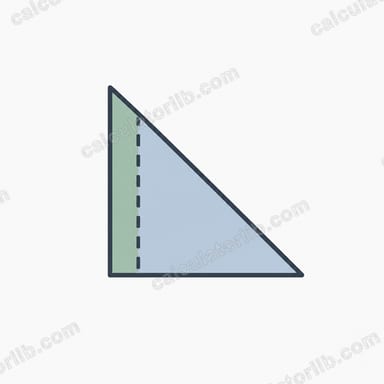
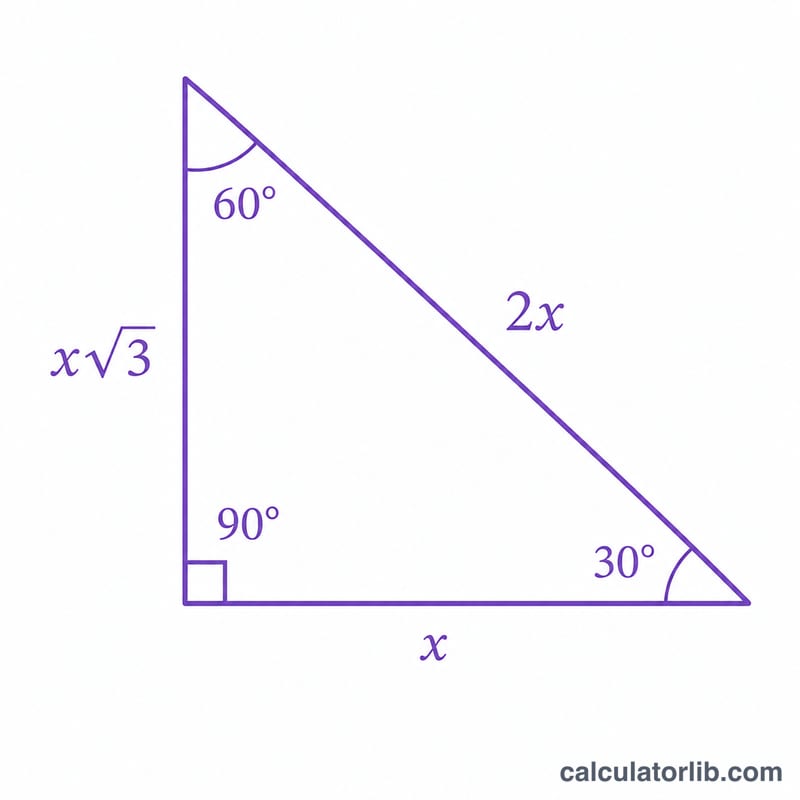
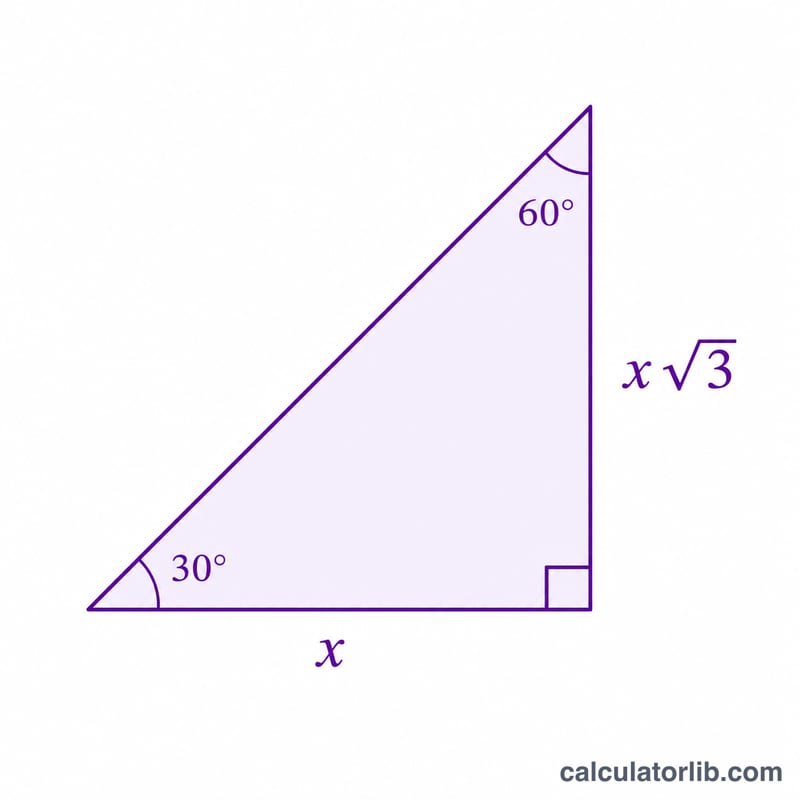
A 30-60-90 triangle is a special right triangle whose three angles measure 30°, 60°, and 90°. Because the angles are fixed, the side lengths always follow the constant ratio \(1 : \sqrt{3} : 2\). The shortest side (the short leg) sits opposite the 30° angle, the long leg sits opposite the 60° angle, and the hypotenuse — the longest side — sits opposite the right angle. This predictable structure makes the triangle a favorite in geometry, trigonometry, drafting, and construction.
How to Use This Calculator
Enter the length of the short leg (the side opposite the 30° angle) in any unit you like. The calculator instantly returns the area in square units, along with the long leg, hypotenuse, and full perimeter so you have the complete triangle described from a single measurement.
The Formula Explained
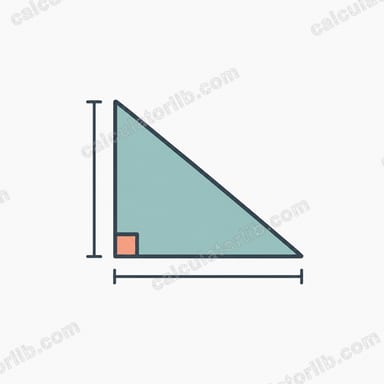
The legs of a right triangle are perpendicular, so they act as the base and height. In a 30-60-90 triangle the short leg is \(x\) and the long leg is \(x\sqrt{3}\). The area formula ½ · base · height becomes:
$$A = \tfrac{1}{2} \cdot x \cdot (x\sqrt{3}) = \frac{\sqrt{3}}{2}\,x^2$$The long leg equals \(x\sqrt{3}\), the hypotenuse equals \(2x\), and the perimeter is the sum of all three sides.
Worked Example
Suppose the short leg is 5 units. Then:
$$A = \frac{\sqrt{3}}{2}\cdot 5^2 = (0.8660254)\cdot 25 \approx 21.65 \text{ square units}$$The long leg \(= 5\sqrt{3} \approx 8.66\), the hypotenuse \(= 2\cdot 5 = 10\), and the perimeter \(\approx 5 + 8.66 + 10 = 23.66\) units.
Short Leg, Area & Perimeter at a Glance
In a 30-60-90 triangle the three sides always follow the ratio \(1 : \sqrt{3} : 2\). If the short leg (opposite the 30° angle) is \(x\), then the long leg is \(x\sqrt{3}\), the hypotenuse is \(2x\), and the area is \(\frac{\sqrt{3}}{2}x^2\). The perimeter is the sum of all three sides: \(x + x\sqrt{3} + 2x = x(3 + \sqrt{3})\).
| Short leg (x) | Long leg (x√3) | Hypotenuse (2x) | Area (√3/2·x²) | Perimeter |
|---|---|---|---|---|
| 1 | 1.73 | 2 | 0.87 | 4.73 |
| 2 | 3.46 | 4 | 3.46 | 9.46 |
| 5 | 8.66 | 10 | 21.65 | 23.66 |
| 10 | 17.32 | 20 | 86.60 | 47.32 |
| 20 | 34.64 | 40 | 346.41 | 94.64 |
Because every dimension scales with \(x\), doubling the short leg doubles the perimeter but multiplies the area by four.
Constants Used in the Calculation
The fixed proportions of a 30-60-90 triangle come from a handful of constants. Knowing where each one appears makes the area formula easy to apply by hand.
| Constant | Approximate value | Where it appears |
|---|---|---|
| \(\sqrt{3}\) | 1.7320508 | Multiplier for the long leg: long leg = \(x\sqrt{3}\). |
| \(\dfrac{\sqrt{3}}{2}\) | 0.8660254 | Coefficient in the area formula \(A = \frac{\sqrt{3}}{2}x^2\), since area = ½·(short leg)·(long leg) = ½·\(x\)·\(x\sqrt{3}\). |
| Side ratio | \(1 : \sqrt{3} : 2\) | Short leg : long leg : hypotenuse — the defining relationship that lets you find every side from \(x\) alone. |
The value \(\frac{\sqrt{3}}{2}\) is also \(\sin 60^\circ\) (equivalently \(\cos 30^\circ\)), which is why it governs both the long leg and the area of this triangle.
FAQ
Which side is the "short leg"? It is the side opposite the 30° angle, always the shortest of the three sides.
Can I use the long leg instead? This tool expects the short leg. If you know the long leg \(L\), divide by \(\sqrt{3}\) to get the short leg \(x = L/\sqrt{3}\), then enter that value.
What units does the area use? The area is in the square of whatever unit you enter — enter centimeters and you get square centimeters.