
What Is the Vector Components Calculator?
This tool resolves a two-dimensional vector given in polar form (a magnitude and a direction angle) into its rectangular x and y components. It is widely used in physics, engineering, navigation, and computer graphics whenever a force, velocity, or displacement needs to be broken down into perpendicular axes.
How to Use It
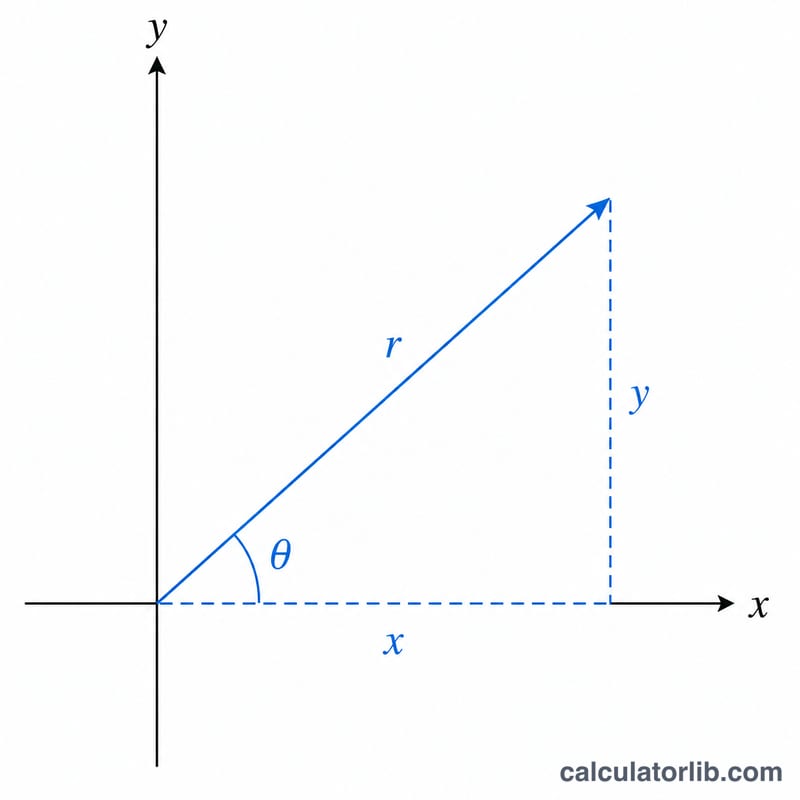
Enter the vector's magnitude (its length, \(r\)) and its direction angle (\(\theta\)). Choose whether the angle is measured in degrees or radians, then read off the x and y components. The angle is measured counterclockwise from the positive x-axis, the standard mathematical convention.
The Formula Explained
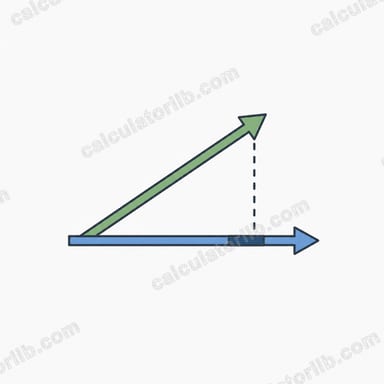
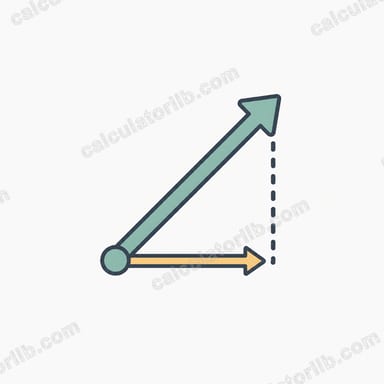
A vector of length \(r\) pointing at angle \(\theta\) projects onto the axes as:
$$V_x = r \cos\!\left(\theta\right), \quad V_y = r \sin\!\left(\theta\right)$$
The cosine gives the share of the length that lies along the horizontal axis, while the sine gives the share along the vertical axis. These two components, placed at right angles, recombine to form the original vector — confirming Pythagoras: \(\sqrt{x^2 + y^2} = r\).
Worked Example
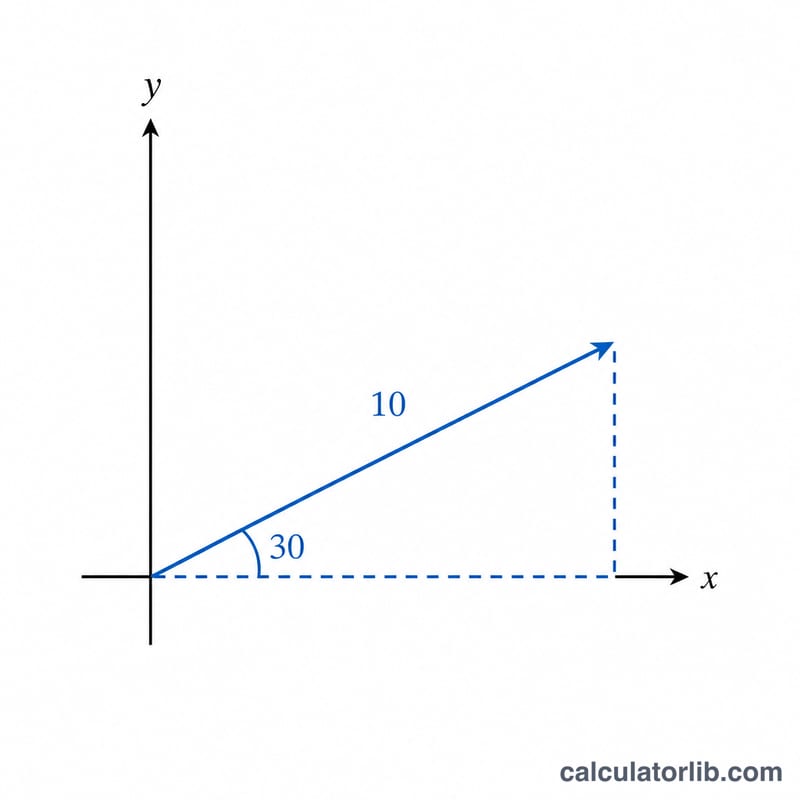
Suppose a force has magnitude \(r = 10\ \text{N}\) at \(\theta = 30°\). Then $$x = 10\cos(30°) = 10\cdot 0.86603 \approx 8.6603\ \text{N}$$ and $$y = 10\sin(30°) = 10\cdot 0.5 = 5\ \text{N}.$$ So the force vector is approximately \((8.66,\ 5.00)\).
FAQ
Which direction is the angle measured from? Counterclockwise from the positive x-axis (standard math convention).
Can I use radians? Yes — switch the angle unit to Radians. For example, \(\theta = \pi/2 \approx 1.5708\) gives \(x = 0\), \(y = r\).
What if my angle is negative or over 360°? The trigonometric functions handle any angle, so negative and large angles work and simply wrap around the circle.