
What is a resultant vector?
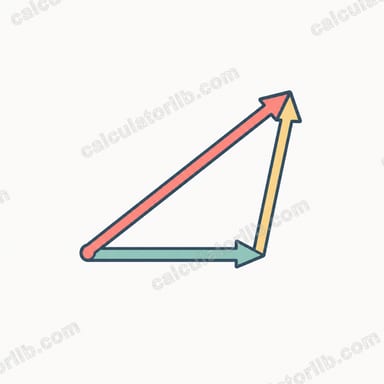
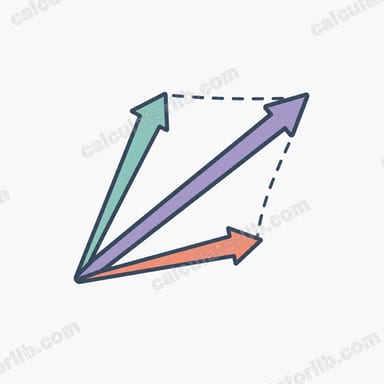
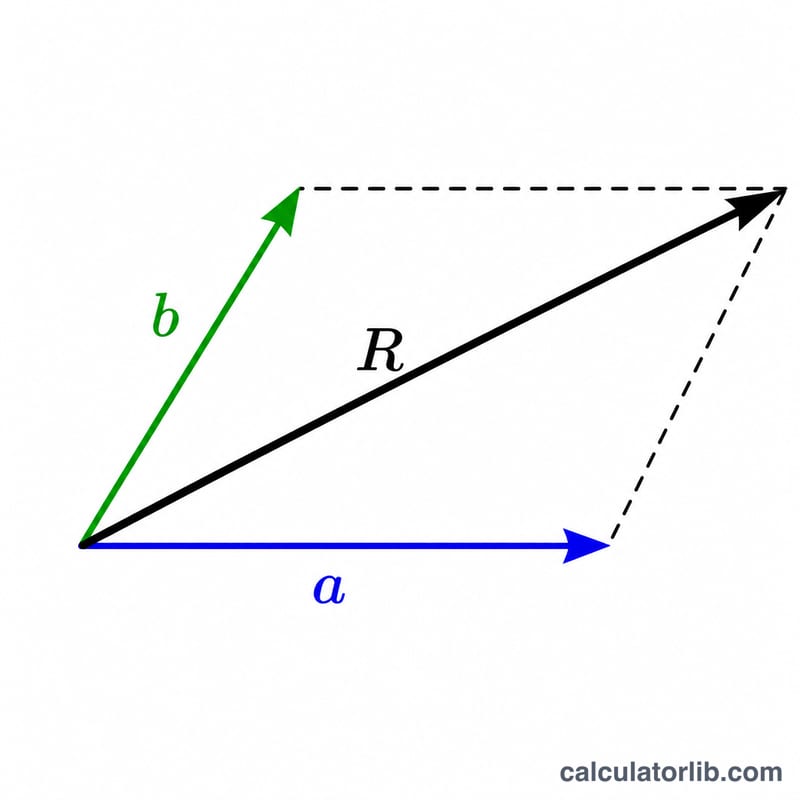
The resultant vector is the single vector that has the same effect as several vectors acting together. To add vectors in two dimensions, you sum their horizontal (X) and vertical (Y) components separately. The summed components, \(R_x\) and \(R_y\), define the resultant, from which you can compute its overall magnitude and direction. This is fundamental in physics (combining forces or velocities), engineering, and navigation.
How to use this calculator
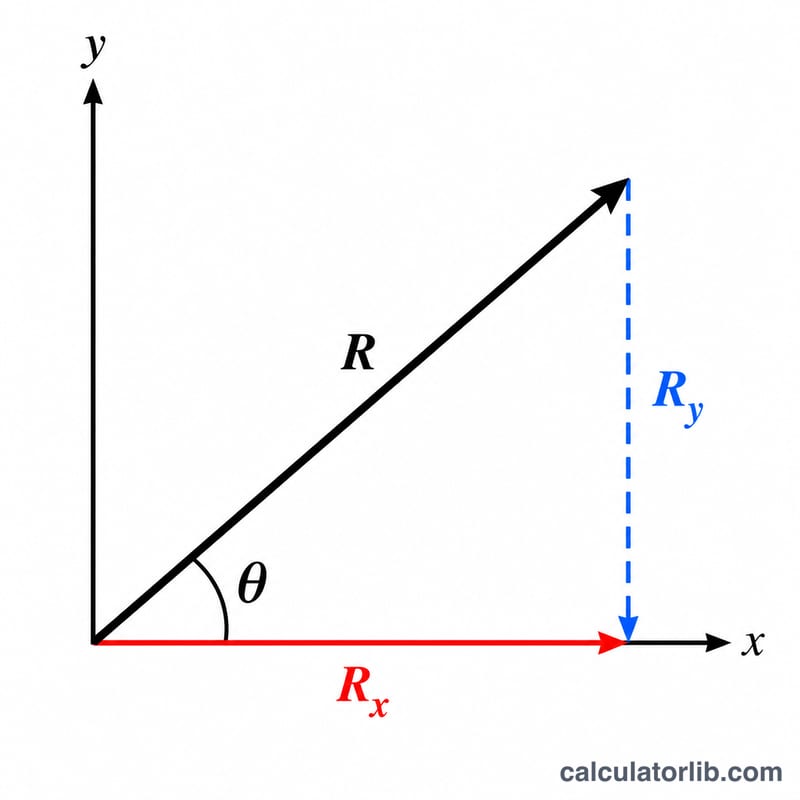
Enter the X and Y components of each vector. The first two vectors are required; the third is optional — leave it at 0 to add only two vectors. The calculator sums the components, then returns the magnitude \(|\vec{R}|\), the direction angle \(\theta\) (in degrees, measured counterclockwise from the positive x-axis), and the summed \(R_x\) and \(R_y\).
The formula explained
First sum components: \(R_x = \sum x_i\) and \(R_y = \sum y_i\). The magnitude follows from the Pythagorean theorem:
$$|\vec{R}| = \sqrt{R_x^{2} + R_y^{2}}$$The direction uses the two-argument arctangent,
$$\theta = \operatorname{atan2}(R_y, R_x)$$which correctly places the angle in the proper quadrant — unlike a plain arctan, atan2 distinguishes, say, the second quadrant from the fourth.
Worked example
Add vector A = (3, 4) and vector B = (0, 0). Then \(R_x = 3\), \(R_y = 4\). Magnitude
$$|\vec{R}| = \sqrt{3^{2} + 4^{2}} = \sqrt{25} = 5$$Direction
$$\theta = \operatorname{atan2}(4, 3) \approx 53.13^{\circ}$$So the resultant points up and to the right at about 53 degrees with a length of 5 units.
FAQ
What does the angle measure from? The positive x-axis, increasing counterclockwise. Positive angles are above the axis, negative below.
Can I add more than three vectors? Add them in groups: take the resultant of three, then enter it together with the remaining vectors.
What units does it use? Any consistent unit — newtons, meters per second, miles, etc. The magnitude comes out in the same unit you entered.