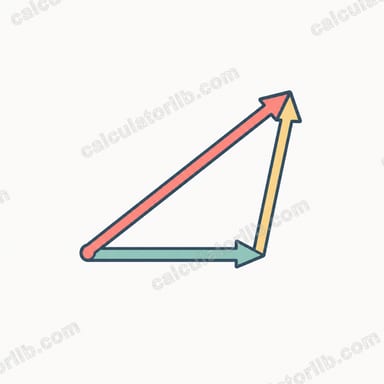

What this calculator does
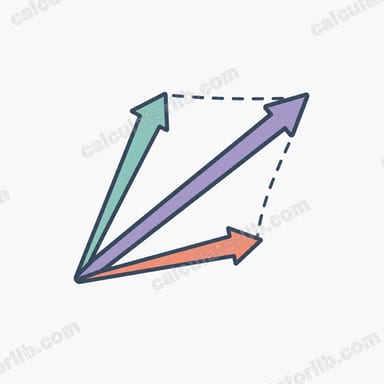
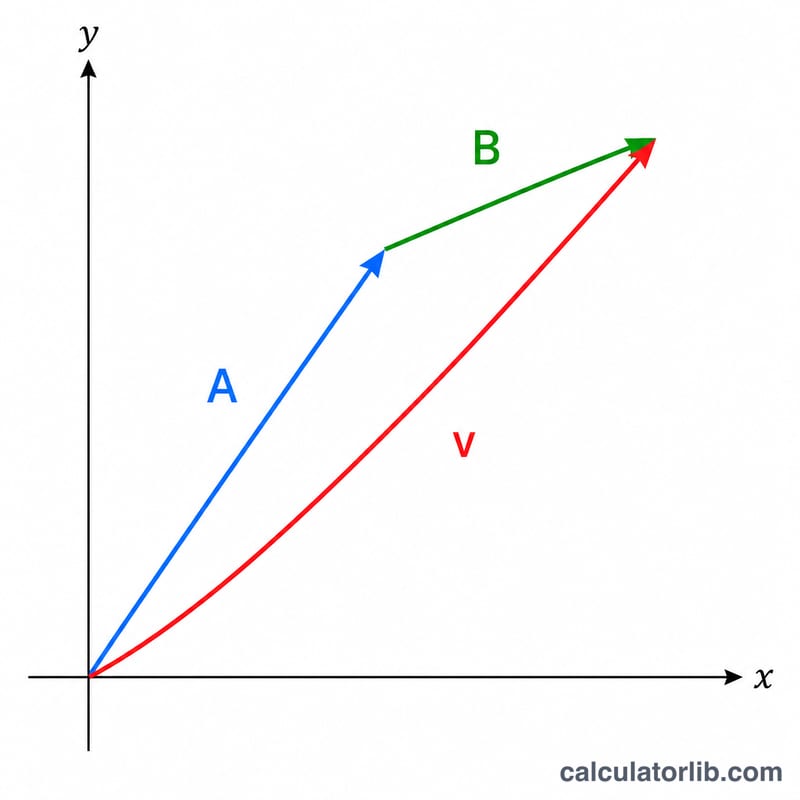
This tool computes the resultant (vector sum) of up to four two-dimensional vectors A, B, C and D. It returns the resultant's x and y components, its magnitude (length), and its direction angle measured counterclockwise from the positive x-axis. Vector addition is pure mathematics, so the calculator applies identically everywhere and uses no physical units — the components are plain real numbers in whatever consistent unit you supply.
How to use it
Enter each vector as an [x, y] pair. You only need two vectors to get a sum: leave C and D at 0 to add just A and B, or fill in three rows to add A + B + C. Negative components are allowed and represent directions pointing into the negative axes. Press calculate to see the resultant components, length and heading.
The formula explained
The sum is taken componentwise: the resultant x is \(v_1 = a_1 + b_1 + c_1 + d_1\) and the resultant y is \(v_2 = a_2 + b_2 + c_2 + d_2\). The length is the Pythagorean magnitude \(|v| = \sqrt{v_1^{2} + v_2^{2}}\). The direction angle uses the two-argument arctangent, \(\theta = \operatorname{atan2}(v_2, v_1)\), which recovers the correct quadrant. We convert to degrees and add 360° when negative so the reported angle lies in [0, 360).
$$\vec{R} = (R_x,\, R_y), \quad |\vec{R}| = \sqrt{R_x^{2} + R_y^{2}}, \quad \theta = \operatorname{atan2}(R_y,\, R_x)$$ $$\text{where}\quad \left\{ \begin{aligned} R_x &= \text{A}_x + \text{B}_x + \text{C}_x + \text{D}_x \\ R_y &= \text{A}_y + \text{B}_y + \text{C}_y + \text{D}_y \end{aligned} \right.$$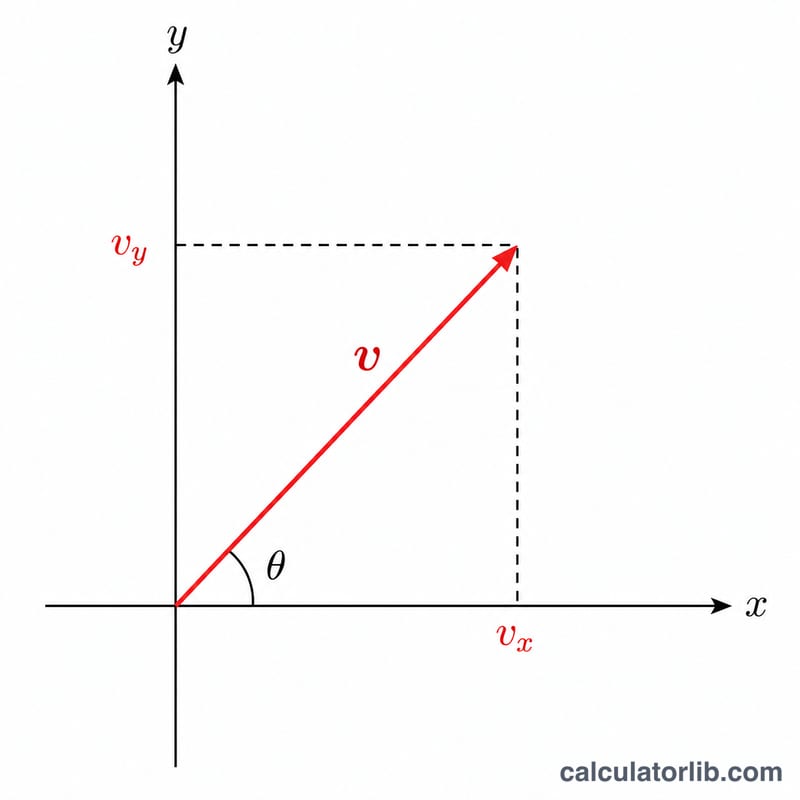
Worked example
Take A = [3, 1] and B = [1, 2], with C and D left at zero. Then \(v_1 = 3 + 1 = 4\) and \(v_2 = 1 + 2 = 3\). The magnitude is
$$\sqrt{4^{2} + 3^{2}} = \sqrt{25} = 5$$and the angle is \(\operatorname{atan2}(3, 4) \approx 36.87\degree\). So the resultant is [4, 3], length 5, heading about 36.87°.
FAQ
Why use atan2 instead of atan? Plain arctangent cannot distinguish opposite quadrants. For example v = [-4, -3] should give about 216.87°, but \(\operatorname{atan}(-3 / -4)\) returns 36.87°. The two-argument atan2 uses the signs of both components to find the right quadrant.
What if the resultant is zero? If both components cancel to zero, the magnitude is 0 and the direction angle is undefined; we report it as 0°.
Do the inputs need units? No. Vector addition is dimensionless math. Just keep all components in the same consistent unit and the resultant will be in that unit too.