
What Is Centrifugal Force?
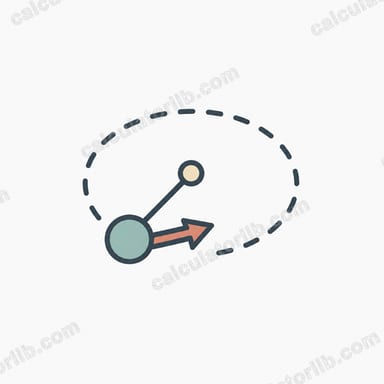
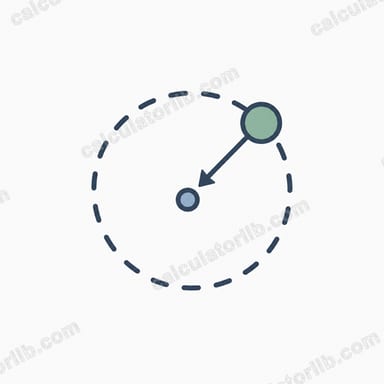
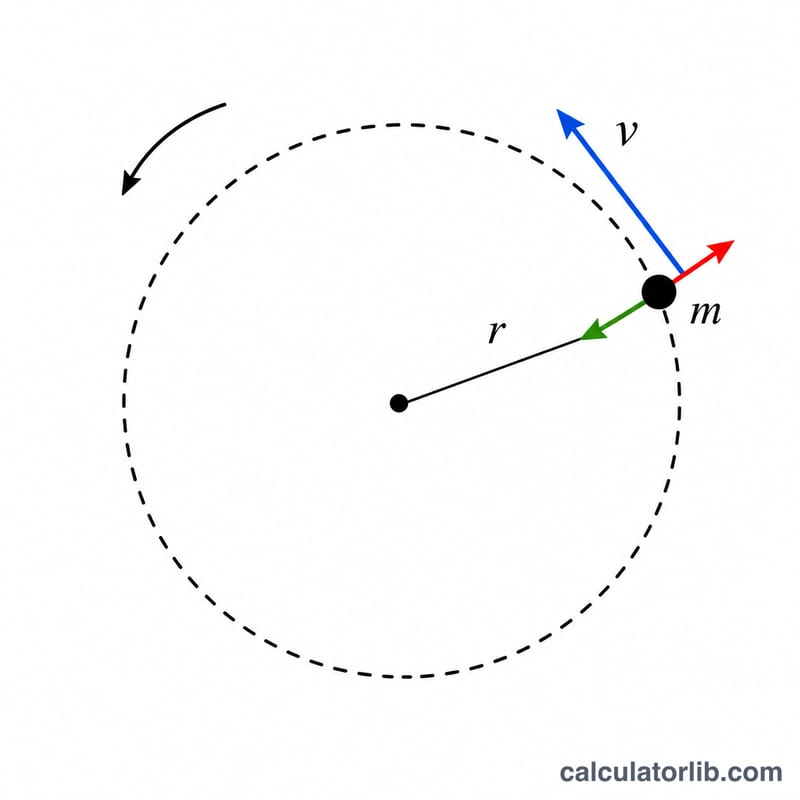
Centrifugal force is the apparent outward force experienced by an object moving along a circular path. In a rotating reference frame, a mass m traveling at tangential velocity v around a circle of radius r seems to be pushed away from the center. It is equal in magnitude to the centripetal force that keeps the object moving in a circle, but directed outward. This calculator works in any consistent SI unit system (kilograms, meters, seconds) and applies universally to physics and engineering problems.
How to Use This Calculator
Enter the object's mass in kilograms, its tangential velocity in meters per second, and the radius of the circular path in meters. The tool returns the centrifugal force in newtons, plus the angular velocity (\(\omega = v/r\)) and the centripetal acceleration (\(a = v^2/r\)) for convenience.
The Formula Explained
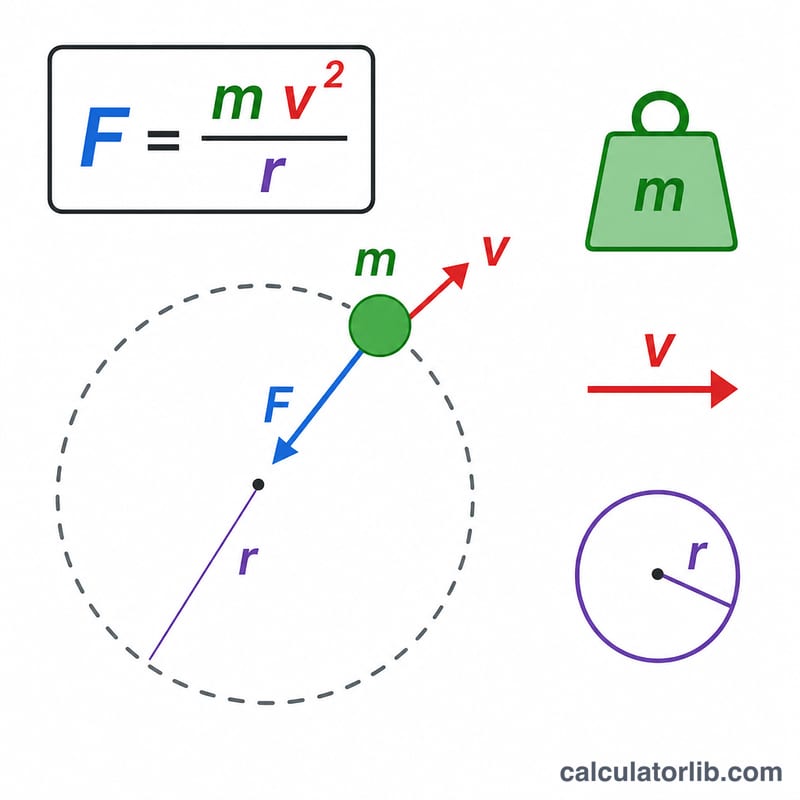
The core equation is $$F = \frac{m \cdot v^2}{r}$$ Force grows linearly with mass, quadratically with velocity (doubling speed quadruples the force), and decreases as the radius increases. Using angular velocity \(\omega = v/r\), the same force can be written $$F = m \cdot \omega^2 \cdot r$$ The matching centripetal acceleration is \(a = v^2/r = \omega^2 \cdot r\).
Worked Example
A 2 kg object moves at 5 m/s on a circle of radius 1.5 m. Then $$F = \frac{2 \times 5^2}{1.5} = \frac{2 \times 25}{1.5} = \frac{50}{1.5} \approx 33.33 \text{ N}$$ The angular velocity is \(\omega = 5 / 1.5 \approx 3.33 \text{ rad/s}\), and the centripetal acceleration is \(a = 25 / 1.5 \approx 16.67 \text{ m/s}^2\).
FAQ
Is centrifugal force a "real" force? It is a fictitious (inertial) force that appears only in a rotating reference frame. From an inertial frame, the real force is centripetal, pointing inward.
What units should I use? Use SI units: kilograms, meters, and meters per second to get force in newtons.
What happens if I increase the radius? For a fixed velocity, a larger radius reduces the force because the path curves more gently.