
What is the Coriolis Effect?
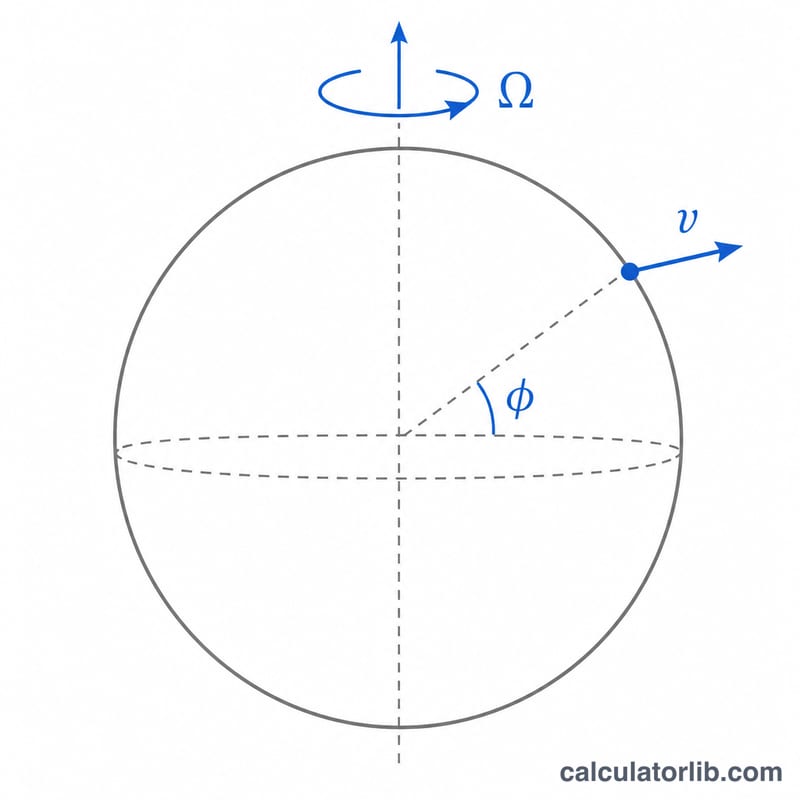
The Coriolis effect is an apparent deflection of moving objects when viewed from within a rotating reference frame, such as the surface of the Earth. It causes large-scale weather systems, ocean currents, and long-range projectiles to curve. This calculator computes the magnitude of the Coriolis force acting on a moving mass given its mass, velocity, latitude, and the angular velocity of the rotating body.
How to use this calculator
Enter the mass of the object in kilograms, its velocity in metres per second, and its latitude in degrees (positive for the Northern Hemisphere, negative for the Southern). The angular velocity \(\Omega\) defaults to Earth's value of about \(7.292\times10^{-5}\ \text{rad/s}\) — change it for other rotating bodies like Mars or a spinning platform. The tool returns the Coriolis force in newtons, the corresponding acceleration, and the sine of the latitude used.
The formula explained
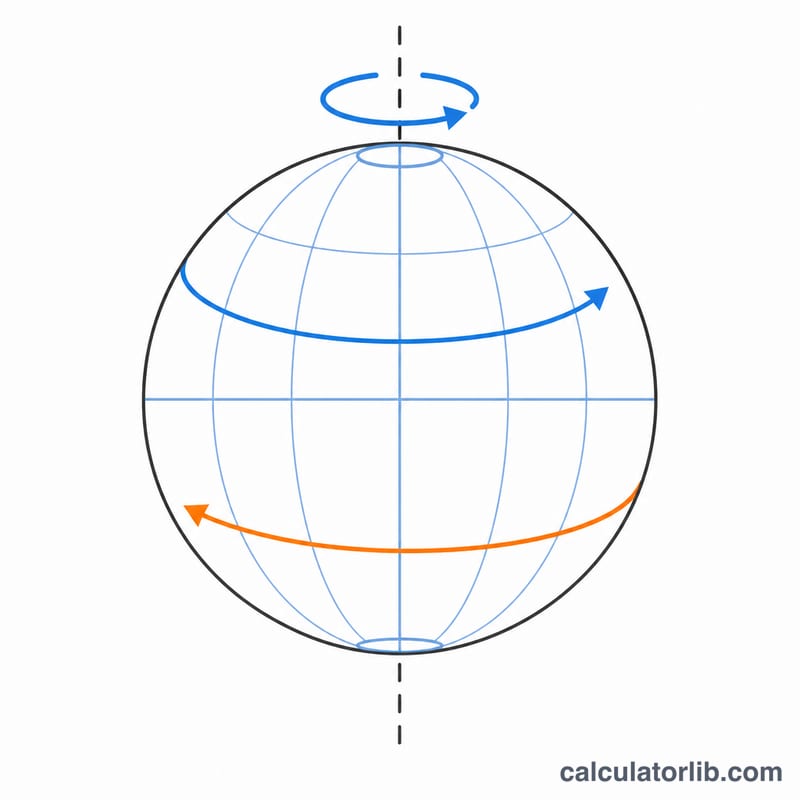
The Coriolis force magnitude is $$F_c = 2 \cdot m \cdot v \cdot \Omega \cdot \sin(\varphi)$$, where \(m\) is mass, \(v\) is speed, \(\Omega\) is angular velocity, and \(\varphi\) is latitude. The latitude is converted to radians before taking the sine. The factor \(\sin(\varphi)\) explains why the horizontal Coriolis effect is strongest at the poles (\(\sin 90^\circ = 1\)) and zero at the equator (\(\sin 0^\circ = 0\)). Dividing by mass gives the acceleration \(a_c = 2v\Omega\cdot\sin(\varphi)\), which does not depend on the object's mass.
Worked example
A 10 kg object moves at 100 m/s at 45° latitude on Earth (\(\Omega = 7.292\times10^{-5}\ \text{rad/s}\)). \(\sin(45^\circ) \approx 0.70711\). $$F = 2 \times 10 \times 100 \times 0.00007292 \times 0.70711 \approx 0.10312\ \text{N}$$ The acceleration is \(0.010312\ \text{m/s}^2\).
FAQ
Why is the force zero at the equator? Because \(\sin(0^\circ) = 0\), the horizontal Coriolis force vanishes at the equator.
Does direction matter? This calculator gives magnitude; in the Northern Hemisphere the deflection is to the right of motion, and to the left in the Southern Hemisphere.
What \(\Omega\) should I use for Earth? Earth completes one rotation per sidereal day, giving \(\Omega \approx 7.292\times10^{-5}\ \text{rad/s}\), the default value here.