
What is the Jacobi cd function?
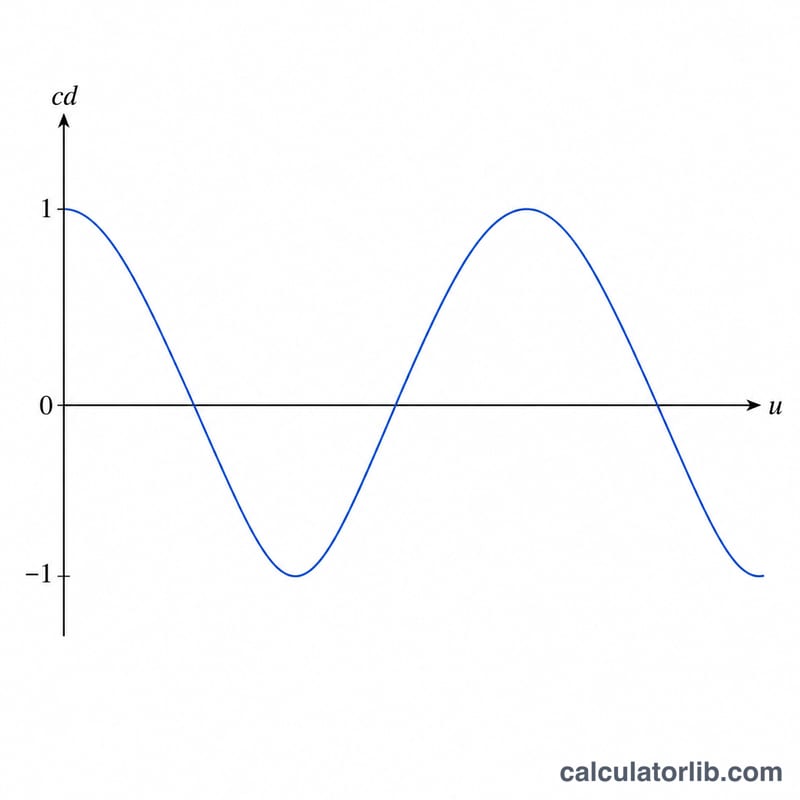
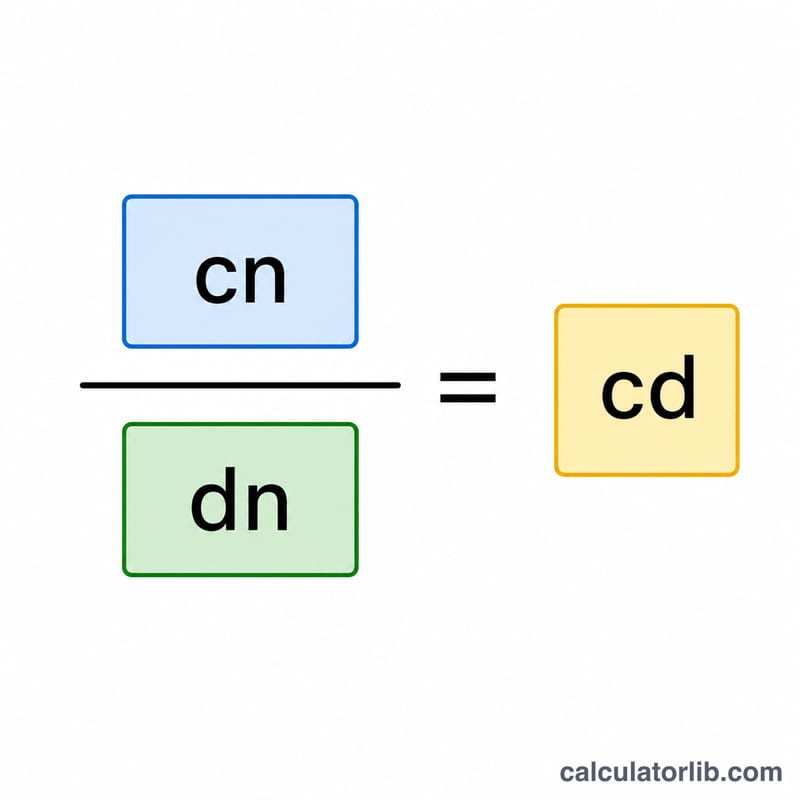
The Jacobi elliptic functions sn, cn and dn generalize the ordinary trigonometric functions and appear throughout physics and engineering: pendulum motion, soliton waves, electrical filter design, and conformal mapping. The function cd(u, k) is one of the derived ratios, defined simply as cn(u, k) divided by dn(u, k). Here u is the argument and k is the modulus, a dimensionless real number with \(-1 \le k \le 1\). This is pure mathematics, so the result is identical everywhere.
How to use the calculator
Enter the argument u (any real number) and the modulus k between -1 and 1. Press calculate to get cd(u, k) to high precision. Because cd depends only on \(m = k^2\), a negative k returns the same value as its absolute value. Large arguments are handled automatically — do not reduce u by hand.
The formula explained
We set the elliptic parameter \(m = k^2\). The amplitude \(\phi = \operatorname{am}(u, k)\) is found with the Arithmetic-Geometric Mean (AGM) descending Landen transformation, which is fast and numerically stable. Then \(\operatorname{sn} = \sin\phi\), \(\operatorname{cn} = \cos\phi\) and \(\operatorname{dn} = \sqrt{1 - m\,\operatorname{sn}^2}\), and finally $$\operatorname{cd}(u,k) = \frac{\operatorname{cn}\!\left(\text{u},\,\text{k}\right)}{\operatorname{dn}\!\left(\text{u},\,\text{k}\right)}$$ Two special cases: when k = 0, $$\operatorname{cd}\!\left(\text{u},\,0\right) = \cos\!\left(\text{u}\right)$$ when k = 1, \(\operatorname{cd}(u, 1) = 1\) for all u.
Worked example
Take \(u = 4\) and \(k = 0.7\), so \(m = 0.49\). Running the AGM ladder and descending to the amplitude gives \(\phi \approx 3.4479\). Then \(\operatorname{cn} = \cos(\phi) \approx -0.9533\) and \(\operatorname{dn} = \sqrt{1 - 0.49\cdot\sin^2\phi} \approx 0.9774\), so $$\operatorname{cd} = \frac{-0.9533}{0.9774} \approx -0.9754$$
FAQ
What is the difference between modulus k and parameter m? Many libraries take the parameter \(m = k^2\) instead of the modulus k. This calculator uses the modulus k directly and squares it internally.
Can dn ever be zero? For \(|k| < 1\), \(\operatorname{dn} = \sqrt{1 - m\,\operatorname{sn}^2} \ge \sqrt{1 - m} > 0\), so cd is always finite. At k = 1, cn = dn so cd = 1.
Is cd even or odd in k? It is even — cd depends only on \(m = k^2\), so \(\operatorname{cd}(u, -k) = \operatorname{cd}(u, k)\).