
What is the Jacobi nd function?
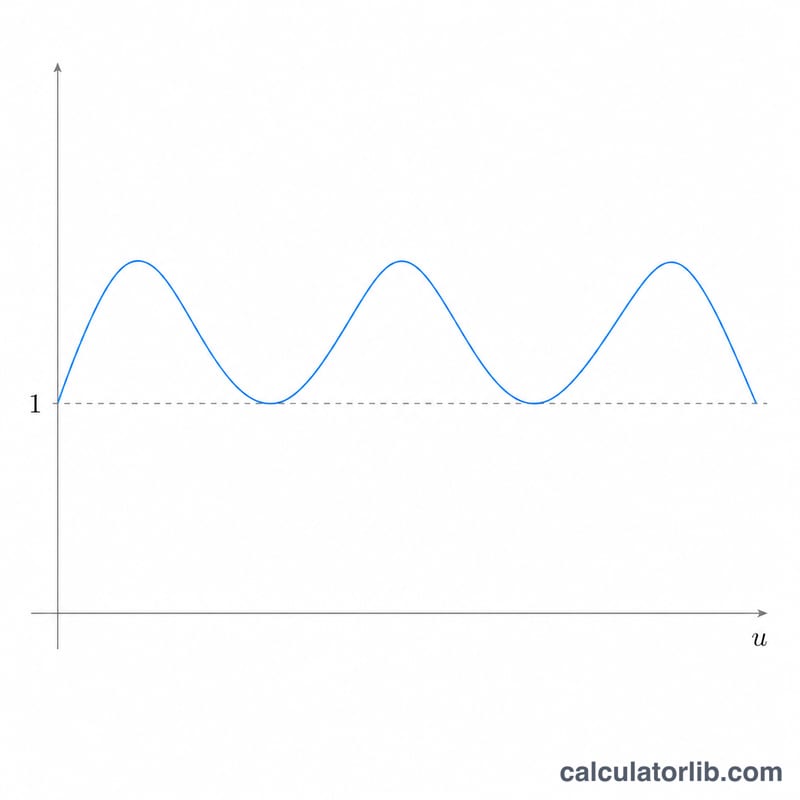
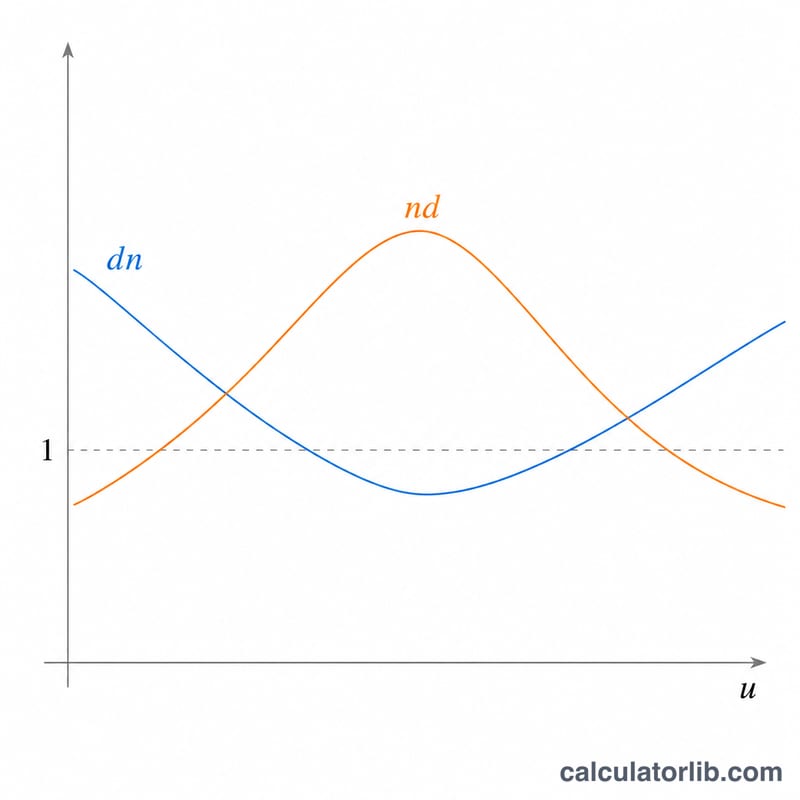
The Jacobi elliptic functions sn, cn and dn generalize the ordinary trigonometric functions and arise from inverting the incomplete elliptic integral of the first kind. The function nd(u, k) is simply the reciprocal of the delta-amplitude function: \(\operatorname{nd}(u,k) = \frac{1}{\operatorname{dn}(u,k)}\). It depends on a real argument u and the elliptic modulus k (note this is the modulus, not the parameter \(m = k^{2}\) and not the modular angle).
How to use this calculator
Enter the argument u (any real number) and the modulus k (typically \(0 \le k \le 1\)). The calculator returns nd(u, k) to about ten significant figures, along with the intermediate values dn(u, k) and sn(u, k).
The formula explained
Setting \(m = k^{2}\), the amplitude is \(\phi = \operatorname{am}(u, k)\) and $$\operatorname{dn}(u,k) = \sqrt{1 - m\cdot\operatorname{sn}^{2}(u, k)}.$$ We evaluate sn using the arithmetic-geometric mean (AGM) and a descending Landen transformation: build sequences a, b, c with \(a_{0}=1\), \(b_{0}=\sqrt{1-m}\), \(c_{0}=k\), iterate the AGM until c is negligible, then descend the angle \(\phi = 2^{N}\cdot a_{N}\cdot u\) back down. Finally \(\operatorname{nd} = \frac{1}{\operatorname{dn}}\).
Worked example
For \(u = 0.5\) and \(k = 0.5\) (\(m = 0.25\)): \(\operatorname{sn} \approx 0.479262\), so $$\operatorname{dn} = \sqrt{1 - 0.25\cdot 0.479262^{2}} \approx 0.970864$$ and $$\operatorname{nd} = \frac{1}{0.970864} \approx 1.0300.$$
FAQ
What happens at k = 0? \(\operatorname{dn}(u, 0) = 1\) for every u, so \(\operatorname{nd}(u, 0) = 1\) exactly.
What about k = 1? \(\operatorname{dn}(u, 1) = \operatorname{sech}(u) = \frac{1}{\cosh(u)}\), so \(\operatorname{nd}(u, 1) = \cosh(u)\).
Is nd ever undefined? For \(0 \le k < 1\), dn is bounded below by \(\sqrt{1 - k^{2}} > 0\), so nd is always finite. Only at \(k = 1\) does dn approach 0 (as \(u \to \pm\infty\)), where nd grows without bound.