
What this calculator does
This tool evaluates the three Jacobi elliptic functions — \(\operatorname{sn}(u,k)\), \(\operatorname{cn}(u,k)\) and \(\operatorname{dn}(u,k)\) — for any real argument \(u\) and a modulus \(k\) in the range 0 to 1. These functions generalize the ordinary trigonometric functions and appear throughout physics and engineering: the exact motion of a pendulum, solitons (the KdV and sine-Gordon equations), elliptic filter design, and conformal maps.
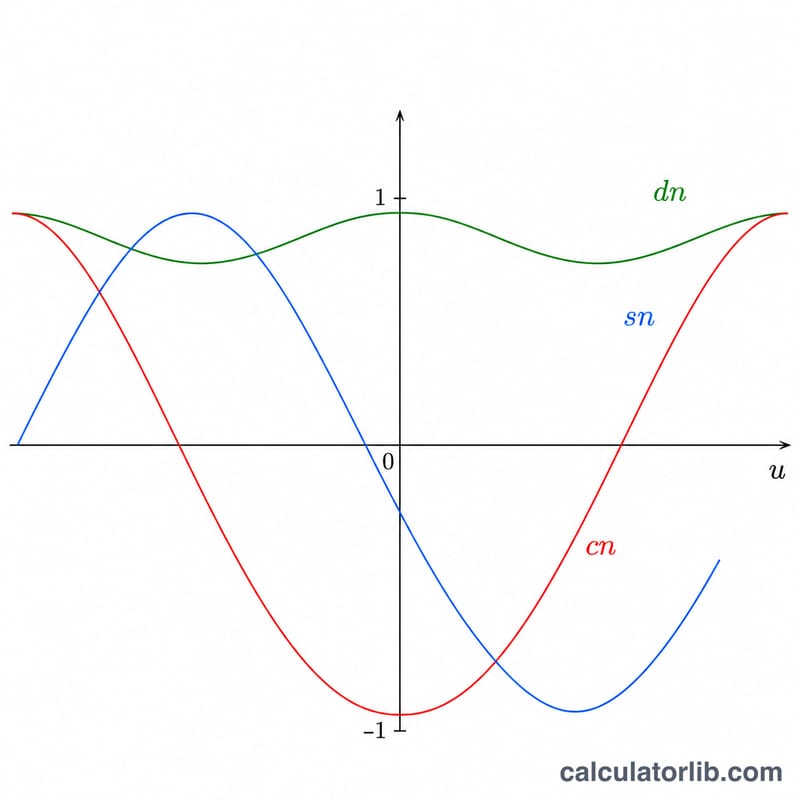
Modulus, parameter and angle conventions
Conventions matter. This calculator uses the modulus \(k\), with \(0 \le k \le 1\). The related parameter is \(m = k^2\), and the modular angle is \(\alpha = \arcsin(k)\). If your source quotes \(m\) or \(\alpha\), convert first: \(k = \sqrt{m}\) or \(k = \sin(\alpha)\). The argument \(u\) and all angles are in radians.
How to use it
Enter the argument \(u\) (any real number) and the modulus \(k\) between 0 and 1, then read off \(\operatorname{sn}\), \(\operatorname{cn}\) and \(\operatorname{dn}\). The result panel also reports the two defining identities, which should both equal 1 — a built-in accuracy check.
The formula and algorithm
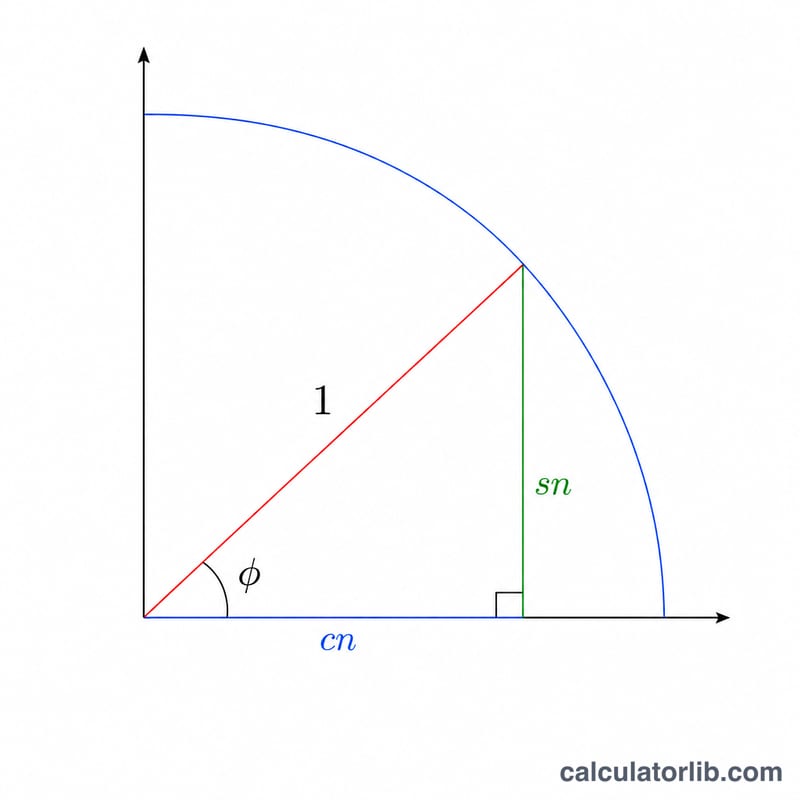
The amplitude \(\phi = \operatorname{am}(u,k)\) is defined implicitly by $$u = \int_{0}^{\phi} \frac{d\theta}{\sqrt{1 - k^2 \sin^2 \theta}}.$$ Then \(\operatorname{sn} = \sin(\phi)\), \(\operatorname{cn} = \cos(\phi)\) and \(\operatorname{dn} = \sqrt{1 - k^2 \sin^2 \phi}\). The calculator inverts the integral with the descending-Landen / Arithmetic-Geometric-Mean (AGM) method, which converges quadratically and reaches double precision in about nine steps. The limiting cases \(k = 0\) ($$\operatorname{sn} = \sin\!\left(u\right),\quad \operatorname{cn} = \cos\!\left(u\right),\quad \operatorname{dn} = 1$$) and \(k = 1\) ($$\operatorname{sn} = \tanh\!\left(u\right),\quad \operatorname{cn} = \operatorname{dn} = \frac{1}{\cosh\!\left(u\right)}$$) are handled by their closed forms to avoid AGM degeneracy.
Worked example
Take \(u = 1.0\) and \(k = 0.5\) (so \(m = 0.25\)). The amplitude is \(\operatorname{am}(1, 0.5) \approx 0.95985\) rad, giving \(\operatorname{sn} \approx 0.81962\), \(\operatorname{cn} \approx 0.57280\) and $$\operatorname{dn} = \sqrt{1 - 0.25 \cdot 0.81962^2} \approx 0.91217.$$ Both identities check out: \(\operatorname{sn}^2 + \operatorname{cn}^2 \approx 1\) and \(\operatorname{dn}^2 + k^2\operatorname{sn}^2 \approx 1\).
FAQ
What are the periods? \(\operatorname{sn}\) and \(\operatorname{cn}\) have real period \(4K(k)\); \(\operatorname{dn}\) has period \(2K(k)\), where \(K(k)\) is the complete elliptic integral of the first kind.
What ranges do the values take? \(|\operatorname{sn}| \le 1\), \(|\operatorname{cn}| \le 1\), and \(k' \le \operatorname{dn} \le 1\) where \(k' = \sqrt{1 - k^2}\) is the complementary modulus.
Can k be greater than 1? Real-valued Jacobi functions require \(0 \le k \le 1\); values of \(k\) outside this range are clamped to the valid interval.