
What is a Complex Number Calculator?
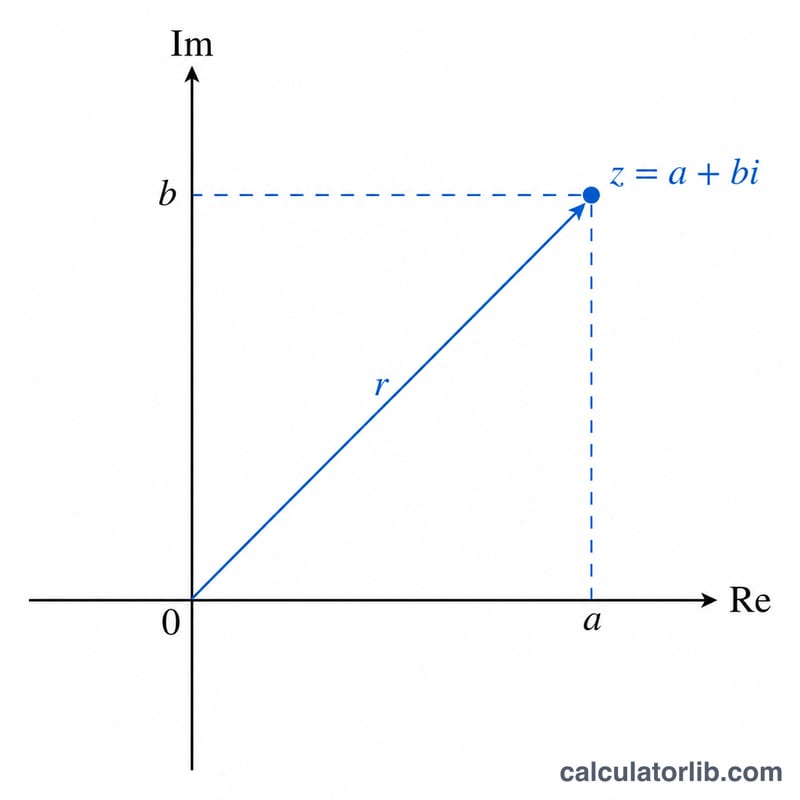
A complex number has the form a + bi, where a is the real part, b is the imaginary part, and i is the imaginary unit defined by \(i^2 = -1\). This calculator performs the four basic arithmetic operations — addition, subtraction, multiplication and division — on two complex numbers and returns the answer in standard a + bi form, along with its magnitude (modulus).
How to use it
Enter the real and imaginary parts of your first number (a and b), choose an operation, then enter the real and imaginary parts of the second number (c and d). The calculator instantly shows the resulting complex number and its magnitude \(|z| = \sqrt{\text{real}^2 + \text{imaginary}^2}\).
The formulas explained
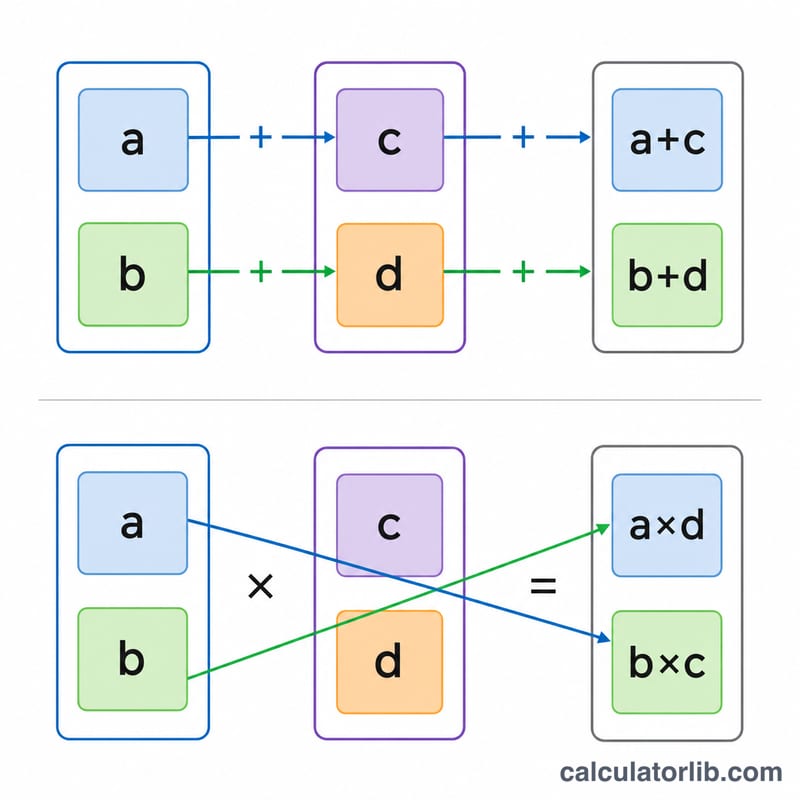
Addition/Subtraction: combine like parts — \((\text{a} \pm \text{c}) + (\text{b} \pm \text{d})\,i\). $$(\text{a} + \text{b}\,i) + (\text{c} + \text{d}\,i) = (\text{a} + \text{c}) + (\text{b} + \text{d})\,i$$ $$(\text{a} + \text{b}\,i) - (\text{c} + \text{d}\,i) = (\text{a} - \text{c}) + (\text{b} - \text{d})\,i$$ Multiplication: expand the product and use \(i^2 = -1\) to get \((\text{a}\text{c} - \text{b}\text{d}) + (\text{a}\text{d} + \text{b}\text{c})\,i\). $$(\text{a} + \text{b}\,i)(\text{c} + \text{d}\,i) = (\text{a}\,\text{c} - \text{b}\,\text{d}) + (\text{a}\,\text{d} + \text{b}\,\text{c})\,i$$ Division: multiply numerator and denominator by the conjugate \((\text{c} - \text{d}\,i)\) of the denominator, giving \(((\text{a}\text{c} + \text{b}\text{d}) + (\text{b}\text{c} - \text{a}\text{d})\,i) / (\text{c}^2 + \text{d}^2)\). $$\frac{\text{a} + \text{b}\,i}{\text{c} + \text{d}\,i} = \frac{\text{a}\,\text{c} + \text{b}\,\text{d}}{\text{c}^{2} + \text{d}^{2}} + \frac{\text{b}\,\text{c} - \text{a}\,\text{d}}{\text{c}^{2} + \text{d}^{2}}\,i$$
Worked example
Multiply \((3 + 2i)\) by \((1 + 4i)\). Real part \(= (3\cdot1 - 2\cdot4) = 3 - 8 = -5\). Imaginary part \(= (3\cdot4 + 2\cdot1) = 12 + 2 = 14\). So the answer is −5 + 14i, with magnitude $$\sqrt{(-5)^2 + 14^2} = \sqrt{221} \approx 14.866.$$
FAQ
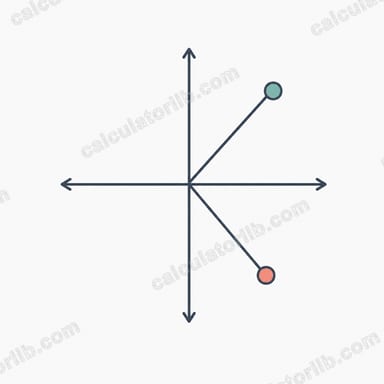
What does the magnitude mean? It is the distance of the point a+bi from the origin in the complex plane, computed as \(\sqrt{\text{a}^2 + \text{b}^2}\).
What happens when I divide by 0+0i? Division by zero is undefined; the calculator returns 0+0i as a safe guard, so avoid a denominator of zero.
Can I enter negative or decimal values? Yes. All four input fields accept any real number, positive, negative or fractional.