
What Is the Complex to Rectangular Form Calculator?
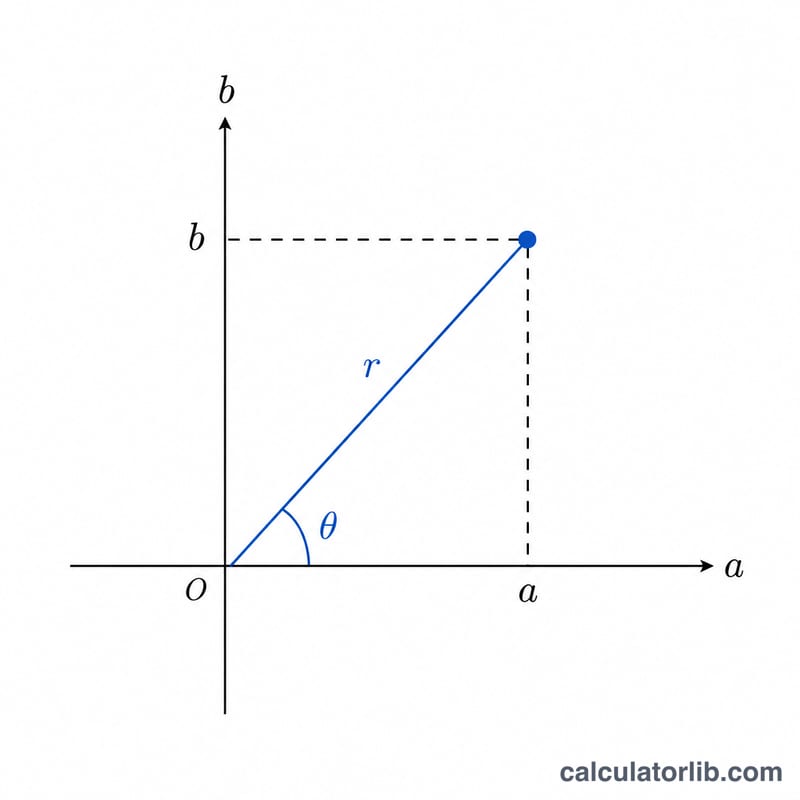
A complex number can be written in two equivalent ways. The polar form describes it by a magnitude r (its distance from the origin) and an angle θ (its direction). The rectangular form writes it as a + bi, where a is the real part and b is the imaginary part. This calculator converts polar coordinates to rectangular form instantly.
How to Use It
Enter the magnitude r and the angle θ, then choose whether the angle is in degrees or radians. The calculator returns the real and imaginary parts and shows the full a + bi expression. Degrees are converted to radians internally using \(\theta \times \pi / 180\).
The Formula Explained
The conversion comes straight from trigonometry on the complex plane. A point at distance r and angle θ has horizontal coordinate a = r·cos(θ) and vertical coordinate b = r·sin(θ). So the complex number is
$$z = \text{r}\cos\!\left(\theta\right) + \text{r}\sin\!\left(\theta\right)i$$which is Euler's relation in disguise (\(r \cdot e^{i\theta}\)).
Worked Example
Suppose r = 5 and θ = 53.13°. Then
$$a = 5 \times \cos(53.13°) \approx 5 \times 0.6 = 3.00$$$$b = 5 \times \sin(53.13°) \approx 5 \times 0.8 = 4.00$$The rectangular form is approximately 3 + 4i, the classic 3-4-5 triangle.
FAQ
What if the angle is negative? Negative angles simply rotate clockwise. The cosine and sine handle the signs automatically, so b may come out negative (e.g. 3 − 4i).
Degrees or radians? Both are supported. Choose the unit that matches your source data; the result is identical once converted.
How is this different from rectangular to polar? This tool goes from (r, θ) to (a, b). The reverse uses \(r = \sqrt{a^2 + b^2}\) and \(\theta = \operatorname{atan2}(b, a)\).