
What this converter does
This tool converts mass between the metric system (kilograms and grams) and the avoirdupois system (pounds and ounces) in either direction. It is a pure, universal unit converter: the definitions used apply worldwide, not to any single country. The numbers are based on the exact international avoirdupois pound, where 1 lb = 0.45359237 kg and 1 lb = 16 oz.
How to use it
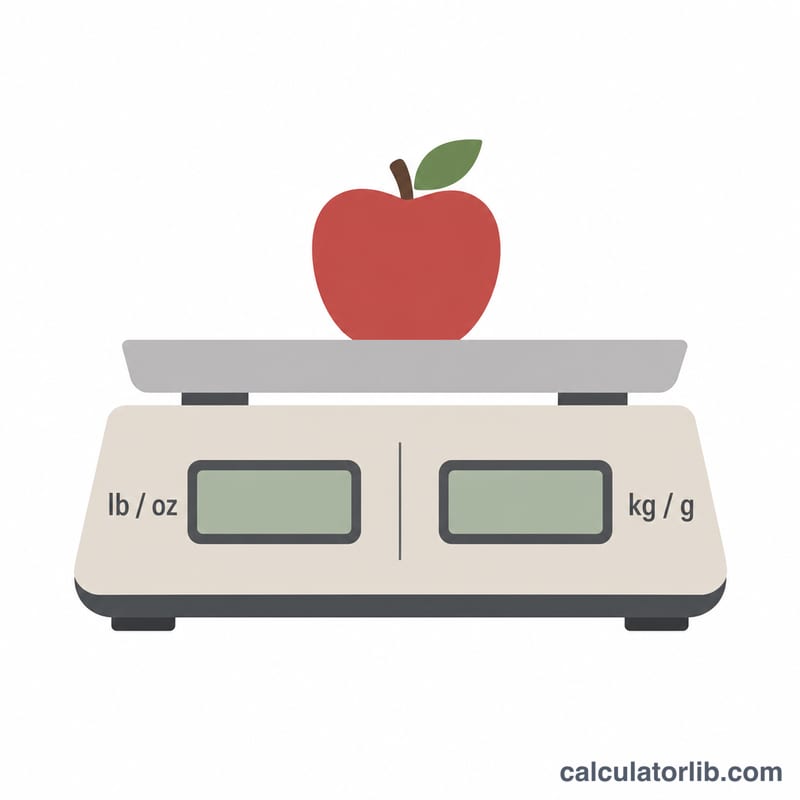
First pick a direction. For Metric to Imperial, type a weight in kilograms and the tool returns the equivalent in whole pounds plus remaining ounces, as well as the decimal-pound and total-ounce forms. For Imperial to Metric, enter pounds and ounces and the tool returns kilograms and grams. Empty fields are treated as zero, and negative values are clamped to zero because mass cannot be negative.
The formula explained
Every conversion is routed through kilograms (the SI base unit). To go from imperial to metric, multiply pounds by \(0.45359237\) and ounces by \(0.0283495231875\) (which is \(0.45359237\) divided by \(16\)), then add them. To go from kilograms back out, divide by \(0.45359237\) to get total pounds; the whole-number part is the pounds and the fractional part multiplied by \(16\) gives the leftover ounces.
$$\text{Grams} = \left( \text{Pounds} + \frac{\text{Ounces}}{16} \right) \times 453.59237$$$$\text{Pounds} = \frac{\text{Kilograms}}{0.45359237}$$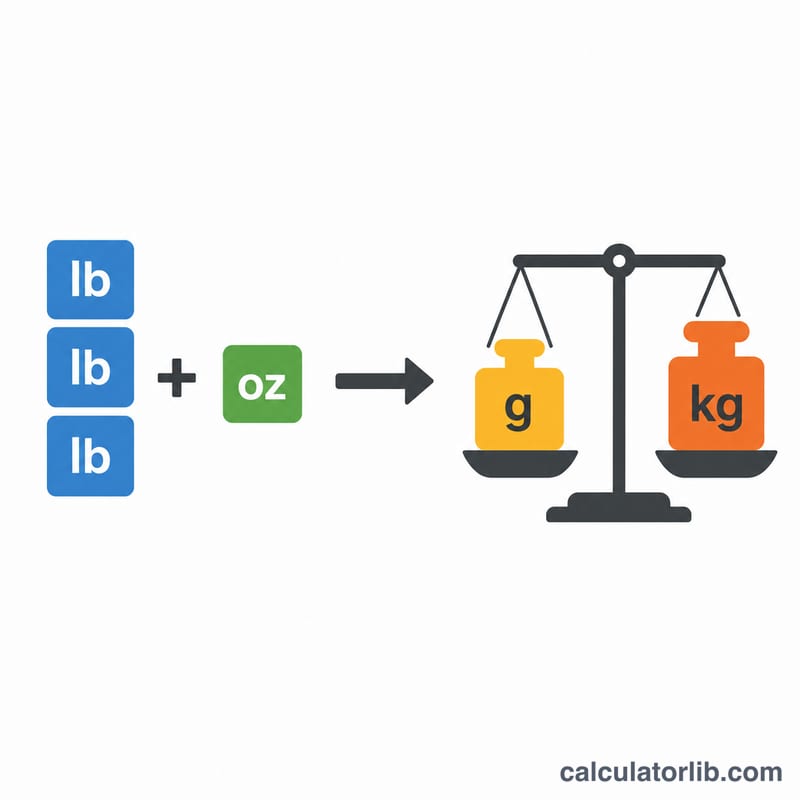
Worked example
Take 1 kilogram. Total pounds = \(1 / 0.45359237 = 2.2046226218\) lb. The whole part is 2 lb. The remainder \(0.2046226218 \times 16 = 3.27396195\) oz. So 1 kg equals 2 lb 3.27 oz, or 2.2046 lb, or 35.274 oz. Reversing it: \(2 + 3.27396195/16 = 2.2046226219\) lb, times \(0.45359237 = 1.000\) kg.
FAQ
Why 0.45359237? That is the exact internationally agreed definition of the avoirdupois pound, adopted in 1959, so the conversion has no rounding error at the source.
Is this the same as troy ounces? No. This converter uses avoirdupois ounces (16 per pound), the everyday unit. Troy ounces, used for precious metals, are heavier and there are only 12 to a troy pound.
Why can ounces show close to 16? The ounce remainder is always less than 16. If display rounding pushes it to 16.0, treat it as one extra whole pound with 0 ounces.