
What this converter does
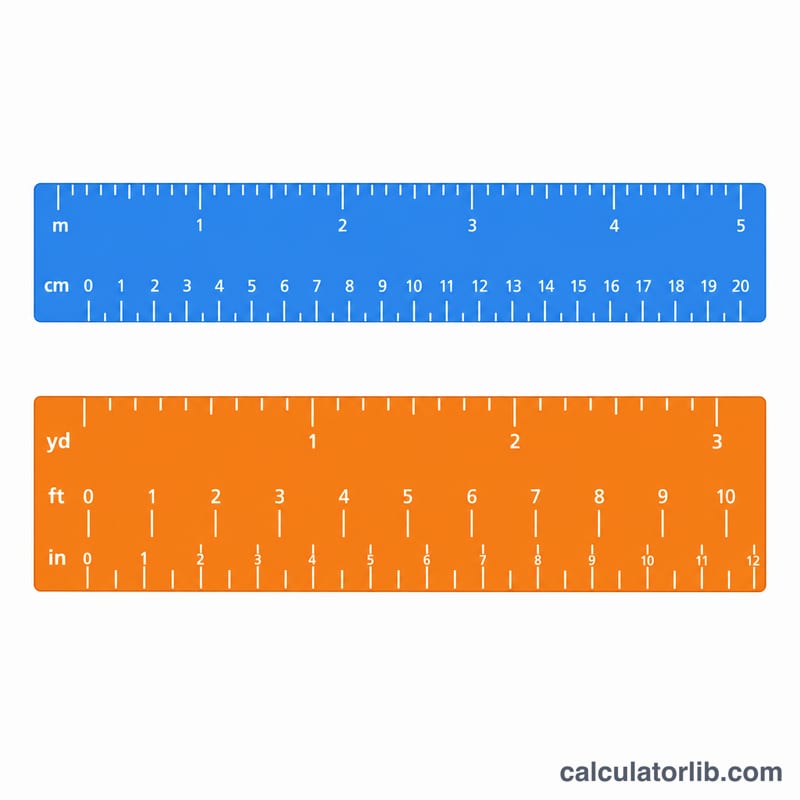
This tool converts a length between the metric system (meters and centimeters) and the imperial / US customary "yard-pound" system (yards, feet and inches), in both directions. Because all the conversion factors are exact international definitions, the calculator is universal and applies anywhere in the world.
How to use it
Pick the unit system your length is given in. Choose Metric and enter meters and centimeters, or choose Imperial / yard-pound and enter yards, feet and inches. Leave any box blank or 0 if you do not need it. The result shows the same physical length expressed in every common form: meters, centimeters, millimeters, total inches, decimal feet, a feet-plus-inches breakdown, decimal yards, and a yards-plus-feet-plus-inches breakdown.
The formula explained
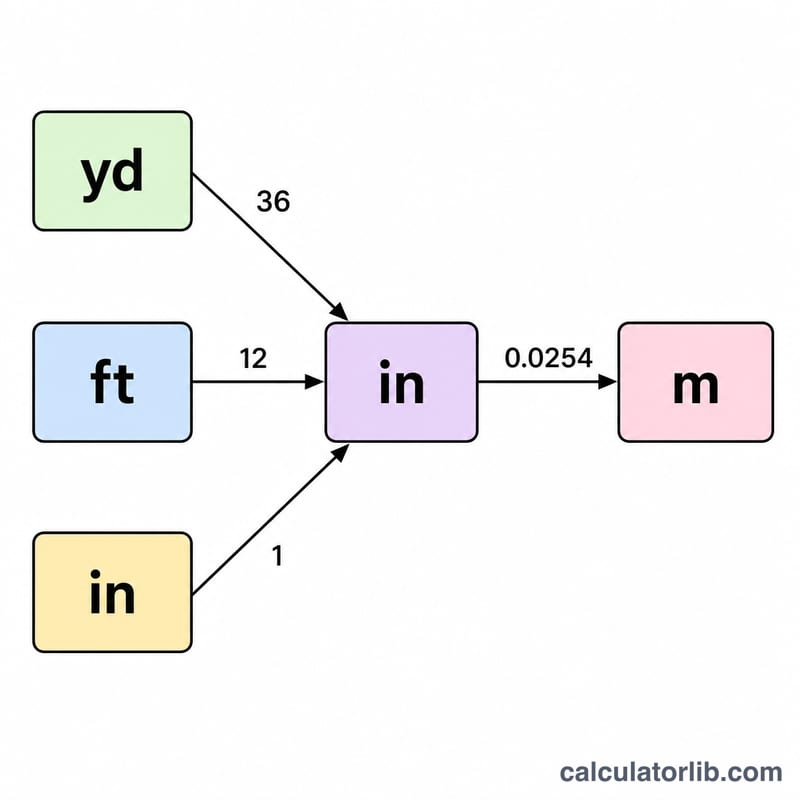
Every input is first normalized to a single value L in meters. From imperial input, $$L = \left(\text{yards} \times 36 + \text{feet} \times 12 + \text{inches}\right) \times 0.0254.$$ From metric input, $$L = \text{meters} + \frac{\text{centimeters}}{100}.$$ Then L is re-expressed: centimeters = \(L \times 100\), millimeters = \(L \times 1000\), total inches = \(L / 0.0254\), decimal feet = \(L / 0.3048\), and decimal yards = \(L / 0.9144\). Whole-part breakdowns use floor on the total inch count.
Worked example
Enter 1 meter. Total inches = \(1 / 0.0254 = 39.3701\) in. Decimal feet = \(39.3701 / 12 = 3.28084\) ft, or 3 feet and 3.3701 inches. Decimal yards = \(1 / 0.9144 = 1.09361\) yd. This equals 100 cm and 1000 mm.
FAQ
Is the inch-to-meter factor exact? Yes. Since 1959 one inch is defined as exactly 2.54 centimeters, making 0.0254 m an exact value with no rounding error.
Why are there two breakdowns for imperial? Lengths are commonly written as feet-and-inches (for height) or yards-feet-inches (for distance), so both are provided.
What about negative lengths? Negative inputs are clamped to zero because a physical length cannot be negative.