What Is the Square Meter Calculator?
The Square Meter Calculator works out the area of a rectangular space in square meters (m²) from its length and width. Square meters are the standard SI unit of area, used worldwide for floor plans, flooring, paint, landscaping, real estate and tiling projects. This tool is universal — it works in any country that uses the metric system.
How to Use It
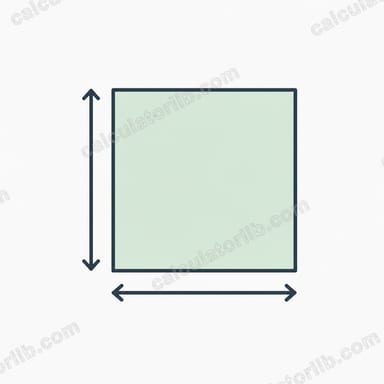
Enter the length and the width of your space in meters. The calculator multiplies the two values to give the area in square meters, and also converts the result to square feet for convenience. For non-rectangular areas, split the space into rectangles, calculate each one, and add the results together.
The Formula Explained
The core formula is simply $$\text{Area} = \text{Length} \times \text{Width}$$ If a room is 5 meters long and 4 meters wide, the area is \(5 \times 4 = 20\) square meters. To convert to square feet, multiply the square-meter result by \(10.7639\), since one square meter equals 10.7639 square feet.
Worked Example
Suppose you are tiling a kitchen floor measuring 6 m by 3.5 m. The area is \(6 \times 3.5 = 21\) m². In square feet that is \(21 \times 10.7639 \approx 226.04\) ft². If each tile box covers 1.5 m², you would need at least \(21 \div 1.5 = 14\) boxes (plus extra for cuts and waste).
Area Unit Conversion Table
The calculator returns area in square metres (m²), the SI unit of area. Use the factors below to express the same area in other units. These conversion factors are international (SI / international foot and yard) and apply everywhere; note that the acre and square foot are customary units used mainly in the United States, the United Kingdom and a few other countries.
| 1 m² equals | Value | Unit |
|---|---|---|
| Square feet | 10.7639 | ft² |
| Square yards | 1.19599 | yd² |
| Square centimetres | 10,000 | cm² |
| Square millimetres | 1,000,000 | mm² |
| Hectares | 0.0001 | ha |
| Acres | 0.000247105 | ac |
| Starting unit | Multiply by | Result in m² |
|---|---|---|
| 1 ft² | 0.092903 | 0.092903 m² |
| 1 yd² | 0.836127 | 0.836127 m² |
| 1 cm² | 0.0001 | 0.0001 m² |
| 1 mm² | 0.000001 | 0.000001 m² |
| 1 acre | 4046.86 | 4046.86 m² |
| 1 hectare | 10,000 | 10,000 m² |
Important: square the linear factor. An area factor is the linear factor multiplied by itself, so you can never reuse a length conversion directly. Because 1 cm = 0.01 m:
$$1\ \text{cm}^2 = (0.01\ \text{m})^2 = 0.01 \times 0.01 = 0.0001\ \text{m}^2$$
The same rule explains the foot factor: 1 ft = 0.3048 m exactly, so \(1\ \text{ft}^2 = 0.3048^2 = 0.09290304\ \text{m}^2\), and inversely \(1\ \text{m}^2 = 1 \div 0.09290304 \approx 10.7639\ \text{ft}^2\). Halving a length quarters the area, and doubling a length quadruples it.
Practical Recommendations for Material Estimates
A square-metre figure is only the starting point for an order. Cutting, breakage and pattern matching all consume material, so add an overage allowance before you buy. The ranges below are widely used trade rules of thumb rather than a formal standard — your supplier or installer may quote different figures for a specific product.
| Job type | Suggested overage | Why |
|---|---|---|
| Straight-lay tile or plank flooring, simple rectangular room | 5–10% | Perimeter cuts and a few breakages |
| Diagonal, herringbone or chevron layouts | 10–15% | Every edge tile is an angled cut, so offcuts are largely unusable |
| Rooms with many alcoves, bays or angles | 10–15% | More cut lines per square metre |
| Patterned or large-repeat wallpaper | 10–15% | Each drop must be trimmed to align the repeat |
| Plain / non-match wallpaper | ~10% | Trimming top and bottom of each drop |
| Broadloom carpet | Plan by roll width, not by area | Carpet is sold in fixed-width rolls, so usable area depends on how the room fits the width |
- Always round up to whole sale units. Boxes of tiles, tins of paint, rolls of wallpaper and packs of laminate are not sold by the fraction — 7.3 boxes means ordering 8.
- Measure each room separately and add the areas. Averaging room sizes, or measuring one bedroom and multiplying by three, hides the differences that cause shortfalls.
- Check squareness. Few rooms are perfect rectangles. Measure the width at both ends; if the two readings differ, use the larger one for ordering and treat the difference as extra waste.
- Subtract large fixed obstructions, keep small ones. Deduct kitchen islands, built-in wardrobes, stair openings and hearths. Do not deduct doorways, thresholds or small pipe boxings — you still need material to cut around them, and floor covering usually runs into the door opening.
- Read the stated coverage on the product. Coverage in m² per box, per roll or per litre varies by brand, tile size and surface porosity. Divide your area by the printed figure rather than assuming a standard value, and remember paint coverage is per coat.
- Buy from one batch and keep one spare box. Dye lots and tile shades drift between production runs. A single retained box (stored flat and dry) lets you repair damage years later without a visible mismatch.
- Confirm before cutting. Re-measure on site before the first cut; an ordering error is cheap to fix, a cutting error is not.
These are general planning guidelines. For structural, regulatory or high-value work, follow the manufacturer's installation instructions and your local building rules, and have quantities confirmed by the installer or supplier who will stand behind them.
FAQ
How do I measure an irregular room? Break it into rectangles, find each rectangle's area, then sum them.
How many square feet is one square meter? One square meter equals about 10.7639 square feet.
Can I enter centimeters? No — convert to meters first by dividing centimeters by 100 (e.g. 350 cm = 3.5 m).