What is the Cubic Meter Calculator?
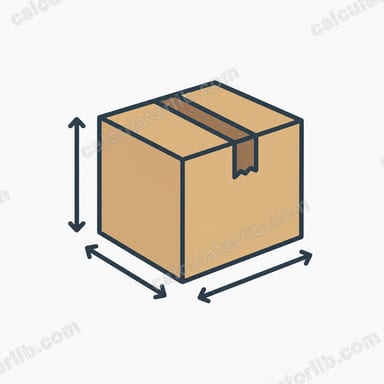
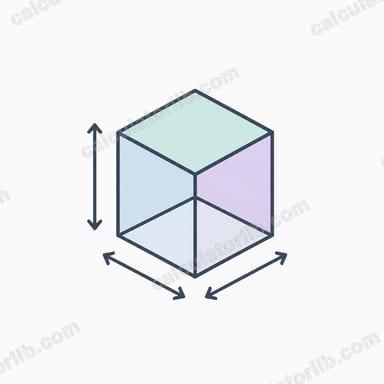
The cubic meter calculator works out the volume of a box-shaped (rectangular) space or object by multiplying its length, width and height. The cubic meter (m³) is the SI unit of volume and is widely used in shipping (CBM), construction, concrete ordering, water storage and freight pricing. This tool is universal — it works the same anywhere in the world.
How to use it
Enter the length, width and height of your object or space, all in meters. The calculator instantly returns the volume in cubic meters, and also converts that figure into liters and cubic feet so you can use whichever unit your supplier or carrier requires. If your measurements are in centimeters, divide each by 100 before entering them (100 cm = 1 m).
The formula explained
Volume of a rectangular box is simply length times width times height: $$V = L \times W \times H$$ Because every dimension is in meters, the product is in cubic meters. To convert, 1 m³ = 1000 liters and 1 m³ ≈ 35.3147 cubic feet.

Worked example
Suppose a shipping carton measures 2 m long, 1.5 m wide and 1 m tall. Volume = $$2 \times 1.5 \times 1 = 3 \text{ m}^3$$ That equals 3000 liters or about 105.94 cubic feet.

Practical Tips for Using Your CBM Result
A cubic-metre figure is a starting point, not the quantity you order or the volume you are billed for. How to bridge the gap depends on what the volume is for.
Ordering concrete, screed, aggregate or topsoil
- Add roughly 5–10% to the calculated volume. The extra covers spillage, over-excavation, uneven subgrade, formwork that bows slightly outward and material left in the barrow or pump line. A trench or a slab poured on rough ground sits at the top of that range; a slab cast between rigid forms on a blinding layer sits near the bottom. On the 3 m³ slab above, that is about 3.15–3.3 m³.
- Expect to order in increments. Ready-mix suppliers in many markets sell in 0.5 m³ steps and apply a minimum load charge below a certain volume; confirm the increment and minimum with your local supplier before you size the pour, as this is a commercial convention rather than a standard and varies by country and plant.
- Never round the calculated volume down. Running short mid-pour creates a cold joint that is far more expensive than the surplus material.
Freight and shipping
- Measure the outer packaging, not the product. Include the carton, pallet, crate, corner protectors and shrink wrap — carriers measure the extremes of the piece as presented.
- Round every dimension up to the next whole centimetre before converting to metres. That is how most carriers re-measure, and it prevents a surprise re-weigh charge.
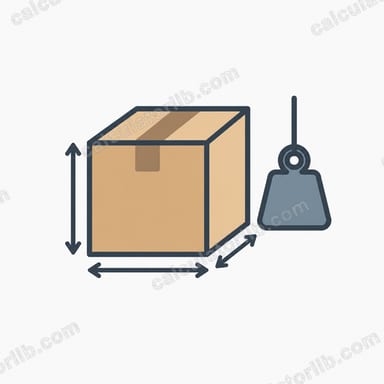
- Compare actual weight against volumetric (dimensional) weight — you are billed on the greater. Two widely used conventions: sea LCL commonly treats 1 m³ as equivalent to 1,000 kg (the "revenue tonne"), and air freight commonly uses 1 m³ ≈ 167 kg (from the IATA 6,000 cm³/kg divisor). Courier and parcel services often use a different divisor again, so check the rate sheet for the service you are actually buying. Light bulky goods bill on volume; dense goods bill on weight.
- Handle irregular loads two ways. To know how much material or space an odd shape truly occupies, split it into boxes and cylinders, compute each, and sum. To know what you will be charged, use the bounding box — the smallest rectangular envelope the item fits inside.
- Check the total against the container before you commit. Compare your summed CBM with the usable (not nominal) capacity in the table below, and confirm the stack height and pallet footprint work — a load can fit on volume yet fail on floor area or on a maximum payload limit.
Also check whether your figure needs to be net or gross: filling a tank uses net internal volume, while shipping, excavation spoil and storage-unit sizing all use gross external volume, which is always larger.
This section is general practical guidance only. Material allowances, carrier billing rules, container specifications and any load, weight or safety limits vary by supplier, carrier and jurisdiction — confirm the numbers that apply to your job with your supplier, freight forwarder or a qualified engineer before ordering or shipping.
FAQ
How do I convert cm to m? Divide centimeters by 100. So 150 cm becomes 1.5 m.
What is CBM? CBM stands for cubic meter and is the standard volume measure used in freight and shipping quotes.
How many liters are in a cubic meter? Exactly 1000 liters.