What is cubic weight?
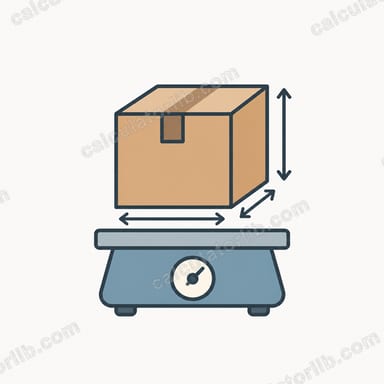
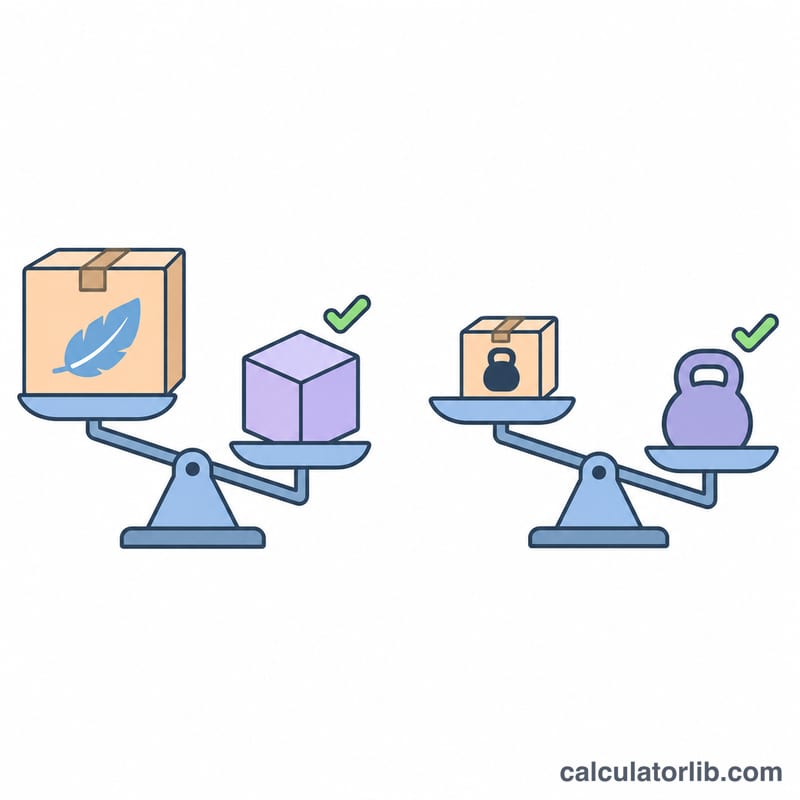
Cubic weight, also called volumetric or dimensional weight, is a pricing technique carriers use for lightweight parcels that take up a lot of space. Because a courier van or aircraft runs out of room before it runs out of weight capacity, shippers are charged on whichever is larger: the real weight of the box or the space it occupies. This calculator converts your parcel dimensions into a cubic weight and shows which figure you will actually pay for.
How to use this calculator
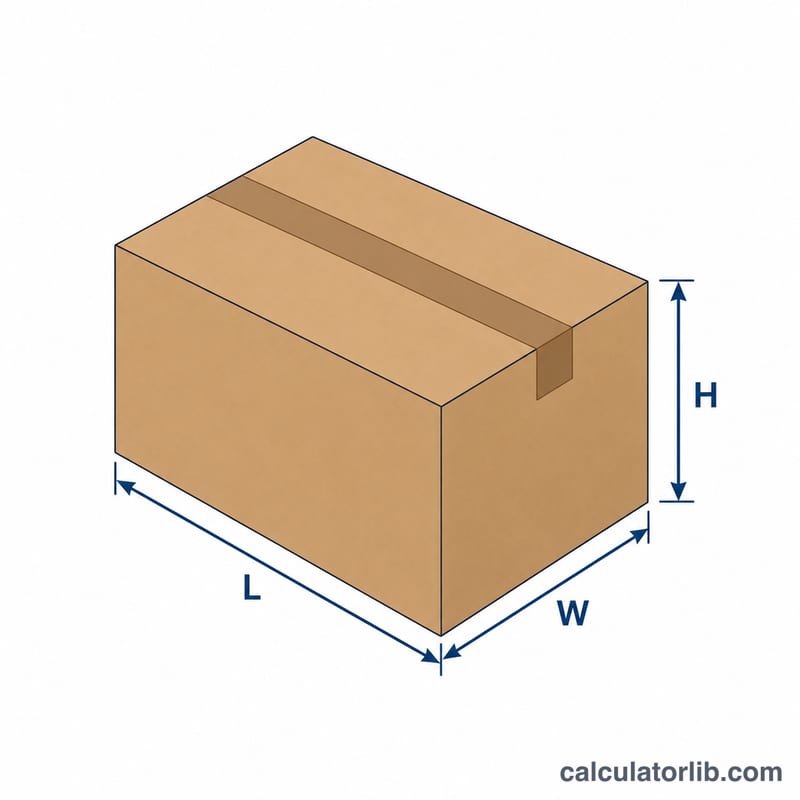
Enter the length, width and height of your package in centimetres, then set the dimensional factor (divisor) used by your carrier. Common divisors are 5000 for international air freight, 6000 for many express couriers and 4000 for domestic road freight. Add the actual scale weight in kilograms to see the chargeable weight.
The formula explained
The cubic weight is the box volume divided by the divisor:
$$\text{CW} = \frac{L \times W \times H}{D}$$where \(L\), \(W\) and \(H\) are the dimensions in centimetres and \(D\) is the dimensional factor. The chargeable weight is then \(\max(\text{Actual}, \text{CW})\), and the volume in cubic metres is the cm³ volume divided by one million.
Worked example
Take a carton measuring 40 x 30 x 20 cm with an actual weight of 3 kg, shipped on a 5000 divisor. The volume is \(40 \times 30 \times 20 = 24000\) cm³, so the cubic weight is
$$\text{CW} = \frac{24000}{5000} = 4.8\,\text{kg}.$$Since 4.8 kg is greater than the 3 kg actual weight, the chargeable weight is 4.8 kg.
Unit Conversions for Inches and Pounds
The calculator works in centimetres and kilograms. If your box is measured in inches or your scale reads in pounds, convert first using the exact or standard factors below.
| Quantity | Conversion |
|---|---|
| Length | 1 in = 2.54 cm (exact) |
| Mass | 1 lb = 0.453592 kg |
| Mass | 1 kg = 2.20462 lb |
| Volume | 1 m³ = 1,000,000 cm³ |
| Volume | 1 ft³ = 28,316.8 cm³ |
| Volume | 1 in³ = 16.387 cm³ |
Imperial divisor equivalents
To turn a metric divisor (cm³/kg) into an imperial one (in³/lb), convert cm³ to in³ and kg to lb:
$$D_{\text{in}^3/\text{lb}} = \frac{D_{\text{cm}^3/\text{kg}}}{16.387} \times 0.453592$$| Metric divisor (cm³/kg) | Calculation | Imperial divisor (in³/lb) |
|---|---|---|
| 5000 | \(5000 \div 16.387 \times 0.453592 \approx 138.4\) | ≈ 139 (the published figure) |
| 6000 | \(6000 \div 16.387 \times 0.453592 \approx 166.1\) | ≈ 166 |
| 4000 | \(4000 \div 16.387 \times 0.453592 \approx 110.7\) | ≈ 111 |
The imperial divisors are rounded, so a result worked out in inches and pounds can differ slightly from the metric one. For example, a 16 × 12 × 8 in box is 1,536 in³, and \(1536 \div 139 \approx 11.05\) lb. Use whichever unit system your carrier quotes in.
How the Divisor and Box Size Change the Chargeable Weight
The chargeable weight is the greater of the actual weight and the cubic weight:
$$\text{CW} = \frac{L \times W \times H}{D} \qquad \text{Chargeable} = \max(A,\ \text{CW})$$The table below takes one standard carton through three divisors. It then compares a small dense box with a large light one.
| Box (cm) | Volume (cm³) | Volume (m³) | Divisor | Cubic weight (kg) | Actual weight (kg) | Chargeable weight (kg) |
|---|---|---|---|---|---|---|
| 40 × 30 × 20 | 24,000 | 0.024 | 4000 | \(24000 \div 4000 = 6.0\) | 3 | 6.0 (cubic) |
| 40 × 30 × 20 | 24,000 | 0.024 | 5000 | \(24000 \div 5000 =\) 4.8 | 3 | 4.8 (cubic) |
| 40 × 30 × 20 | 24,000 | 0.024 | 6000 | \(24000 \div 6000 = 4.0\) | 3 | 4.0 (cubic) |
| 20 × 15 × 10 (dense) | 3,000 | 0.003 | 5000 | \(3000 \div 5000 = 0.6\) | 3 | 3.0 (actual) |
| 60 × 40 × 40 (light) | 96,000 | 0.096 | 5000 | \(96000 \div 5000 =\) 19.2 | 5 | 19.2 (cubic) |
What the comparison shows
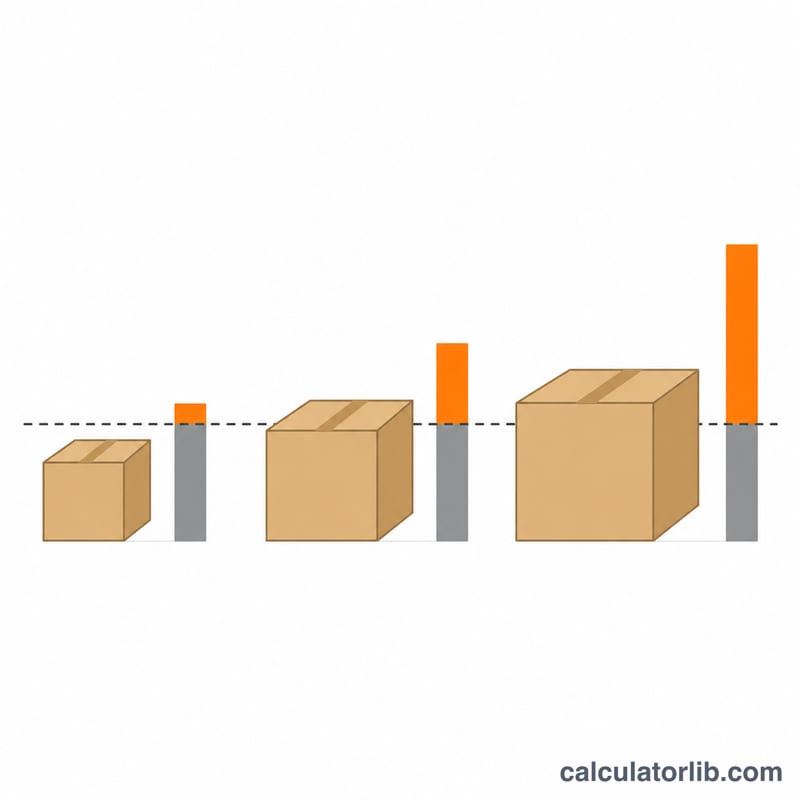
- The divisor matters a lot. For the same 40 × 30 × 20 cm carton, the billed weight drops from 6.0 kg to 4.0 kg as the divisor rises from 4000 to 6000. That is a 50% difference in billed weight for an identical parcel.
- Dense items are billed on actual weight. The 20 × 15 × 10 cm box has a cubic weight of only 0.6 kg, so its 3 kg actual weight is what you pay for.
- Large, light items are billed on volume. The 60 × 40 × 40 cm box weighs 5 kg, but you are charged for 19.2 kg, almost four times its actual weight. Cutting a few centimetres from the box can lower the cost noticeably.
Carriers may round dimensions or weights up, for example to the next whole centimetre or the next 0.5 kg. Your invoice can therefore be slightly higher than the raw figures above.
FAQ
Which divisor should I use? Check your carrier's terms; 5000 and 6000 are the most common for air and express shipments.
Why is my light box so expensive? Bulky but light parcels are billed on cubic weight rather than scale weight.
Does it work in inches and pounds? This version expects centimetres and kilograms, so convert your units first.