
What Is Dimensional Weight?
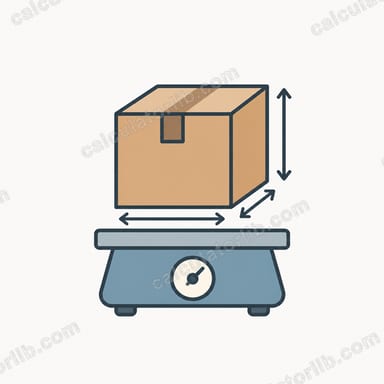
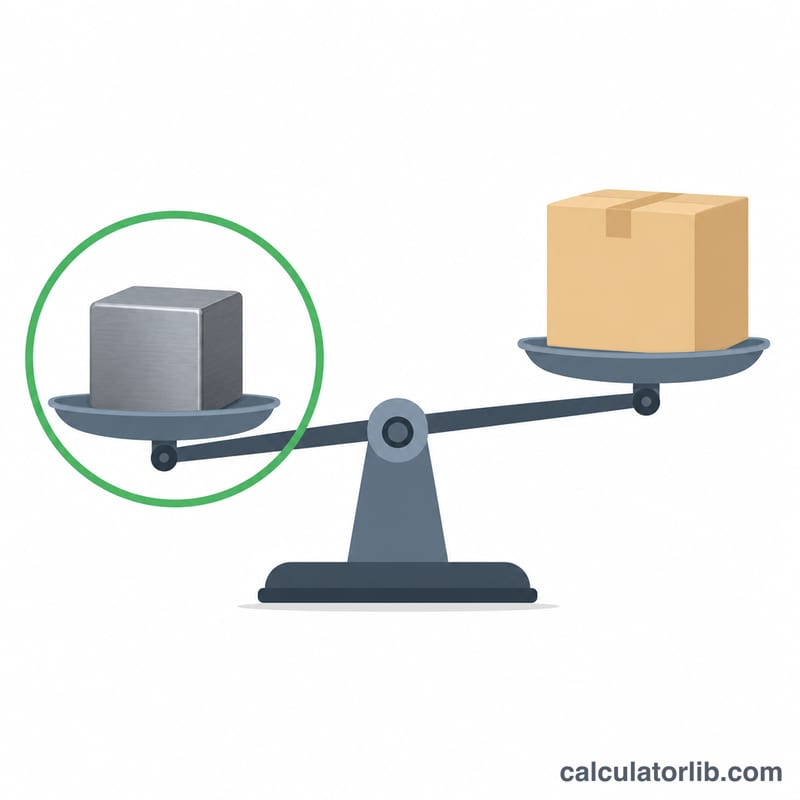
Dimensional weight (also called DIM weight or volumetric weight) is a pricing technique carriers use so that lightweight but bulky packages are charged fairly for the space they occupy. Instead of billing only by scale weight, carriers compare your package's actual weight to a weight derived from its volume and charge for whichever is larger — the billable weight.
How to Use This Calculator
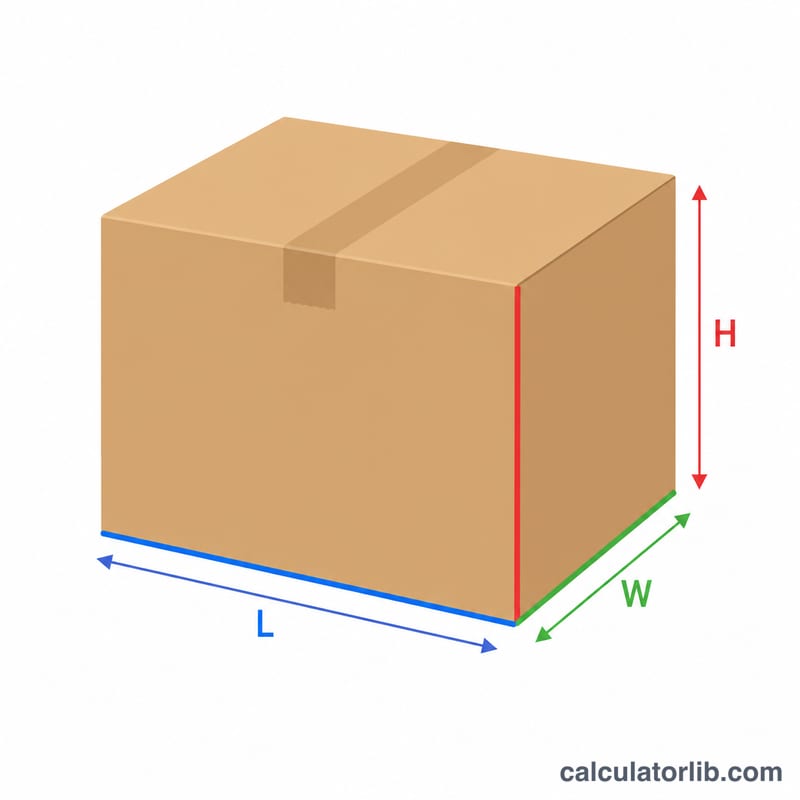
Enter the package's length, width, and height, choose the DIM divisor your carrier uses, and enter the actual (scale) weight. Use inches with divisors 139 or 166 for pounds, or centimeters with divisors 5000 or 6000 for kilograms. The calculator returns the dimensional weight and the billable weight.
The Formula Explained
First the package volume is computed as \(\text{L} \times \text{W} \times \text{H}\). Dividing that volume by the DIM divisor converts the cubic measurement into a weight. The billable weight is then the maximum of the actual weight and the dimensional weight, because carriers always charge for the higher number.
$$\text{Billable} = \max\!\left(\text{Actual},\ \text{DIM}\right)$$ $$\text{where}\quad \left\{ \begin{aligned} \text{DIM} &= \dfrac{\text{Length} \times \text{Width} \times \text{Height}}{\text{DIM Divisor}} \\ \text{Actual} &= \text{Actual Weight} \end{aligned} \right.$$
For example, a 12 × 10 × 8 inch box has a volume of 960 in³. With a divisor of 139, the dimensional weight is \(960 \div 139 \approx 6.91\) lb. If the box actually weighs 5 lb, the billable weight is \(\max(5,\ 6.91) = 6.91\) lb — you'd be charged as if it weighed nearly 7 pounds.
FAQ
Which divisor should I use? UPS and FedEx domestic US shipments commonly use 139 (inches/pounds); international and some USPS services use 166. Metric express often uses 5000 and economy 6000 (cm³/kg). Always confirm with your carrier's current rate guide.
Do I always pay the dimensional weight? No — you pay the billable weight, which is the greater of actual and dimensional. Dense, heavy items are usually billed by actual weight.
Should I round up? Most carriers round each dimension and the final weight up to the next whole unit. This tool shows the exact computed values so you can apply your carrier's rounding rule.