
What is the Glass Weight Calculator?
This tool estimates the weight of a flat glass pane or sheet from its length, width and thickness. Knowing the weight is essential for safe handling, choosing the right number of installers, specifying suction cups and lifting gear, and confirming that a frame, shelf bracket or table base can support the load.
How to use it
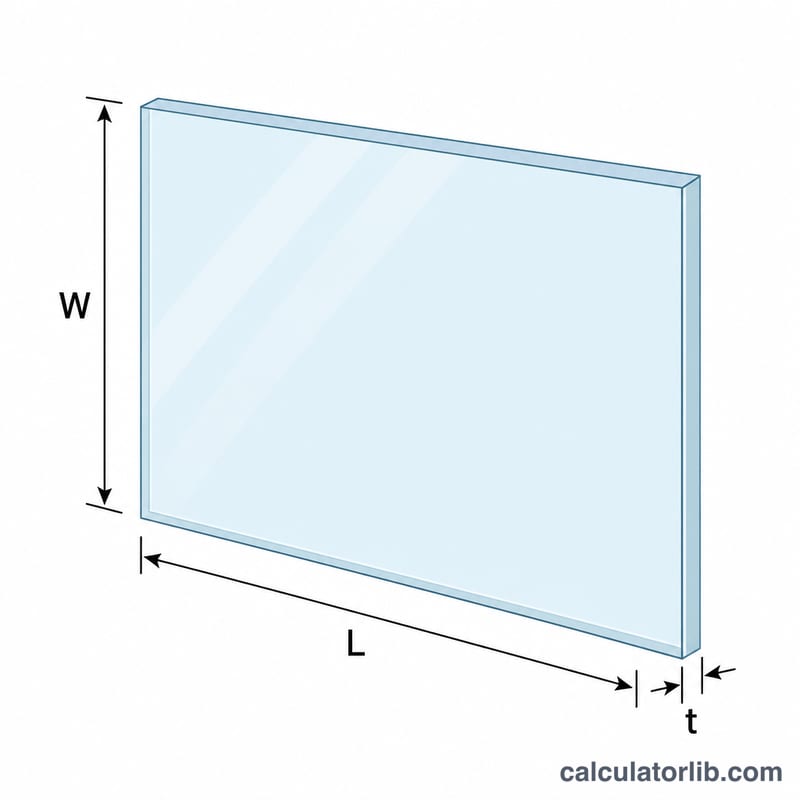
Enter the length and width of the glass in centimetres, the thickness in millimetres (e.g. 4, 6, 10), and the density. The default density is 2.5 g/cm³, typical for ordinary soda-lime float glass. Adjust it for special glass types if you know the exact value. The result shows weight in kilograms and grams, plus the volume and surface area.
The formula explained
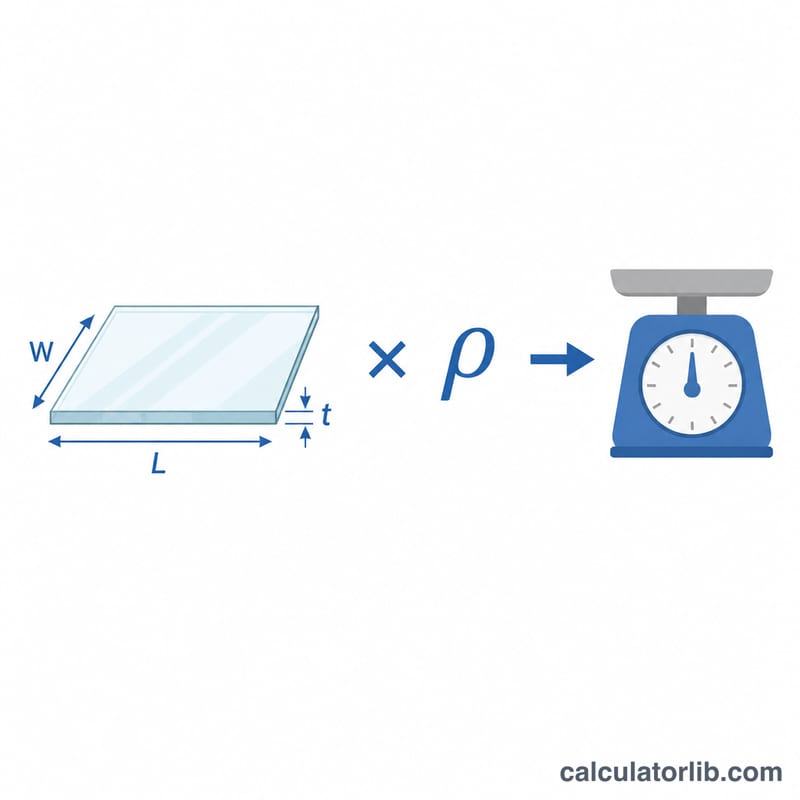
Weight equals volume times density. Volume is length × width × thickness, with all dimensions in centimetres, so thickness in mm is divided by 10 first:
$$\text{Weight (g)} = \text{Length (cm)} \times \text{Width (cm)} \times \left( \frac{\text{Thickness (mm)}}{10} \right) \times \text{Density (g/cm}^3)$$
Dividing by 1000 converts grams to kilograms.
Worked example
A pane 100 cm × 50 cm × 6 mm of standard glass: thickness 6 mm = 0.6 cm. Volume = \(100 \times 50 \times 0.6 = 3{,}000 \text{ cm}^3\). Weight = \(3{,}000 \times 2.5 = 7{,}500 \text{ g}\) = 7.5 kg.
FAQ
What density should I use? Standard float/soda-lime glass is about 2.5 g/cm³. Borosilicate is roughly 2.23 g/cm³, and lead crystal can exceed 3.0 g/cm³.
Does this work for laminated or toughened glass? Yes for weight purposes — toughening doesn't change density. For laminated glass, the PVB interlayer is slightly lighter, so this gives a small overestimate, which is fine for safe handling.
Why convert thickness from mm to cm? Glass thickness is quoted in mm but length and width are usually in cm. Mixing units would give the wrong volume, so the calculator converts thickness to cm internally.