
What is the Retaining Wall Block Calculator?
This calculator estimates how many blocks you need to build a retaining wall. It divides the total face area of the wall by the face area of a single block, then adds a waste allowance to cover cuts, breakage, and irregularities. It works with standard segmental retaining wall (SRW) blocks and most masonry units.
How to use it
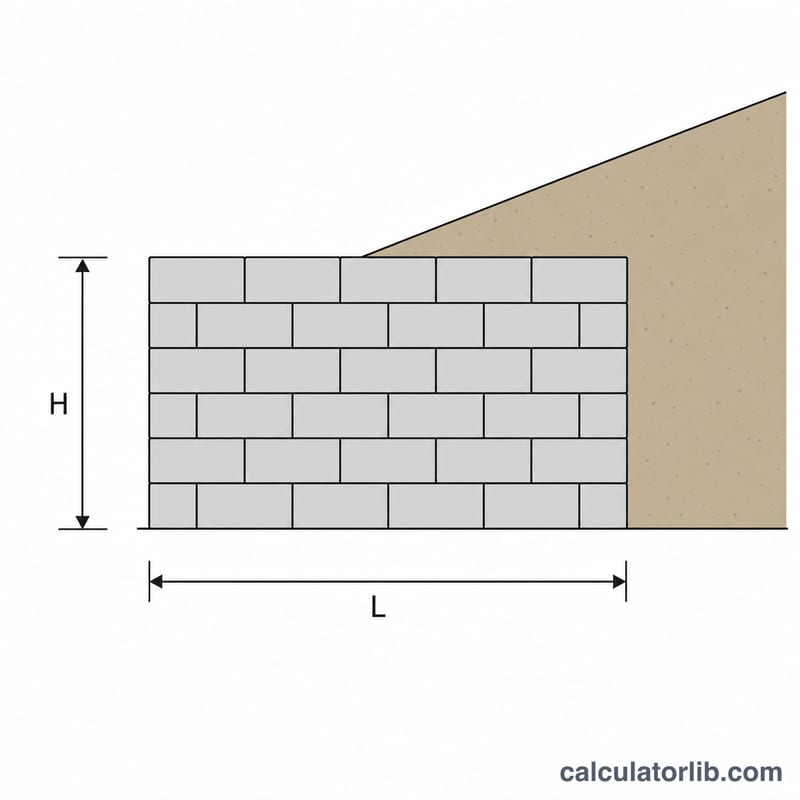
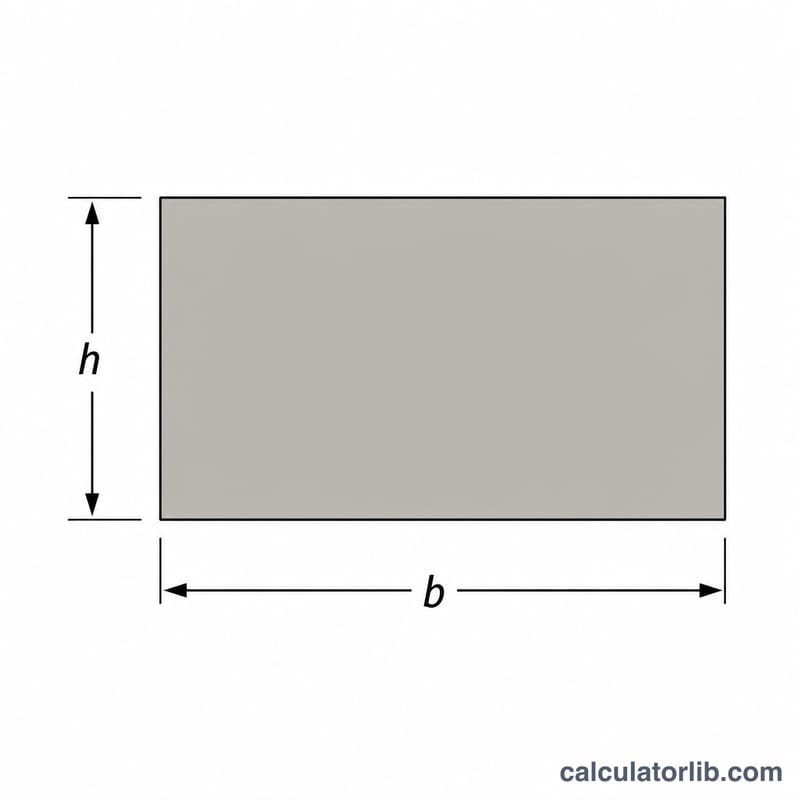
Enter the wall length and height in feet, then enter the length and height of one block in inches (typical SRW blocks are about 12 in long by 8 in high, but check your manufacturer's specs). Set a waste allowance — 5% to 10% is common. The calculator converts everything to consistent units, divides the areas, applies waste, and rounds up to whole blocks. It also reports the number of rows (courses) and the total wall face area.
The formula explained
The core relationship is simple area division: $$\text{Blocks} = \frac{\text{Wall Length} \times \text{Wall Height}}{\text{Block Length} \times \text{Block Height}}$$ Because wall dimensions are in feet and block dimensions in inches, the tool multiplies the wall figures by 12 to convert to inches before dividing, ensuring both areas use the same units.
$$\text{Blocks} = \left\lceil \frac{(12\,\text{Wall Length (ft)})\times(12\,\text{Wall Height (ft)})}{\text{Block Length (in)}\times\text{Block Height (in)}}\times\left(1+\frac{\text{Waste (\%)}}{100}\right)\right\rceil$$
Worked example
For a wall 20 ft long and 3 ft high using blocks 12 in long and 8 in high: wall area = \((20\times12) \times (3\times12) = 240 \times 36 = 8{,}640\) sq in. Block area = \(12 \times 8 = 96\) sq in. Base blocks = \(8{,}640 \div 96 = 90\) blocks. With a 5% waste allowance: \(90 \times 1.05 = 94.5\), rounded up to 95 blocks. The wall has \(36 \div 8 = 4.5\) rows.
FAQ
How much waste should I add? 5–10% is typical; add more for curved walls or many corners that require cutting.
Does this include the base or cap blocks? No — it estimates the main wall face. Add base course and capstones separately based on wall length.
What units should I use? Wall dimensions in feet and block dimensions in inches, as labeled. The calculator handles the conversion automatically.